On a steel-framed job in Dallas, the team was ready to set the next lift when someone spotted a clash between the drawings and the shop details. The superintendent stopped the work, the subcontractor called the office, and the project manager requested an RFI. That one document saved a lot of rework.
In construction, that kind of moment happens all the time. You do not always need a full bid set. Sometimes, you just need clarity, and it is where the RFI’s meaning matters. It keeps the job moving when plans start going the wrong way, incomplete, or conflicting.
And once you understand what an RFI is, the rest, including RFP, RFQ & RFT, start to make sense, too. All of them serve a different stage of procurement. You just need to get that sequence right to ensure everything is on the right side.
Let’s understand what RFI, RFP, RFQ & RFT are!
What Is an RFI?
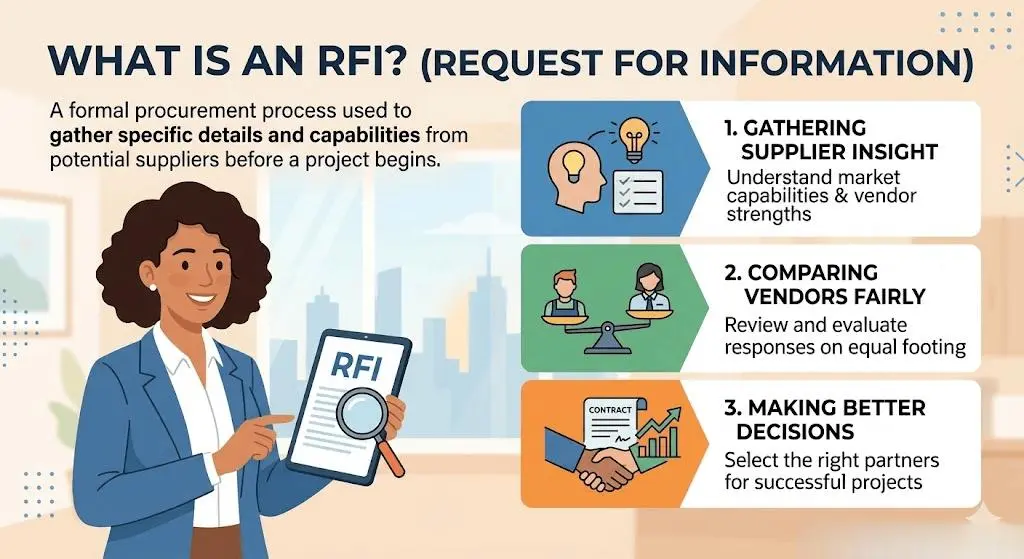
RFI stands for Request for Information. In construction procurement, it helps teams clarify missing, confusions, or conflicting details in drawings, specifications, or agreements. It is usually non-binding and exploratory.
In other words, you are not buying yet, but you are asking smarter questions before the job shows confusion. Professional teams use RFIs during both bidding and active construction to resolve design details, constructability issues, differing site conditions, and alternate methods.
Purpose of an RFI
The purpose is simple: get facts before anyone makes an expensive mistake. RFIs help contractors, architects, engineers, and owners align on what the documents actually mean. They also help teams compare market options before moving into a more structured procurement step. In construction, that clarity helps teams protect schedule, cost, and quality at the same time.
Key Features of an RFI
RFI documents usually stay high level. They use open-ended questions, request supporting context, and avoid locking the buyer into a commitment. They ask about capabilities, timing, integration, or constructability rather than exact pricing. That matters because an RFI is meant to explore, not negotiate a contract.
When to Use an RFI?
- Use an RFI when the problem is clear, but the solution is not. That often happens with unfamiliar systems, unclear scopes, new materials, or evolving design needs.
- It also works well when you want to shortlist vendors before launching a formal proposal or quotation stage.
This is where Procurement Analytics and Procurement Advisory Services play an important role, because the team has to frame the right questions before the market can answer them.
Mistakes to Avoid During RFI
● Indefinite Scope & Requirements
If the RFI’s list is unclear, vendors will answer differently, and consequently, the comparison gets messy for you. Further, it will create rework, increasing project cost and time. According to a report, rework (due to poor data and miscommunication) increases the project cost by ~48%, which is $31.3 billion annually.
Solution: Start with a clear scope of work and avoid these losses.
● Unrealistic Timelines
Rushed RFIs lead to uninformed responses. Vendors cannot review constraints, check integration, or validate options properly. This way, you end up with weak information and a higher risk.
Solution: Give enough time for thoughtful replies, especially when the set touches design, logistics, or compliance.
● Ignoring Integration and Scalability
This mistake shows up when teams focus on only current workability and ignore future operations. In other words, ignoring integration and scalability causes issues late in the project lifecycle.
Solution: Make sure the RFI asks how a solution fits current systems and future growth.
● Missing or Disorganized Documentation
If attachments, drawings, or reference points are scattered, answers will be scattered too—this forces vendors to respond to their own assumptions, and not the specific ones.
Solution: Keep your RFI package organized and consistent. The better structure will support transparent comparison.
● Sending to Too Many Vendors
More vendors do not always mean better insight. However, it can also mean more mess. In the results, you will waste time reviewing answers from firms that were never a real match.
Solution: Target the vendors who actually fit the project stage, scope, and technical direction.
What Is an RFP & What Is Its Purpose?
RFP means Request for Proposal. It asks vendors to present a detailed solution, not just a price. In construction, owners use RFPs when they need to judge approach, expertise, schedule, quality, and cost together.
Key Features of an RFP
RFPs go deeper than RFIs. They usually include scope details, timelines, technical approach, qualifications, and evaluation criteria. Note that RFPs suit complex procurements where quality, innovation, and expertise matter beyond rates. Therefore, an RFP works well for design-heavy, service-heavy, or risk-heavy work.
When to Use an RFP?
Use an RFP when you know the problem, but the best solution still needs comparison. It fits complex scopes, multi-trade packages, specialized systems, and projects where methodology matters.
Mistakes to Avoid During RFP
● Unclear Scope & Requirements
This is the fastest way to receive attractive but useless proposals. If you do not define the problem clearly, vendors will guess, and then you will compare guesses, not actual solutions. That slows down evaluation and opens the door to disputes later.
Solution: Take a start with a transparent project scope and requirements.
● Ignoring Instructions
RFPs need discipline. This means if you ignore formatting, submission rules, or mandatory attachments, you will make the process harder for everyone. Furthermore, you can accidentally compare incomplete bids against complete ones, which can shake your whole plan.
Solution: Keep an eye on instructions and ensure discipline in RFPs.
● Using Old Content
Copying old language is not efficient since old templates mostly carry off specifications, wrong assumptions, or outdated risks. Every project has its own conditions, and your RFP should reflect that reality. Otherwise, vendors answer a version of your last project, not the updated one.
Solution: Work with updated templates and data every time. You can use software for real-time project status.
● Focusing Only on Price
Cheap bids can hide weak execution. An RFP should weigh technical skill, delivery confidence, staffing, and commercial value. When teams work on the lowest number alone, they usually pay later due to delays, change orders, or quality misses.
Solution: Along with pricing, keep an eye on factors that can cause project delays, change orders, and quality issues.
● Failing to Define Evaluation Criteria Up Front
If scoring rules are undefined, the review will go to the negative side fast. Professionals set the criteria in a way that ensures the team can score consistently and defend the decision later. That also keeps internal politics from hijacking the process.
Solution: Set the good criteria for evaluation early in the project lifecycle.
What Is an RFQ & What Is Its Purpose?
RFQ means Request for Quotation. It asks vendors to estimate a clearly defined scope. RFQs work best when the materials, quantities, specifications, and delivery expectations already exist.
Key Features of an RFQ
RFQs focus on measurable details. They use standardized formats, which makes side-by-side comparison easier. Moreover, RFQs are narrow by design, with price-focused evaluation and little room for interpretation, and they signal a firm intent to purchase.
When to Use an RFQ?
Use an RFQ when the project scope is fixed, and price is the main question. It fits standard products, commodities, and repeat buys. It also suits procurement moments where you already know the technical answer and just need the market to make the estimates more accurate.
Mistakes to Avoid During RFQ
● Missing or Inaccurate Data
RFQs depend on precision. If quantities, dimensions, or delivery terms are wrong, the quote becomes unreliable. Small errors quickly turn into large cost gaps. In construction, that can distort budgets before the job even starts.
Solution: Start with precise and accurate estimates. You can also outsource and estimate for comprehensive budget plans.
● Ignoring Technical Compliance
Price means very little if the product misses technical requirements. Note that skipping technical compliance can lead to defective products, project delays, and failures.
Solution: In RFQs, check the compliance before pricing.
● Poor Process Management
If the RFQ process lacks control, the project timeline extends, and responses get messy. You must avoid this to keep vendors aligned and avoid reworks.
Solution: Standardize the document, the submission window, and the review method.
● Focusing Solely on Price
The cheapest quote is not always the best value. Freight, handling, warranty, and lead time can change the actual expense.
Solution: Make your RFQs compare total commercial impact, not just headline price.
● Ignoring Supplier Communication
If clarification rounds disappear, quotes lose consistency. Vendors can only price what they understand, and unclear communication creates weak bids and weak decisions.
Solution: Ask questions early, then close the loop clearly.
What Is an RFT & What Is Its Purpose?
RFT means Request for Tender. It is the most formal and compliance-heavy of the four (discussed on this page). In construction and public procurement, it deals with bids for a highly defined project. In this whole game, transparency stands at the top.
Key Features of an RFT
RFTs demand strict compliance. They use highly detailed specifications, formal response rules, and structured evaluation. Unlike an RFP, an RFT leaves very little room for creative deviation. It is about matching the tender exactly, not reshaping the brief.
When to Use an RFT?
Use an RFT for high-value, well-defined, and tightly controlled procurements. It fits public projects, infrastructure, and contracts that need a legally defensible process.
Mistakes to Avoid During RFT
● Confusing Requirements and Outcomes
If the scope of work is not fixed, the tender loses rightness. Suppliers need exact outcomes, exact rules, and exact expectations. Otherwise, compliant bids become impossible to compare. That is where project risk starts integrating into project plans.
Solution: Start with a well-defined work scope to keep things on track.
● Improper Price Weighting
Price matters in RFTs, but it should not blind the team. If price carries too much weight, the award can shift toward poor execution or poor quality. Cost control matters, but compliance and delivery quality still matter too.
Solution: Address pricing and compliance side by side.
● Unrealistic Timelines
Tendering needs time for document review, pricing, and internal approvals. Short windows push suppliers into poor bids. That leads to mistakes, omissions, and avoidable clarification rounds. Give the process room to breathe.
Solution: Keep flexibility in project timelines for review, estimates, and approvals.
● Using Complex Matrices
A messy evaluation matrix makes a strict process random. In tendering, clarity protects trust as well as the client if the award gets challenged.
Solution: Keep scoring transparent, disciplined, and easy to defend.
● Lower Bid Bias
The cheapest compliant bid can carry hidden risk. Also, the wrong winner can cost far more than a slightly higher bid.
Solution: Check credentials, capacity, and delivery history before award.
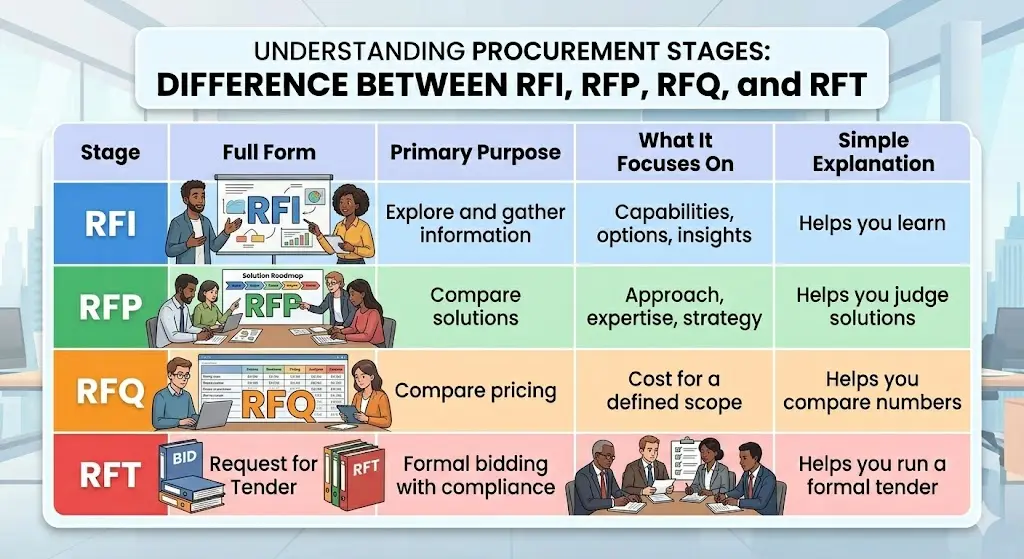
Difference Between RFI, RFP, RFQ, and RFT
| Stage | Full Form | Primary Purpose | What It Focuses On | Simple Explanation |
| RFI | Request for Information | Explore and gather information | Capabilities, options, insights | Helps you learn |
| RFP | Request for Proposal | Compare solutions | Approach, expertise, strategy | Helps you judge solutions |
| RFQ | Request for Quotation | Compare pricing | Cost for a defined scope | Helps you compare numbers |
| RFT | Request for Tender | Formal bidding with compliance | Strict requirements, compliance | Helps you run a formal tender |
How RFI, RFP, RFQ, and RFT Work Together to Streamline Procurement
- First, the team uses an RFI to understand the market and narrow the field.
- Next, an RFP helps compare solutions where design, method, and experience matter.
- Then, an RFQ sharpens the pricing for a defined scope.
- Finally, an RFT handles formal tendering when compliance has to stay airtight.
It is where expert support matters.
What does an Expert Procurement Support Bring?
- Precise RFx documents that reduce confusion.
- Faster vendor shortlisting with fewer wasted reviews.
- Better compliance checks before award.
- Stronger pricing comparisons across bids.
- Less rework, fewer delays, and smoother handoffs.
Conclusion
RFI meaning matters because it changes how projects start. When you use the right document at the right stage, you stop guessing and start controlling risk. RFI clears the screen; RFP shapes the solution; RFQ sharpens pricing; and RFT protects formal tendering.
Procurement is not just paperwork. It is decision-making with consequences. If you want better outcomes, you need a process that is deliberate. And that is where expert help pays off. Pro Procurement supports construction teams with solutions that keep the process on track. Reach out early, before the project starts showing change orders!
FAQs
Why should one consider RFI vs RFP?
Use an RFI when you need information. Use an RFP when you need a solution. The difference saves time, because each document asks a different question and triggers a different kind of vendor response.
How can you ensure consistency in RFI, RFP, RFQ, and RFT?
Keep one scope story, one approval path, and one evaluation method. Also, standardize templates, deadlines, and communication rules. Consistency keeps vendors comparing the same project, not different versions of it.
Is an RFI legally binding?
No, RFIs are generally non-binding. They gather information, shape decisions, and reduce uncertainty, but they do not commit the buyer to a purchase. That is why they work so well early in procurement.
Can an RFP include pricing?
Yes, but pricing usually stays beside technical and commercial factors, not above them. RFPs evaluate solution fit, delivery approach, and capability, so price becomes only one part of the decision.
What makes an RFQ different from an RFP?
An RFQ asks for pricing on a defined scope. An RFP asks for a proposed solution to a defined problem. That difference decides whether you need numbers or thinking.
What is the biggest RFI mistake in construction?
The biggest mistake is an unclear scope of work. When the question stays confusing, the answers do too. That usually leads to conflicting responses, slower decisions, and more risk during execution.
What is the biggest RFP mistake?
The biggest mistake is asking for proposals before defining the actual problem. If the buyer cannot explain the need clearly, vendors waste time producing polished answers to an unclear brief.
Why do RFQs fail so often?
RFQs fail when the scope is not truly fixed. If the buyer still needs design thinking, the RFQ comes too early. Then vendors either under-respond or price the wrong thing.