How can a mid-sized company compete with big global companies when buying raw materials? The answer is to stop thinking of procurement as just a “buying department.” Today, managing supply needs smart tools and expert knowledge.
Procurement as a Service (PaaS) levels the playing field, allowing mid-sized firms to leverage the same global supply chain leverage as Fortune 500 companies. It transforms procurement from a back-office burden into a strategic asset.
Defining the Modern Edge: What is Procurement as a Service?
The PaaS model operates as a modular digital ecosystem. It integrates directly with your existing ERP to provide a 360-degree view of global spend through real-time data streaming and human-in-the-loop expertise. Unlike old outsourcing, where you only hire a firm for one task, this is a subscription-based or outcome-based partnership. We join our team with yours to manage everything from choosing vendors to paying invoices. We use simple tools like spend cubes to view your data from three sides: What you buy, who you buy it from, and which team is spending money. This clear view is the first step in procurement as a service.
By using category intelligence, we bring deep data on areas like IT hardware or logistics straight to your dashboard. This means you are not guessing on prices; you use real-time market data.
To keep data clean, we match all item groups with the UNSPSC (United Nations Standard Products and Services Code®). This gives a “gold standard” for sorting goods and services worldwide. Without this level of detail, your spend data stays a “black box” that hides savings and makes audits very hard for tax or compliance needs in modern business environments today globally.
The Four Pillars: Categorizing Your Spend
To master procurement as a service, you must know that not all purchases are the same. We divide spending into four clear technical groups. Each needs a different set of NAICS codes and risk control steps.
1. Direct Procurement: The Lifeblood of Production
This includes raw materials and parts that go straight into your final product. If you build engines, the steel is direct procurement. We focus on long-term deals here, so your production line never stops. We use should-cost modeling to question supplier price increases by finding the true cost of materials and labor before we start talks.
2. Indirect Procurement: Maintaining Operations
These are goods and services that keep work running but are not in the final product. Think of office supplies, JanSan, and travel. This is where maverick spend often happens. Our system utilizes automated pattern recognition to flag non-compliant purchases, helping you recapture up to 15% of spend on operational supplies.
3. Services Procurement: Managing Expertise
This covers services like consultants, legal teams, and marketing agencies. It is hard to track because there is no physical item to count. We use S2C (Source-to-Contract) workflows to link payments with clear milestones and SLA needs.
4. Capital Procurement: High-Value Assets
Buying a new machine or a fleet of trucks is capital spending. These have high risk and long-term value loss. We use TCO (Total Cost of Ownership) analysis to look beyond the price, including repair, energy use, and final disposal costs.
Strategic spend management requires the right expertise for every category. Let our technical workflows and TCO models do the heavy lifting for your business.
Our Procurement as a Service Process
Efficiency does not happen by luck. It needs a clear, step-by-step plan. This procurement as a service process makes sure every dollar is tracked and used in the best way.
Requirement Analysis
First, we study what you truly need. This is more than a simple list. We deploy predictive analytics to audit historical consumption patterns. By mapping past NIGP Code™ data against future project schedules, we eliminate excess safety stock.
Mapping the Market
We do not just search for the lowest price. We look for trusted suppliers. Our team checks vendors using UEI (Unique Entity Identifier) codes to make sure they are real businesses. We also review NAICS codes to support diversity goals, such as working with minority- or woman-owned firms.
Sourcing and Negotiation
This is where careful planning matters. We use Digital Twins to test how price changes in one place affect your total cost. We also update Force Majeure terms in every contract to protect you from global risks or climate issues.
Transactional Precision
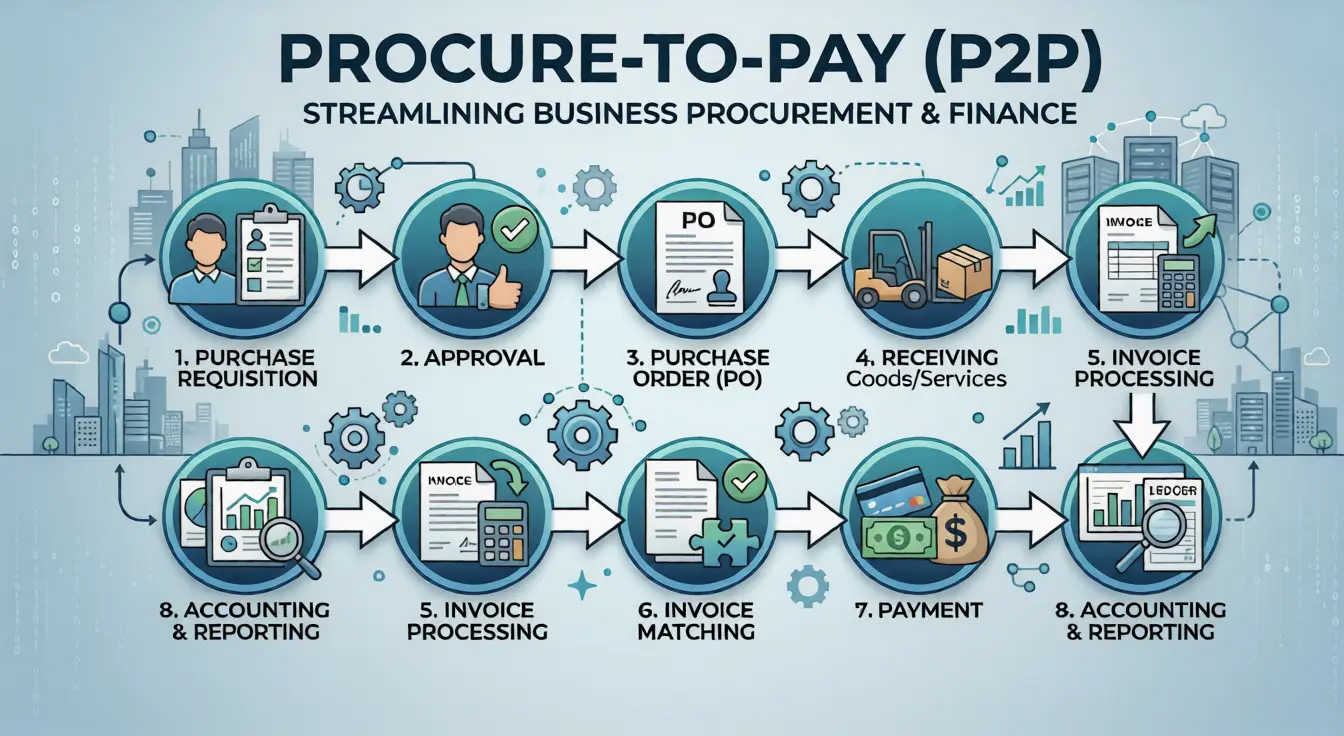
After signing the deal, we move to the P2P (Procure-to-Pay) stage. This manages orders and payments. We make sure all vendors submit an IRS Form W-9 and a valid COI (Certificate of Insurance) before any payment is made.
How to Purchase a Service Effectively
Buying services is harder than buying physical goods. When you purchase a service, you are not buying a box; you are paying for time and expertise. This category requires a distinct framework of governance. For service contracts, we check the Davis-Bacon and Related Acts (DBRA). If you hire for construction or on-site work, the law sets fixed pay rates. Our system checks this automatically. We also handle sales tax exemption certificates, so if your group is a non-profit or government body, you do not pay extra taxes in different states.
Architecting the SOW: From Effort-Based to Outcome-Based
The biggest risk in services is scope creep, where work keeps growing without control. Today, we do not just pay for hours worked. Our PaaS model uses smart Statement of Work (SOW) templates that focus on results, not efforts.
We set clear acceptance criteria for each step. This means payments are only made when real work is done and shared on the system. This stops unclear billing and makes sure you only pay for finished work.
Managing the “Invisible” Workforce: VMS Integration
When you buy services, you often work with outside staff. We use a vendor management system (VMS) to track them properly.
This system keeps a record of who joins and leaves your project. When a contract ends, their system access is removed right away. This lowers security risks and stops “ghost spend,” where you keep paying for someone who is no longer working.
Service Level Credits and Penalty Realization
Fixing bad service is harder than returning a faulty product. This is why we use Service Level Agreement (SLA) tracking.
If a provider does not meet targets like response time or system uptime, the system calculates a Service Level Credit. This amount is automatically applied against their next payment. This way, poor service costs the provider, not your business, and no long legal process is needed.
Procurement as a Service Benefits
Why move to this model? The strategic sourcing partnership benefits are more than just saving money. Beyond unit price, the primary value is operational velocity. By automating the P2P cycle, we reduce the ‘requisition-to-order‘ timeline by up to 60%, allowing your core team to focus on high-level category strategy rather than paperwork.
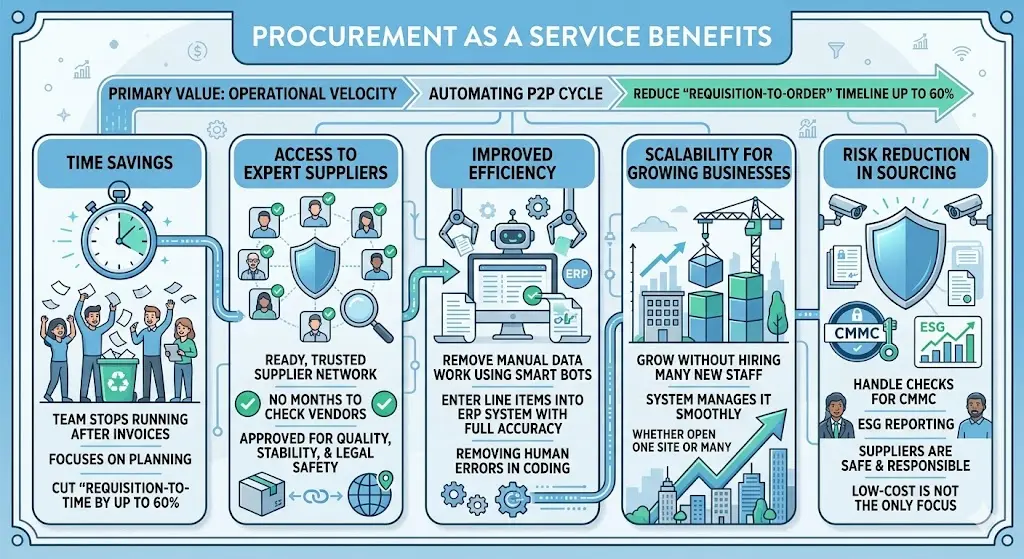
Time Savings
Your team stops running after invoices and focuses on planning. By automating the P2P cycle, we cut the “requisition-to-order” time by up to 60%.
Access to Expert Suppliers
We have a ready, trusted supplier network. You do not need months to check vendors; we already approve them for quality, stability, and legal safety.
Improved Efficiency
We remove manual data work using smart bots. These bots enter line items into your ERP system with full accuracy, removing human errors in coding.
Scalability for Growing Businesses
As you grow, our service grows with you without hiring many new staff. Whether you open one site or many, our system manages it smoothly.
Risk Reduction in Sourcing
We handle checks for CMMC (Cybersecurity Maturity Model Certification) and ESG reporting. We make sure your suppliers are not only low-cost, but also safe and responsible.
PaaS vs. Traditional Procurement
The move from traditional buying to PaaS is a big change in how businesses think. Traditional procurement is a “cost center” that only reacts to needs. In contrast, PaaS is a “value driver” that plans and responds to market changes early.
Traditional methods depend on personal knowledge, one buyer knowing one supplier. PaaS replaces this with global data and Agentic AI. While a traditional buyer may only look at the price at purchase time, a PaaS provider studies the total cost of ownership (TCO), including shipping, taxes, and final disposal.
| Feature | Traditional Procurement | Procurement as a Service (PaaS) |
| Data Focus | Siloed spreadsheets | Unified Spend Cube analytics |
| Strategy | Reactive / Tactical | Proactive / Strategic |
| Technology | Basic ERP/Email | Agentic AI & Digital Twins |
| Staffing | Heavy internal headcount | Lean internal / Scalable external |
| Compliance | Manual / High risk | Automated / Audit-ready |
| Vendor Selection | Relationship-based | Data-driven (Should-Cost) |
| Classification | Vague descriptions | UNSPSC & NAICS standardized |
Traditional procurement often struggles during global crises because it cannot see deeper into supplier levels. PaaS uses category intelligence to map the full supply chain and spot risks early. This helps you stay ready instead of facing sudden delays.
Procurement as a Service Companies
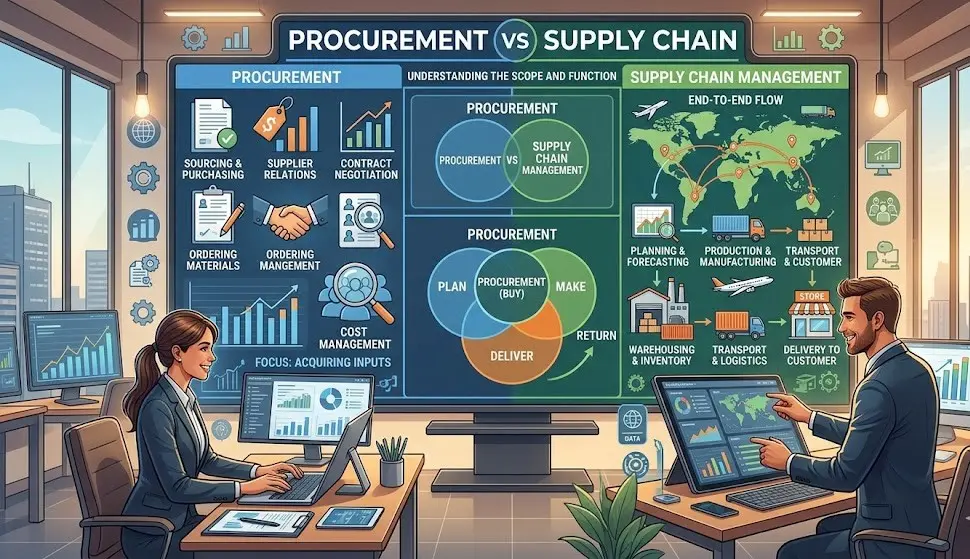
Not all procurement as a service companies are the same. You need to understand who you are working with. Some focus on small areas like Tail Spend Management, the 80% of small suppliers that are often ignored. Others offer full, wide services.
Consulting Firms
These companies focus on planning and strategy. They help you build the spend cube and create clear rules. They are useful for strong category intelligence and improving your internal structure.
Supply Chain Management Companies
These firms handle real-world tasks. They manage shipping, storage, and the movement of goods. They are important if your business deals with heavy production or global transport, where close control is needed.
Digital Procurement Platforms
These are technology-based providers. They give you tools like Agentic AI and P2P systems to make work fast and simple. In 2026, most procurement-as-a-service leaders combine all three types. They serve many sectors, from healthcare (following 2 CFR Part 200 Uniform Guidance) to federal defense (meeting FAR standards).
Selecting Your Ally: Procurement as a Service Providers
When choosing a procurement-as-a-service provider, check their tools and systems first. Do they support circular procurement to help meet carbon goals? Can they handle scope 3 reporting for emissions? The right provider should feel like part of your own team.
Make sure they follow the Build America, Buy America Act (BABA) under IIJA rules. If your work uses federal money, this is required. A good provider should also explain their Prompt Payment Act process so suppliers are paid on time. If they cannot control Tail Spend, you may lose big savings.
Evaluation of Gainshare vs. Fixed-Fee Commercial Models
A good partner should offer a pricing model that fits your goals. There are two main types: fixed-fee and gainshare. With a fixed fee, you pay a set monthly cost. With gainshare, the provider earns a share of the savings they create. This motivates them, but you must check for a baseline audit. This makes sure savings are based on real past data, not guesses. For many growing companies, a hybrid model works best. It mixes a fixed monthly fee with bonus rewards for saving more money.
Data Sovereignty and SOC 2 Type II Compliance
A PaaS provider handles your private data, like money records and supplier details. They should have SOC 2 Type II Compliance, which means their systems are checked over time, not just once. Make sure to ask where your data is stored and if they use encryption to keep it safe. In 2026, the best approach is that a provider should also have cyber liability insurance and a clear backup plan if systems fail.
Cross-Border Harmonization and Incoterms 2020 Expertise
Only if you work with global suppliers, your provider must know Incoterms 2020 and trade rules. So that they can manage shipping steps between the buyer and seller without problems. This makes it easier for them to calculate the full landed cost, including taxes, duties, and shipping, before placing an order. Look for providers who offer duty drawback services. This helps you get back some taxes on goods that are imported and later exported, increasing your profit.
When Should Your Business Transition?
Knowing when to switch to third-party supply chain management means spotting system problems before they become serious. If your internal data shows these warning signs, moving to PaaS is needed to protect your profits.
Recognizing Capital Leakage
If your Maverick Spend, buying outside approved contracts, exceeds 15%, your system is losing money. This shows your process is slow or hard to use. Maverick spend is a direct tax on your profits. When employees purchase outside of approved channels, you incur a ‘shadow cost’ that negates negotiated volume discounts. PaaS enforces compliance through automated ‘Guided Buying’ portals.
Mitigating Regulatory Risk
Money loss is not the only issue. If you cannot meet CMMC (Cybersecurity Maturity Model Certification) levels for vendors, you risk data leaks or losing federal contracts. A managed procurement services provider gives you a ready list of approved suppliers, improving security. The 2026 rules are strict, especially for groups handling federal funds under 2 CFR 200 compliance. Missing these rules can lead to funding loss, which PaaS helps prevent with automatic audit records.
Managing Environmental Liability
Another trigger is complex reporting. If your supply chain uses old systems, you cannot track Scope 3 emissions properly. Modern ESG rules require reporting supplier emissions, not just your own. A PaaS partner adds tracking tools so you stay compliant and avoid fines or greenwashing claims.
Solving the Personnel Crisis
Finally, think about staff costs. Small teams often spend more on hiring procurement staff than on a PaaS subscription. Moving to PaaS replaces fixed salaries with flexible service while still giving access to large negotiated savings. If your business is growing faster than your admin team, switching is the best way to protect margins and keep operations smooth.
The Future of Procurement as a Service
By the end of 2026, we expect the transition to autonomous sourcing. Agentic AI will serve as the primary engine, negotiating low-value ‘tail spend’ contracts and performing should-cost modeling in real-time without manual intervention.
We will also see stricter rules for local sourcing as BABA updates become tougher. The “Service” in PaaS will grow from just buying goods to offering “resilience as a service.” Future systems will also connect with circular economy ideas, choosing items that can be reused or fully recycled to meet strong ESG goals. The data created by PaaS will become important for company financial planning.
Final Verdict
Using end-to-end P2P outsourcing is a smart step for any business that wants to survive long-term. With category intelligence and modern P2P systems, we remove guessing from your budgeting. You get a strong global supply chain without running a large internal team.
It is time to stop seeing procurement as a back-office cost and start treating it as a key advantage. Whether you deal with FAR rules or try to reduce Maverick Spend, the right partner is very important. This system keeps your business compliant, efficient, and ahead of others.
Frequently Asked Questions
What is a procurement service?
It is a professional service where an outside team handles a company’s buying work. They use smart tools and market knowledge to reduce costs and keep everything legal and in order.
What is procurement as a service in simple words?
It means hiring expert shoppers for your business. They use modern technology to find good deals, check suppliers, and manage all documents for you.
What are the benefits of procurement as a service?
The main benefits include fast cost savings through better deals, less time spent on admin work, and stronger protection from legal and supply chain risks.
Who provides procurement as a service?
These services are offered by consulting firms, supply chain companies, and digital platforms that combine software tools with human experts.
How does the procurement-as-a-service process work?
It begins by studying your spending, finding strong suppliers, negotiating contracts using data, completing purchases, and regularly checking supplier performance.