Procurement is not about buying supplies at low rates anymore. Its scope has advanced, and now, procurement is about knowing where the material comes from, how it is made, and whether the supplier is responsible enough to perform their duty or not. This is called responsible sourcing, when buyers check the product quality and production before placing an order.
It is also known as ethical sourcing, and in business, it prioritizes social, environmental, and economic factors in procurement, production of the goods, delivery, and its services. Buyers make sure that their suppliers follow standards, laws, and honest dealing.
In ancient times, businessmen considered the cost factor over everything else. However, things didn’t work out the same way. Owners choose a procurement strategy now. They know the quality of the product, going into the market, matters the most.
Breaking Down Responsible, Sustainable, and Ethical Sourcing
It’s important to understand procurement before selecting a supplier for your business. Under procurement, there fall three more terms that have slightly different meanings. Business owners must be aware of the difference between these terms so that they can make better decisions for the company.
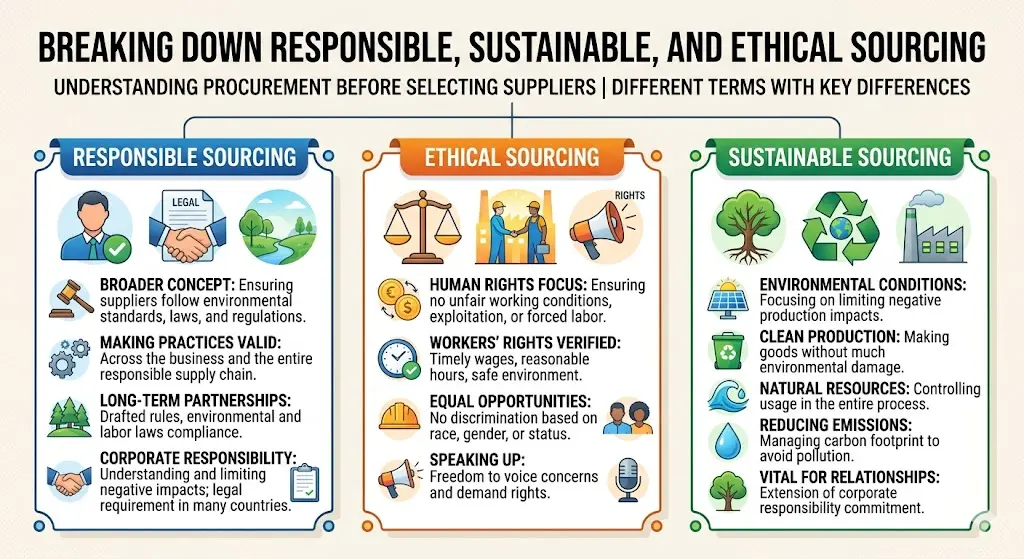
Responsible Sourcing
It is a broader concept, and it ensures that the supplier is following the environmental standards, laws, and regulations. It shows that the business is making sure its business practices are being followed in the business and across its responsible supply chain as well. The services that businesses provide to the people must have a positive impact on them and on the environment; only then can they lead to limitless success in the future.
Most people think that once they have found a reliable supplier, they don’t have to put in any effort anymore. But in reality, it’s important to maintain a good relationship with them. Having a long-term healthy partnership with the suppliers is what matters the most. Companies often draft a set of rules for the suppliers, which includes that suppliers must follow the environmental standards and labor laws. If they follow them, only then will the company continue to work with them.
Businesses have a responsibility to understand the impact their activities and sourcing decisions can have, and to limit negative impacts. This includes understanding the impact of suppliers’ operations. This corporate or supply chain responsibility is a legal requirement in many countries for companies operating within a country or selling to its people.
Ethical Sourcing
It focuses on human rights, and there are no unfair working conditions implemented for the workers. Teams verify that the workers in their ethical supply chain are getting their wages on time, and there are no delays, no exploitation of their rights, and they are not forced to work extra hours at low wages.
- There are multiple rights that workers get under ethical sourcing. It includes:
- Workers must not be forced to work extra hours without extra wages.
- Workers should feel free to speak for their rights; a safe and comfortable environment must be provided to them.
- There should not be any discrimination regarding race, gender, or status. Everyone must be given equal opportunity to grow.
- They must be provided with a safe environment, and there shouldn’t be any danger for the workers who are working on site.
Sustainable Sourcing
It mainly focuses on environmental conditions, so that there is no negative impact of production on the environment. The goods are made without much damage, and ensure that the usage of natural sources in the process remains under control. Sustainable sourcing takes care of carbon emissions to avoid environmental pollution.
Improving performance on environmental, social, and ethical issues is vital to developing such relationships. Working toward this has become an extension of a company’s commitment to corporate responsibility and, as such, a key component of the overall business structure and model.
This table will help you understand the difference between the three terminologies:
| Comparison Factor | Responsible | Sustainable | Ethical |
| Main Focus | Combines ESG responsibilities in sourcing decisions | Focuses mainly on protecting the environment | Focuses mainly on the fair treatment of workers and human rights |
| Supply Chain Scope | Looks at the entire supply chain from raw materials to the final product | Focuses on how materials are produced and their environmental impact | Focuses on labor practices used in production |
| Example | A company choosing suppliers that follow fair labor laws and environmentally safe production | A brand using recycled materials and reduces emissions in production | A company ensures that workers in factories are paid fairly and work safely |
Many businesses around the world follow an established framework as a guide for their sourcing policies. These include
- The United Nations Global Compact
- The OECD Guidelines for Multinational Enterprises
- International Labor Organization.
When a business follows these frameworks, there seems to be a positive change within the business and across its responsible supply chain.
Why Responsible Sourcing is Non-Negotiable in 2026
Since modern procurement has evolved, it has made its space among businesses. Most of the companies have tried to skip ethical sourcing under the shadow of Corporate Social Responsibility( CSR). Later on, following ethical sourcing is no longer the choice. It becomes mandatory for every company to follow it. Here is why the shift has become so significant:
1. The Legal Pressure
The government is now pressuring the companies to adopt strategic procurement. Many countries have included in their legal standards for every company to follow that there is no unfair dealing in their business and their supply chains, and have a positive impact on the environment. If they are found to avoid following the laws, they are fined, and legal action is taken against them. In order to keep their reputation and place in the market, they strongly follow the laws and implement them across their supply chain as well.
2. The Investor Lens
It’s not just about the bottom line anymore. Today’s investors are looking at how a company makes its money, not just how much it makes. Investors don’t only care about the profits; now they do their investigation before investing to ensure the company is following ESG factors and does not work with unreliable suppliers. If they see the risk, they back out of their investments. This makes the company lose its value and trust among the investors and results in a loss.
3. Consumers Want to Know the Story Behind Products
Customers don’t just look at the price tags; they are now more concerned about the quality and the social reputation of the brand. Once, negative publicity or reports of unethical practices can lead to immediate consumer boycotts, no matter what the prices are. When companies share that they are confidently following the ESG, it helps them gain customer trust.
4. Supply Chains Are Becoming More Complex
It has become complex for most of the industries to ensure responsible sourcing because many products involve suppliers, factories, and shipments done in different countries. For businesses to look at every step is not easy, so that every step is done fairly. To ensure they’ll have to put in extra effort and struggle.
The Operational Blueprint: Building a Responsible and Resilient Supply Chain
How do business owners make workers and suppliers follow the rules? They must make policies and ensure their implementation across the company and their suppliers. And for that, it requires monitoring and planning.
A reliable, responsible supply chain ensures that suppliers meet the standards and follow laws while maintaining that operations work smoothly. There are times when suppliers don’t follow the rules. It isn’t because they don’t want to, but because they don’t fully understand them. important for the company to write the codes and standards in clear wording and provide training if required. The procurement team needs to combine risk management, supplier transparency, and sustainability reporting to achieve its goals.
Risk Management
When the procurement team chooses its suppliers without proper investigation, they face different problems later on. Sometimes suppliers are from different countries, and every country has its own laws and conditions. To ensure fair dealing in their business, teams do an investigation first, to understand how they work and what their working standards are; only then do they sign the contract with the suppliers.
Supply Chain Resilience
Responsible sourcing also makes the relationship stronger with their supply chains. Supplies with their set standards to follow the law work smoothly and in an organized manner. Having a good relationship with the supplier means they are available to you in your crisis and urgent needs. Only the businesses that followed the strategy and maintained their relationship were able to get the goods during the time of crisis.
In short, procurement ensures long-term relationships between businesses and their suppliers. And it also helps both parties to understand any emergency with coordination and think about a solution beneficial for both parties.
ESG Reporting
Maintaining a good reputation and attracting most customer trust is the main focus of business nowadays. They publish their ESG report online to tell their customers how they are dealing with things internally. They are working ethically and morally, ensuring every worker is getting their wages and the rights they deserve. And how their business is not making any bad impact on the environment and society. These reports help businesses in maximizing their success stats. It also gains the attention of investors in how efficiently and transparently they work.
Geopolitical Risk
When businesses have their supply chain in different countries, and those countries’ economic and social situations affect the business directly, such as delays in shipments and production.
So, a properly planned procurement means a company has its ethical supply chains in different countries, and not just one country, and is not completely relying on that. It’s better to have them in different countries. If one country is dealing with some crises, it won’t delay the process. A company does have the other option to continue its operation efficiently.
Supplier Transparency
It’s difficult for a company to understand the full supply chain, so most of the companies keep a check and balance on the direct suppliers. In modern times, technology has resolved this issue, with different management apps and artificial intelligence helping industries to track their suppliers’ information.
| Metric | Impact of Responsible Sourcing |
| Brand Value | Ethical supply chains can increase brand valuation by 15% to 30%. |
| Risk Mitigation | Companies with high ESG ratings see a 10% lower cost of capital due to reduced risk. |
| Consumer Behavior | 73% of Gen Z consumers are willing to pay more for sustainable goods. |
| Operational Efficiency | Sustainable procurement can reduce costs by 5% to 10% through waste reduction and energy efficiency. |
The Business Case: Can Responsibility Reduce Costs?
There was an American company that chose the fabric supply just because they were selling it at lower rates. The company made a deal with those suppliers and started taking the fabric from them. With the passage of time, they start to face the issue about the quality, the fabric quality was so bad, and retailers and even customers start to give bad reviews to them.
Sometimes the deliveries were late, which slowed down their production time and their deliveries to their retailers. They did complain about the delays, but there was no coordination.
Then the company decided to place an order for fabric of good quality through responsible sourcing. They made sure the suppliers are reliable and deliver their services on time without compromising on the quality.
This proved that even if the fabric cost a little more, it was worth it. They no longer had to deal with late shipments or waste money on emergency orders to replace bad materials. This all had saved them from placing an order because of poor fabric and unreliable suppliers. This showed them that planned procurement reduces hidden costs and makes the overall supply chain process even smoother.
Final Thoughts
Procurement is not about purchasing something, but it’s more about carefully planning the strategy and following the legal rules. Businesses have to keep their reputation in the market. With their ESG report, they attract more investors and gain the customers’ trust. Companies might feel that they are paying more for the goods, but when they realize that they have invested in their growth. That slightly higher cost while purchasing has ensured that they have gained a good reputation in the market.
Business owners are answerable to the government regarding whether they are following sustainable sourcing. If not, then they are charged with a fine.
Responsible sourcing has become the key part of the procurement process, and ensures that suppliers are following standards, laws, and rules in their operations. It also helps the owners to have a healthy and long-term relationship with their suppliers, who stand with them in their difficult times without any delays. Procurement is one of the most important ways for companies to stay trustworthy, ethical, and prepared for the future.
FAQs
How does responsible sourcing help a company build trust with customers?
Customers are not just concerned about their own benefit; they do care about how the company is treating their employees and how they deal with the production process while ensuring they are following ESG factors.
Can responsible sourcing save a company money?
Yes, the companies that are using procurement strategies and publish their ESG stats successfully gain more investors and customers. Also, considering the cost and quality side by side, using proper planning and strategy can save them from emergency ordering or covering the delays with extra money.
Do all companies need responsible sourcing?
Yes, all companies need to follow responsible sourcing regardless of their business and size. Most countries have laws like the UK Modern Slavery Act, the German Supply Chain Due Diligence Act, which ensure that every legal company in the country must follow proper procurement and eradicate child labor and workers’ rights exploitation.
What key advantages does responsible sourcing offer to businesses?
It improves the brand reputation in the market. It helps them have more investors because they follow ESG. Customers start to build more trust and become their regular customers. It helps in maintaining a stable partnership with suppliers.
How can a company start and use responsible sourcing in real life?
It’s not about just making a policy that tells you to follow an advanced procurement strategy. It depends on how the company plans and makes a strategy to get it implemented. It’s better for them to investigate the suppliers, what their working conditions are, and maintain a healthy and long-term relationship with the suppliers.