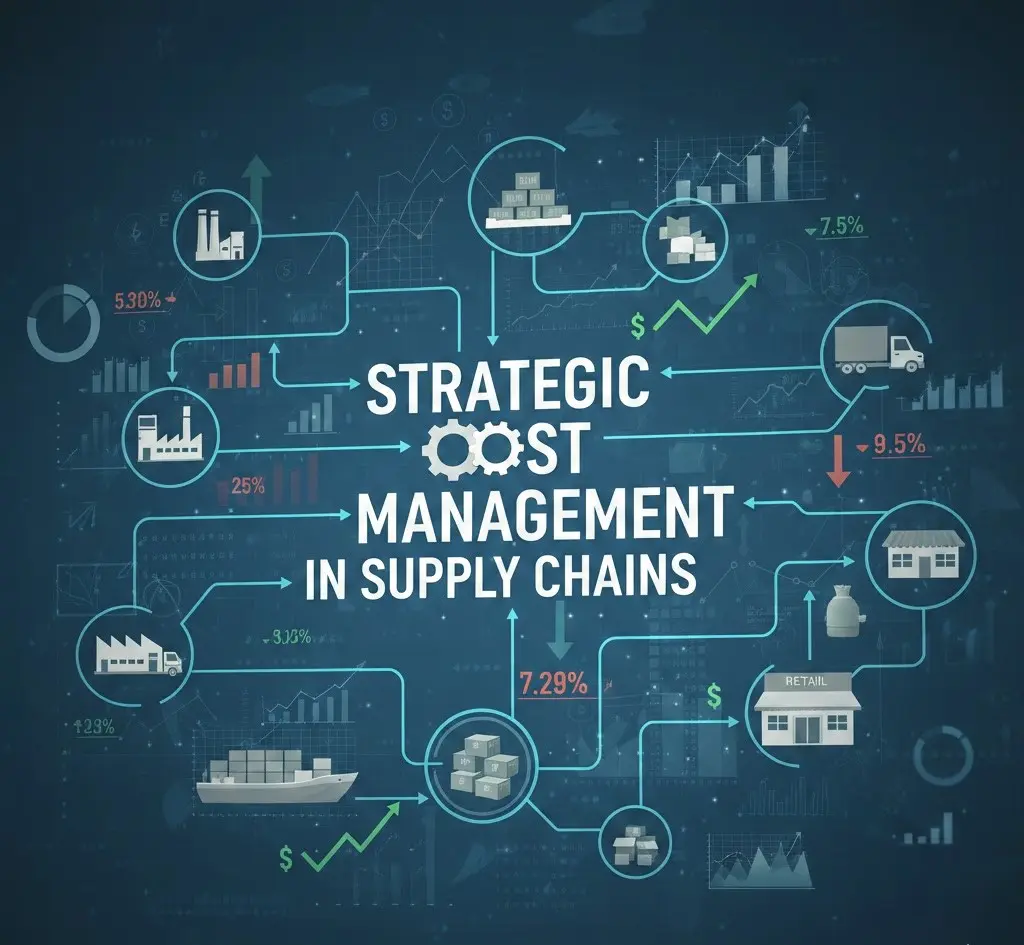
On large construction projects, cost overruns rarely come from a single headline mistake, and strategic cost management is what keeps the small misses from stacking up. They usually show up as hundreds of small misses, such as a scope gap in Div 09, a late submittal on switchgear, a freight surprise, a substitution that doesn’t meet specifics, a missed closeout requirement, or a buyout that locked in the wrong terms.
Strategic cost management is how experienced teams keep those small misses from turning into schedule issues, change orders, and margin problems. Simply put, it’s a tool that manages project total cost, risk, and performance across the supply chain. There are many more positive points of strategic cost management for construction supply chains; let’s explore them in this blog!
What is Strategic Cost Management?
Strategic cost management is a disciplined approach to improving cost outcomes. Team link cost decisions to business strategy and value delivery across the value chain to meet their goals. The concept is rooted in value chain analysis that looks beyond internal budgets to the upstream and downstream activities that drive cost and competitiveness.
What is Strategic Cost Management in Construction Procurement?
In construction, this means that teams must ensure cost decision evaluation considering estimating, procurement, field production, commissioning, and closeout.
What is Total Cost Management (TCM)
In cost engineering, the same life-cycle mindset is captured in Total Cost Management (TCM). AACE International describes TCM as a systematic approach to managing cost throughout the life cycle of an enterprise, program, facility, project, product, or service.
This life-cycle framing is the reason strategic cost management works, as it treats early procurement decisions as cost drivers.
Example
On healthcare and mission-critical projects, one long-lead item can hold an entire phase.
If the AHU submittal is late because the controls sequence wasn’t coordinated, you lose fabrication slots. In the results, you will experience:
- Resequenced duct rough-in
- Delayed ceilings
- Compressed commissioning
So, other than the issue with AHU, you will also experience the problem with labor inefficiency.
To better understand how early procurement decisions shape total project cost, read our guide on procurement process flow and optimization
The Link Between Strategic Cost & Financial Management
Strategic cost and financial management connects project procurement decisions to company cash flow, working capital, risk profile, and growth targets. Construction procurement decisions can quietly waste dollars. And they can also quietly protect cash if you structure them correctly.
Example
Retainage is a simple example. Industry guidance describes retainage as a withholding, often 5% to 10%, to help ensure completion. It directly impacts contractor financial flexibility and cash flow. When procurement ignores that reality, teams end up financing the job through their balance sheet.
Where Do Procurement & Finance Connect?
- Cash flow sequencing: Early buyouts can accelerate deposits, storage costs, and insurance.
- Working capital protection: Overbuying ties up cash; underbuying can force premium freight and overtime later.
- Risk transfer and claims posture: Contract terms define whether escalation, tariffs, and delivery disruptions are yours to absorb or risks that are shared and measurable.
- Capacity and bonding: When exposure is controlled and costs are predictable, the business is easier to underwrite and scale.
Here is a table showing how procurement choices hit company financials
| Procurement decision | What the field sees | What finance sees | Strategic cost management move |
| Early buyout of long-lead items | Fewer schedule surprises | Larger early cash outflow | Link release to submittal path + cash forecast; negotiate deposit milestones |
| “Lowest number wins” awards | Bid day looks great | Change orders + rework later | Require scope alignment + total cost comparison before award |
| Short supplier payment terms | Faster awards | Working capital squeeze | Negotiate terms; align with the owner’s pay cycle where possible |
| No escalation language | “We’ll figure it out later” | Margin exposure, disputes | Use objective indices and clear triggers (with counsel review) |
| Weak closeout requirements | End-of-job chaos | Slow final payment, retention stuck | Tie O&M and as-builts to contract deliverables; enforce early |
Pro Tip: Keep procurement aligned to pay apps and approvals. If approvals lag, procurement deposits and fabrication releases can outpace the owner’s funding cycle.
Also, before awarding any critical package, run a buyout readiness check:
- Scope sheet complete (inclusions and exclusions signed off).
- Alternates, allowances, and defined unit prices.
- Long-lead and submittal register updated.
- Compliance requirements confirmed as per domestic content, EPDs, and certified payroll where required.
- Reviewed contract terms, including escalation, LD flow-down, storage, warranty, and closeout
Key Components of Strategic Cost Management Procurement
Strong strategic cost management procurement programs stand on three pillars:
- Visibility
- Cost-driver control
- Risk-managed execution
Visibility
You can’t manage what you can’t see. In construction, visibility means you can answer these questions:
- What is committed (executed subcontracts + issued POs)?
- What is pending (RFQs out, bids received, bids being leveled)?
- What is at risk (expiring quotes, missing approvals, supplier capacity)?
- Where is the scope unclear (phantom gaps between trades)?
Industry groups have highlighted that materials costs can increase and lead times can become uncertain. These are the conditions that increase the value of a disciplined procurement register and early warning system.
Cost-Driver Control
Strategic cost management focuses on levers that move total installed cost:
- Specification choices and performance criteria.
- Logistics, handling, and delivery sequencing.
- Labor productivity impacts on prefab, standardization, and kitting.
- Quality-driven cost, which can be due to rework, failed inspections, commissioning issues.
- Lead-time exposure, like float burn, acceleration, and out-of-sequence work.
This is where value engineering belongs. Value methodology standards emphasize structured approaches and function analysis. Therefore, real VE must protect the function on time.
Risk-Managed Execution
Procurement lives and dies by risk allocation. AGC guidance emphasizes contract provisions, such as price escalation clauses, when tariffs and volatility threaten cost predictability.
ConsensusDocs 200.1 is designed to address time and price-impacted materials. It lists materials and adjusts prices using an agreed objective index.
Below is the table focusing on common supply-chain risks and the control that actually works:
| Risk type | What it looks like on a job | Typical cost impact | Control that fits strategic cost management |
| Scope risk | Exclusions, RFIs, missed accessories | Change orders, rework | Scope sheets + scope-first bid leveling |
| Schedule risk | Long-lead slip, submittal delays | Acceleration, downtime | Long-lead register tied to schedule; expediting |
| Price risk | Volatility, tariffs, freight changes | Margin erosion | Escalation clauses using objective indices |
| Compliance risk | Missing domestic content or EPD docs | Payment delays, rejection | Compliance tracker + early documentation capture |
| Data/cyber risk | Platform access, vendor security gaps | Contract risk, owner rejection | Vendor qualification + Fed contract clauses awareness |
Quick checklist for controls you can implement:
- Publish a monthly procurement risk register for long-lead packages.
- Standardize scope sheets by CSI division and enforce bidder acknowledgement.
- Require a bid leveling template for every award, focusing on flow: scope first, then terms, and then price.
- Build a contract language playbook for escalation, storage, and documentation, reviewed by counsel.
- Track supplier performance, considering OTIF deliveries, documentation completeness, and quality issues.
To strengthen visibility and control in procurement, explore our guide on procurement KPIs and performance tracking
Step-By-Step Process of Strategic Cost Management
The process of strategic cost management is a continuous loop:
Below is a workflow that works, especially when you’re managing multiple bids, multiple trades, and aggressive occupancy dates.
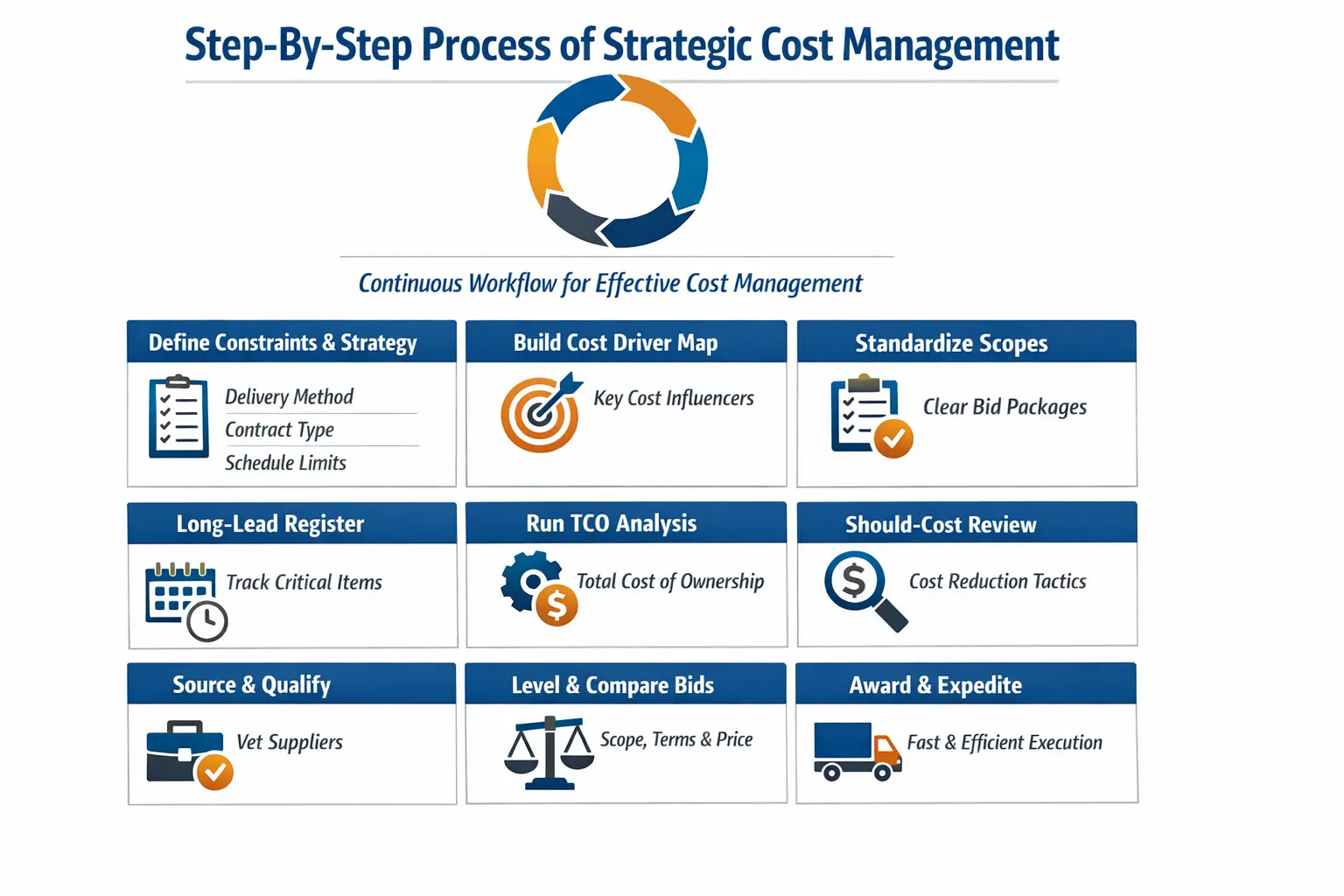
1. Define Constraints & the Procurement Strategy
Start with the facts, including:
- Delivery method (CMAR, design-build, hard bid).
- Contract type (GMP, lump sum, unit price).
- Funding constraints (public procurement, domestic content, reporting).
- Schedule requirements (phasing, turnover dates, long-lead items).
2. Build a Cost-Driver Map
Map what actually shakes cost and schedule:
- Long-lead equipment dictating rough-in, like switchgear, AHUs, and generators.
- Commodity-sensitive packages, including steel, copper, asphalt, and concrete.
- Specialty trades with limited capacity.
- Documentation-heavy scopes, including domestic content certifications, EPDs, and testing.
Remember that life-cycle cost thinking helps you see these drivers early, before buyout decisions lock risk into the contract.
3. Standardize Scopes & Bid Packages
Scope clarity is the cheapest risk reduction you can buy. In practice, this means:
- Align bid packages to CSI divisions and schedule logic.
- Attach scope sheets with explicit inclusions or exclusions.
- Define alternates, allowances, and unit prices up front.
- Use one documented clarification log before bids close.
CII research on procurement and materials management emphasizes defining the materials management process and providing guidance for effective materials management systems. This is the discipline that directly supports construction supply chain performance.
4. Build a Long-Lead Register Tied to the Schedule
If a long-lead register isn’t tied to the schedule, it becomes a spreadsheet nobody believes. A usable register includes:
- Item, package owner, lead time assumptions.
- Submittal due date and approval turnaround expectation.
- Release date, fabrication start, and delivery window.
- Site constraints for laydown, hoisting, access, and storage.
5. Run the Total Cost of Ownership for Major Systems
Price is easy. Total cost is where strategic cost management earns its keep. ISM describes the total cost of ownership (TCO) as encompassing every dollar across an asset’s life, from purchase through installation, service, energy, support, and disposal.
Below are the construction-specific add-ons that change best value decisions:
- Submittal and coordination labor.
- Freight, storage, and jobsite handling.
- Commissioning and training scope.
- Warranty and operational risk.
6. Use Should-Cost Thinking for High-Value Sets
DoD describes should-cost as a management tool to control and reduce costs by reviewing contributing cost elements instead of accepting them as fixed. What you need to do is apply the mindset to construction packages with practical questions. Ask:
- What drives the installed cost: labor, material, or logistics?
- Are we paying for a spec premium that doesn’t improve owner outcomes?
- Can prefab reduce labor and improve QA or QC?
- What is the cost of schedule risk, and who owns it?
7. Source & Qualify with Compliance
Qualification criteria should include:
- Capacity and lead-time credibility.
- QA or QC program and documentation.
- Relevant project experience.
- Compliance documentation readiness.
Build America, Buy America compliance is a major 2026 driver in U.S. infrastructure.
The Department of Commerce explains BABA establishes domestic content procurement preferences for federally funded infrastructure, covering iron, steel, manufactured products, and construction materials.
OMB’s guidance is implemented in 2 CFR Part 184, including definitions and classification rules that affect compliance reviews.
8. Level Bids Scope First, Then Terms, & Then Price
Bid leveling should answer three questions:
- Is the scope comparable?
- Is the schedule supportable?
- Are the terms acceptable?
Bid leveling red flags you must catch during processing:
- Per plans or specifics with no inclusions list.
- TBD after submittal on lead times.
- Exclusions are buried in proposal notes, like testing, firestopping, access, and rigging.
- Substitution language that bypasses specific intent.
9. Execute Awards & Expediting Like a Production Process
This is where strategic cost management becomes real. Use a simple expediting tempo:
- Weekly long-lead calls between the owner, PM, and key trades.
- Submittal log review tied to fabrication release dates.
- Early approvals for approved equals and alternates.
- Delivery planning aligned to site access and hoisting.
Below are what experienced teams add to that workflow to make strategic cost management pay off:
- First, a quote expiration tracker for volatile packages
- Second, a defined escalation decision path, who can approve, what documentation is required, and what index applies.
- Third, a rapid substitution workflow that still protects performance and code intent.
- Last, a receiving and inspection plan, so that wrong deliveries get caught at the gate.
Buyout Readiness Checklist
Use this checklist before you sign a subcontract or issue a major PO. It is the simplest way to operationalize the process of strategic cost management and stop rework before it starts.
- Scope sheet signed by the PM and estimator
- Drawing or specific revision confirmed
- Schedule milestones confirmed
- Alternates and unit prices documented
- Qualifications acknowledged
- Compliance items assigned
- Closeout expectations included
- Logistics confirmed
- Insurance and bonding requirements confirmed (if applicable).
- Payment terms reviewed against cash flow plan
How to treat long-lead equipment in strategic cost management?
Long-lead risk is a production problem. You must use this practical approach:
- Identify long-leads during schematic or design development.
- Prioritize early submittals on schedule-critical equipment.
- Release for fabrication only after coordination checks are complete.
- Tie expediting to the master schedule, with weekly updates to the superintendent and scheduler.
- Build contingency: Approved equals or alternate manufacturers where performance allows.
When teams treat long-lead items this way, strategic cost management becomes visible in the field. Labor team stays in sequence. Temporary work and acceleration stay under control. And the supply chain stops dictating the schedule.
All About Material Management: The Major Part of the Cost Strategy
A lot of supply chain cost isn’t in unit prices, it’s in handling. On busy sites, you must consider:
- Kitting and staged deliveries by floor/zone to reduce re-handling.
- Vendor-managed inventory for consumables where it makes sense.
- Pre-labeled pallets tied to room numbers or grid lines to reduce install errors.
- Receiving logs that capture damage, shortages, and documentation at delivery.
Those are small practices, but they are exactly the kinds of factors of strategic cost management that separate smooth installs from constant field interruptions.
10. Lock Contract Terms
Practical levers include:
- Escalation clauses tied to objective indices where appropriate.
- Submittal deadlines tied to procurement milestones.
- Storage or staged delivery language (who carries risk while stored).
- Documentation requirements (domestic content, EPDs, certifications).
11. Integrate Procurement with BIM & Information Management
Wrong revision or wrong quantities can wipe out a good buyout. NBIMS-US is intended to improve organization or classification of electronic object data and streamline communication among owners, designers, material suppliers, and constructors.
Similarly, Penn State’s BIM Project Execution Planning Guide defines cost estimation and quantity takeoff as a BIM use that supports accurate takeoffs and cost estimates throughout the project lifecycle.
Furthermore, buildingSMART notes that IFC can archive or exchange information during design, procurement, construction, and as-built phases. This works when teams use multiple platforms.
12. Measure Performance & Improve
Track what matters:
- Buyout variance by package.
- Submittal cycle time.
- OTIF delivery on critical items.
- Documentation completeness.
- Change order root cause.
For a deeper look at optimizing each stage of this workflow, read our guide on end-to-end procurement strategy.
Here is a table showing what supply chain leaders should track
| KPI | Why it matters | What good looks like | Data source |
| Buyout variance | Shows estimating vs market reality | Variance explained with documented scope/terms | Estimate vs executed contracts |
| Submittal cycle time | Drives fabrication start | Predictable turnaround on critical packages | Submittal log + PM platform |
| OTIF delivery | Prevents idle labor/out-of-sequence work | Critical items arrive when promised | Receiving logs + supplier reports |
| Documentation completeness | Prevents compliance delays | Certifications/EPDs collected before install | Compliance tracker |
| CO root cause | Reveals systemic cost drivers | Fewer COs from scope gaps | CO log + postmortems |
Critical Factors of Strategic Cost Management Success in 2026
The factors of strategic cost management success in 2026 are compliance readiness, volatility controls, digital information discipline, and supplier risk management. Let’s dive into the depths of each:
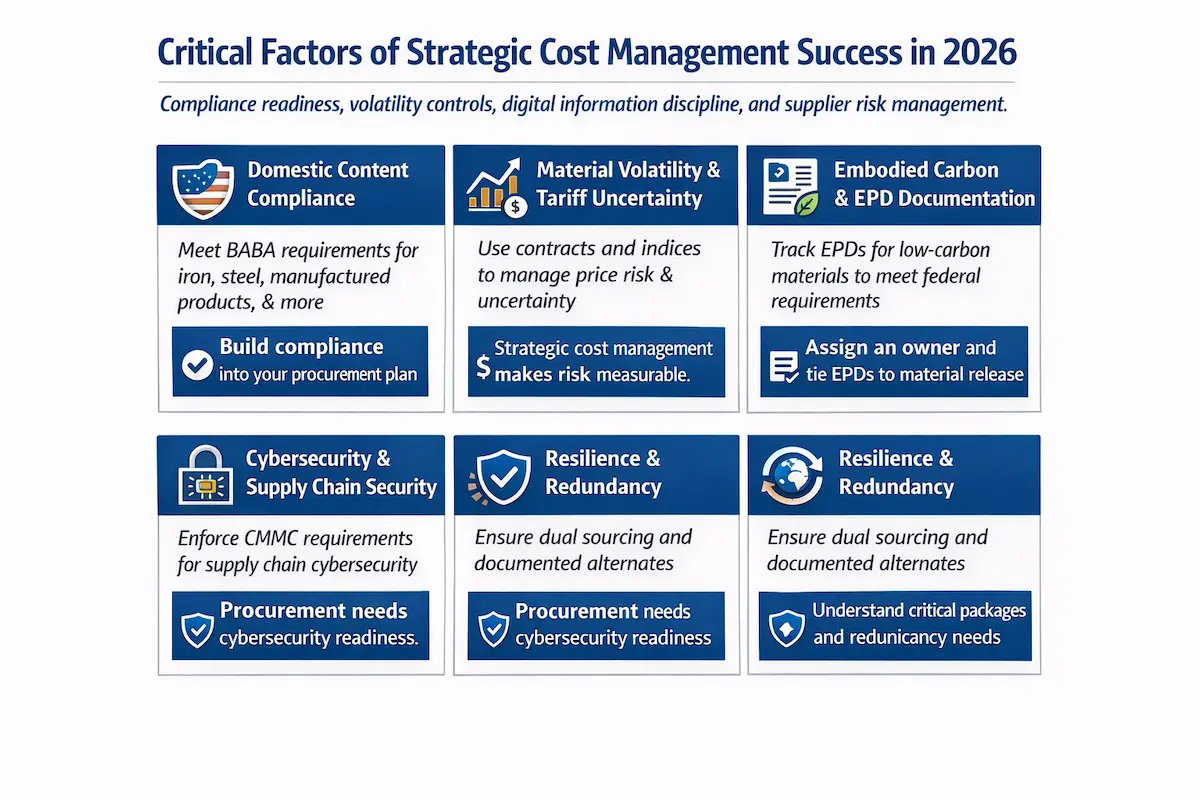
● Domestic Content Compliance
BABA’s domestic preference requirements apply to iron, steel, manufactured products, and construction materials on covered federally funded infrastructure. Similarly, OMB’s final guidance is reflected in 2 CFR Part 184, which sets definitions and rules that can affect classification and compliance checks.
Results: Build compliance into your procurement plan.
● Material Volatility & Tariff Uncertainty
Construction materials price trends are tracked through indices such as the construction materials PPI series, which teams often use to inform escalation assumptions. AGC’s tariff resources emphasize contract strategies such as escalation provisions to manage uncertainty.
Results: If you can’t price risk, you’re going to own risk. Strategic cost management uses contracts and indices to make risk measurable.
● Embodied Carbon & EPD Documentation
EPA guidance describes EPDs as an industry standard for disclosing environmental impacts and defines embodied carbon associated with production stages. Furthermore, GSA publishes IRA low-embodied carbon material requirements (including for concrete/cement/CMUs, asphalt, steel, and glass), which can influence procurement and submittal pathways on federal work.
Results: Treat EPD collection like a submittal package. Assign an owner, track it, and tie it to material release.
● Cybersecurity & Supply Chain Security
The DFARS clause 252.204-7021 places CMMC requirements into contracts, and those requirements can flow down to subcontractors and vendors. Also, NIST supply chain risk management guidance emphasizes identifying, assessing, and mitigating risks across the supply chain.
Results: Vendor qualification now includes basic security posture on some projects. If your owner is federal or defense-adjacent, procurement needs cybersecurity awareness.
● Resilience & Redundancy
ASCM defines supply chain resilience as the ability to return to equilibrium after an event causes results to deviate from expectations.
Results: Resilience is dual sourcing, documented alternates, and understanding which packages can fail without taking the schedule down.
Why Strategic Cost Management Consulting is Essential for Global Enterprises?
For global enterprises building, strategic cost management consulting provides market intelligence, compliance support, and repeatable procurement controls across projects and regions.
Large enterprises, like data centers, manufacturing, healthcare, energy, and infrastructure, face similar friction when scaling U.S. capital programs:
- Regional variation in supply and labor capacity.
- Different public procurement and funding requirements.
- Compliance and reporting burdens
- Misalignment between corporate sourcing and the realities of preconstruction and field production.
Remember that strategic cost management consulting is not about adding bureaucracy. It’s about establishing a procurement operating system that scales across sites and delivers consistent governance.
To align corporate sourcing with field execution, explore our guide on procurement transformation strategies
What Can You Expect from Your Consulting Partner?
In deliverables, look for:
- Category strategies aligned to construction realities.
- Cost-driver and should-cost models for high-value packages.
- Bid packaging standards and scope templates.
- Supplier qualification and prequalification frameworks.
- Contract language playbooks for volatility and long-leads.
- Practical KPIs and measures
Ready to build a scalable, risk-controlled procurement operating system across your global projects?
Frequently Asked Questions
How is strategic cost management different from cost-cutting?
Strategic cost management optimizes total cost and value across the life cycle, using cost-driver analysis and risk controls. On the other hand, cost-cutting focuses on reducing immediate spend, which can increase downstream costs.
What’s the fastest first win if procurement is reactive?
Create a long-lead register tied to the schedule, and enforce a buyout readiness check before award. This reduces the late-submittal or late-delivery spiral that drives downtime.
How to prevent scope gaps between trades during bid leveling?
Use standardized scope sheets by the CSI division and require bidders to acknowledge inclusions or exclusions. Then level bids scope-first, terms-second, and price last.
When does an escalation clause make sense?
Use escalation clauses when duration and volatility make fixed pricing unrealistic. Objective indices, clear triggers, and defined materials are common best practices for escalation provisions.
How do Buy America and Buy Clean requirements change procurement planning?
They turn procurement into a compliance workflow. Domestic content rules (BABA) and embodied carbon documentation (EPDs or low-embodied carbon programs) can reduce eligible suppliers and add submittal steps, so plan them before buyout.
Can category management help construction procurement?
It helps in repeating programs. GSA describes category management as buying common goods and services as an organized enterprise to improve acquisition efficiency and effectiveness, and the same logic applies when you standardize recurring construction packages across multiple sites.
How to respond in case of design changes after buyout?
Treat every design revision as a cost-driver event. Update your scope sheet, re-baseline the long-lead register, and confirm whether the change hits fabrication, logistics, or commissioning. Then document the cost/schedule impact immediately, before the field absorbs it as lost time.
What tools help teams operationalize strategic cost management without overcomplicating the job?
Use simple tools that keep one source of truth:
- Standard scope sheets + bid leveling template
- Submittal log connected to long-lead items
- PO/subcontract commitments log
- BIM-based quantity checks on critical packages
Conclusion
Strategic cost management is what separates predictable projects from constant procurement firefighting. Teams that do strategic cost management well:
- Manage total cost of ownership, not just price.
- Use contract terms as cost controls under volatility and tariffs.
- Integrate procurement with schedule, BIM information, and field constraints.
- Build resilience through supplier qualification and redundancy.
- Align procurement with cash flow realities.
If you want strategic cost management to work on your next U.S. construction project, start earlier with Pro Procurement! The company helps owners, GCs, and CMs implement strategic cost management with practical procurement processes, disciplined bid leveling, and risk-aware contracting, so your supply chain supports production instead of slowing it down. Reach out now!