If you’ve been on a live project when a critical submittal stalls or a minor material miss turns into a resequence, you already know that the cost overruns often start before the site is fully mobilized.
In today’s market, schedule risk frequently begins during sourcing and procurement. When long-lead items slip, the team experiences productivity loss, expediting, out-of-sequence work, and change orders.
On design-bid-build jobs, the playbook is especially unforgiving. As Procore describes it, construction procurement is a multi-step process that includes selection, approvals, logistics, delivery, and installation, while purchasing is only the transaction. That difference is exactly where procurement savings are either captured or quietly go away.
Simply put, procurement savings in construction are not a paper exercise. However, ot’s the discipline of protecting the project’s budget and schedule through smarter buying, tighter compliance, and better supplier execution, from start to finish of the project. Let’s explore more on procurement cost savings!
Capturing these savings requires a comprehensive approach to what is procurement management, ensuring that logistics and approvals are as disciplined as the initial bid.
What Is Procurement Savings?
Procurement savings are the measurable values created when procurement decisions reduce actual project costs or prevent credible, forecastable cost increases. This is all done without breaking the scope, quality, safety, or schedule of the project.
That sounds simple until finance gets involved. The Institute for Supply Management (ISM) makes an uncomfortable-but-accurate point: if you don’t align on definitions with finance, you’ll end up arguing methodology. Finance generally trusts what shows up in invoices and financial reporting. Remember that the cost avoidance may not be recognized as savings unless it clearly hits the numbers.
In construction, that finance alignment is even harder because so much spend is project-based and unique. A Sourcing Industry Group (SIG) paper notes that hard saving is often defined as a reduction from prior-year spend for the same or similar item, and those narrow definitions can exclude savings on capital projects or new technologies when there’s no clean prior-year equivalent.
Aligning with finance requires a robust system for what is invoice management, ensuring every cost reduction is documented and verifiable in the final reporting.
Types Of Procurement Cost Savings
In construction, savings are not in one bucket. You should treat it as a portfolio, as some benefits hit invoices, some protect the budget, and some reduce lifecycle cost for the project owner.
The SIG paper summarizes a common hard savings approach as the difference between new and prior prices, multiplied by the quantity purchased. That’s useful, but it’s not the full story on a project where scope evolves, alternates trigger, and schedule drives logistics.
Here is a table describing the types of procurement savings:
| Savings type | What it means in the field | What proof looks like | Why it matters |
| Realized price savings | Lower unit price on the same spec and scope | Executed PO/subcontract + invoice pricing | Cleanest procurement savings for finance |
| Buyout savings | Awarded trade/material package below the budgeted line item | Buyout log + schedule of values comparison | Directly protects the fee/profit and contingency |
| Cost avoidance (credible) | Prevented a likely increase (volatility, escalation, tariffs) | Index-based clause, supplier letter, market benchmark and approvals | Protects GMP and reduces disputes |
| Demand/spec optimization | Reduced quantities or right-sized spec without performance loss | RFI/substitution approval + updated takeoff + revised package | The “hidden” lever many teams miss |
| Logistics and handling reduction | Less waste, fewer touches, less storage, fewer returns | Delivery plan + damage/return logs + productivity impacts | Shrinks the total installed cost |
| Lifecycle value (owner view) | Lower operating/maintenance cost over asset life | Documented LCC/TCO rationale | Often, more value than unit price wins |
Profitable Procurement Cost Savings Ideas
These procurement cost savings ideas show up repeatedly across U.S. commercial, industrial, and civil work.
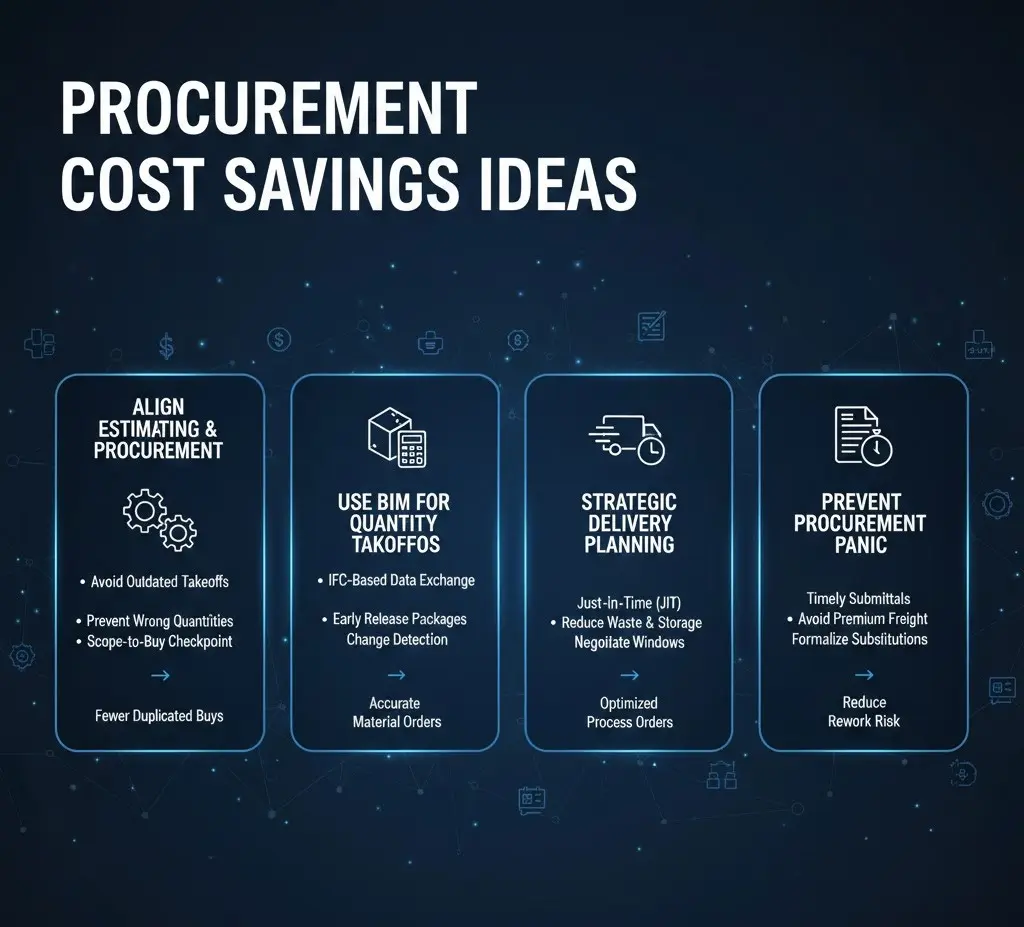
● Tighten The Handoff Between Estimating & Procurement
The fastest way to lose procurement savings is to buy the job off a takeoff that’s already outdated. On many projects, procurement starts while design is still evolving. If the team does not align the estimating, takeoff, addenda tracking, and procurement packages, they end up with:
- Wrong quantities
- Wrong alternates carried forward
- Missed specifications & clarifications
- Duplicated buys between GC and trades
You can avoid these issues by building a scope-to-buy checkpoint before issuing major bid packages for steel, concrete, curtain wall, and major MEP equipment.
● Use BIM-Driven Quantity Takeoffs
If you use BIM correctly, it can reduce quantity issues early enough to help procurement. The National BIM Standard–US describes Design to Quantity Takeoff for Cost Estimating (QTO) as an open, IFC-based BIM information exchange that enables stakeholders to assess quantities of materials and manufactured products and project construction cost.
Move below to see where this helps procurement savings the most.
- Early release packages, like foundations, embeds, and sleeves
- Prefabrication planning for MEP racks
- Consistent change detection between model revisions
Pro Tip: Never assume that the model is complete without validating modeling standards.
● Treat Delivery Strategy As A Sourcing Lever
Site logistics is a silent cost driver in procurement. If you’re buying materials without a delivery plan, you’re usually buying hidden waste. Just-in-time (JIT) is one of the most practical cost-saving methods in procurement for construction.
The Lean Construction Institute describes JIT as a materials management strategy that aligns the construction schedule with inventory transportation. This way, it ensures that the workers receive materials only when needed, reducing waste.
Procore adds that in construction, JIT involves scheduling or procuring materials to arrive close to installation and aims to reduce excess inventory, carrying costs, storage costs, and waste.
What you should do is to negotiate delivery windows, off-site staging, and packaging or handling requirements in the buy.
● Stop Paying For Procurement Panic
When long-lead approvals are late, teams often pay for panic, such as:
- Premium freight
- Overtime for re-sequenced installs
- Substitution pressure that creates rework risk
AIA-focused guidance highlights that the absence of a submittal schedule often indicates the contractor has not planned the sequence of submittals, which is a serious work-plan flaw. The submittal schedule is required to be coordinated with the overall construction schedule as it’s procurement savings protection.
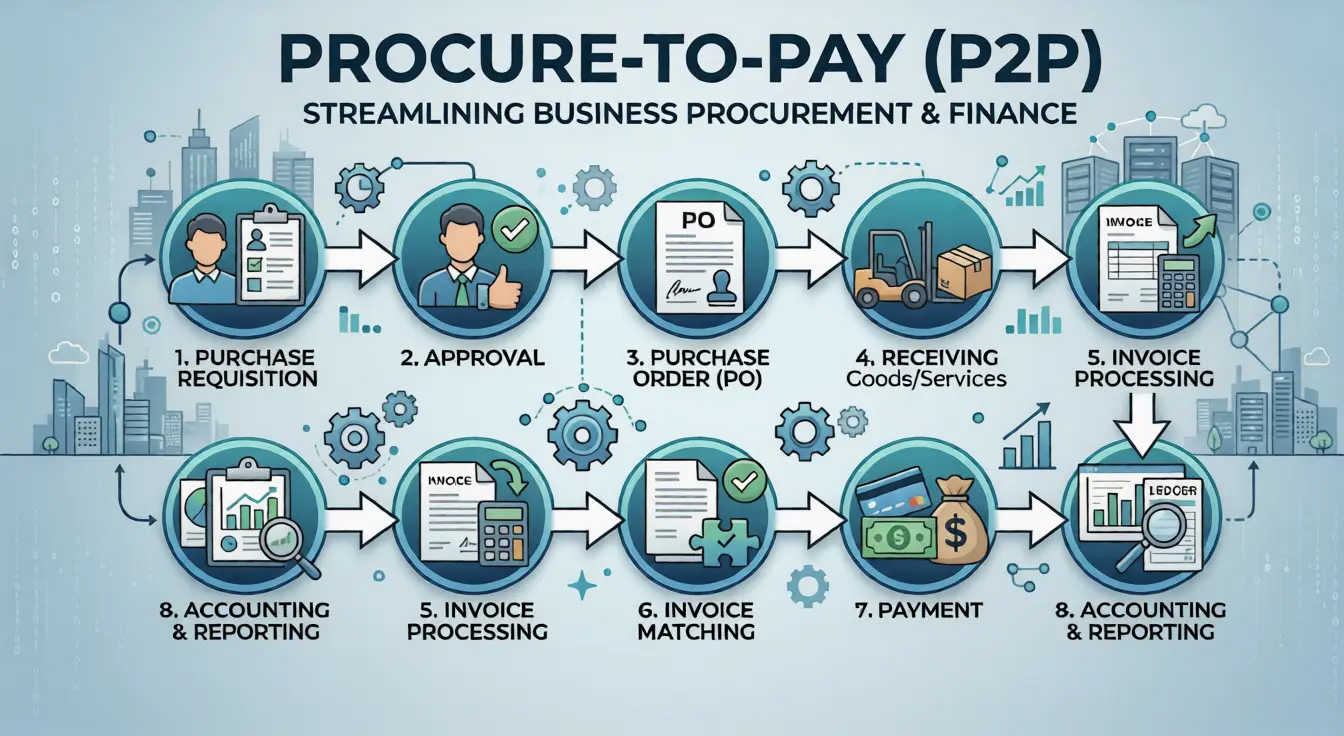
Integrating delivery strategies like Just-In-Time requires a highly optimized procurement process flow to ensure materials arrive exactly when the field is ready.
Procurement Cost-Saving Initiatives
● Spend Visibility Programs
You can’t manage expenses if you can’t see them. So, spend analysis is a core building block. SAP defines spend analysis as the data-driven process of collecting, cleansing, classifying, and analyzing expenditure information, with goals like lower procurement costs, greater efficiency, and higher compliance.
Rather than considering only invoices, professional teams include job-coded spend and commitments on POs or subcontracts. Procurement savings opportunities often sit in commitment gaps before they hit AP (Accounts Payable).
A practical spend visibility setup includes:
- A standardized vendor master (avoid split vendors)
- Category tagging aligned to CSI divisions, because U.S. specification books are commonly organized using CSI divisions
- Commitment vs. invoice reconciliation so that you can catch pricing errors early
● Maverick Spends Control
In construction, maverick spend usually appears as field buys and emergency orders that quietly bypass negotiated terms. Tipalti defines maverick spend as transactions made outside an organization’s predefined spending rules.
Cost-saving initiatives procurement teams can implement immediately:
- Single front door intake for purchases, even if it’s just a disciplined form & approval routing
- Approved supplier catalogs for high-frequency items, like fasteners, PPE, consumables, and temporary works
- Jobsite purchasing limits with exceptions requiring PM approval
Remember that the procurement savings disappear when compliance is optional.
● Supplier Performance Reviews
Construction suppliers are not interchangeable. Delivery reliability and quality issues create costs that never show up as a unit price delta. Gartner defines supplier relationship management (SRM) as the partnership between buyer and supplier to sustain and enhance supplier value, foundational to strategic collaboration.
In construction terms, if a supplier misses ship dates or ships incomplete kits, you pay for it in labor inefficiency and resequencing.
Therefore, you should run supplier performance reviews with these KPIs:
- On-time delivery to the installation window
- Completeness of deliveries
- Submittal responsiveness and documentation quality
- Damage rate and packaging compliance
- Billing accuracy
● Category Management
Category management is a disciplined way to stop buying the same thing 12 different ways across 12 projects. According to a study, category management is a strategic approach where organizations segment spending into areas containing similar or related products. This enables consolidation and efficiency opportunities.
In construction, strong categories often include:
- Concrete and admixtures
- Rebar/embeds/connection hardware
- Drywall, framing, ceilings
- Doors, frames, hardware
- Electrical gear and lighting packages
- HVAC equipment and controls
- Temporary works (fencing, toilets, trailers)
● Strategic Sourcing Initiatives
Strategic sourcing is more than three bids and a buy. It’s selecting suppliers and terms based on risk, market conditions, and project objectives. This is where procurement cost savings strategies become long-term. They lock pricing where it makes sense, protect schedule where it must, and structure terms to reduce total installed cost.
High-impact sourcing levers in construction:
- Volume bundling across multiple projects
- Dual-sourcing for critical materials to reduce disruption exposure
- Qualified alternates to reduce substitution chaos later
- Supplier capacity checks tied to the schedule
Procurement Cost Savings Strategies
Short-term price wins are easy to announce and hard to keep. However, long-term procurement savings depend on systems that survive staff turnover, schedule pressure, and market volatility.
Below are some cost-saving strategies:
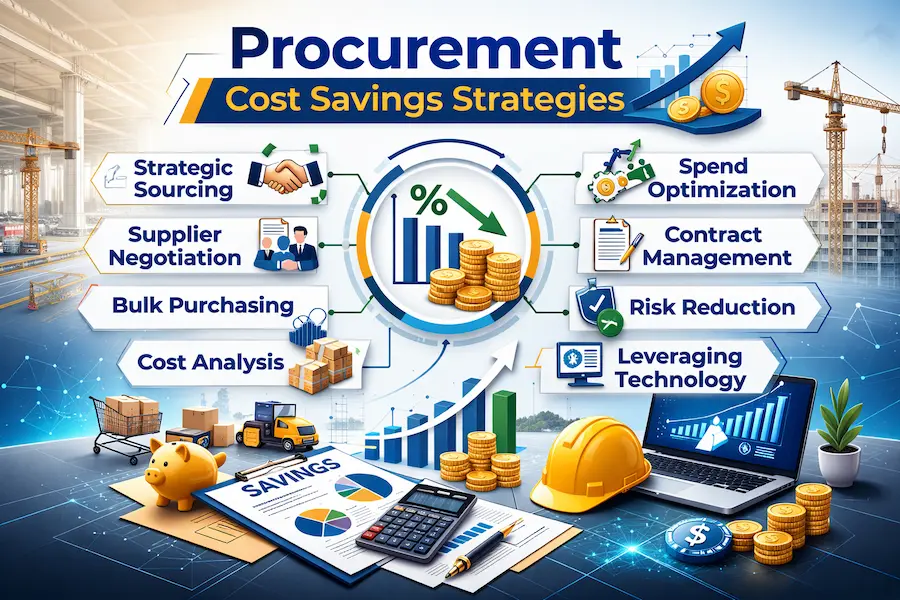
● Tie Procurement To The Submittal Schedule & Procurement Log
Procore notes that contractors confirm lead times and plan the submittal schedule to prioritize long-lead approvals so materials or equipment arrive on time. Best practice is to treat the procurement log as a project control document, and not a PM side task.
Your log should show:
- Submittal required date
- Approval required date
- Release date to fabrication
- Promised ship date
- Required on-site date
- Contingency options
When teams do this well, procurement savings show up as fewer expedite fees, fewer resequences, and fewer time recovery costs.
● Use Price Escalation Clauses Strategically
Material volatility and tariffs can throw away procurement savings if the contract doesn’t address them. Procore explains that escalation clauses allow contract price adjustments for labor or materials to address price fluctuations during the project. This protects contractors from unexpected increases, limiting expenses within the project budget.
As per the ConsensusDocs mechanics, a material price escalation clause adjusts the contract price based on a metric, usually an objective index, and selecting a reliable index is a key challenge. So, escalation clauses are not free money, but they’re risk allocation tools. Therefore, you should use them for:
- Long-duration projects
- Early design-phase commitments
- Supply-constrained items
- High-volatility commodities
Pro Tip: Always coordinate with your legal team and the project delivery method because risk allocation differs.
● Avoid Negotiating Unit Price & Focus On Total Installed Cost
This is one of the most overlooked cost-saving strategies in procurement. Winning suppliers often reduce total cost through:
- Fewer deliveries by bundling and optimized shipments
- Kitting that reduces field labor searching and staging
- Better packaging, reducing damage or rework
- Clearer documentation to reduce submittal revisions
● Formalize Substitution Governance
AIA-oriented guidance warns about forced substitutions, where last-minute submittals pressure approvals because of threatening schedules. That pressure is where procurement savings can turn into warranty risk. A better approach is to:
- Establish substitution windows and required documentation early
- Pre-approve alternates where appropriate
- Require impacts on schedule, warranty, and maintenance to be stated explicitly
- Document decisions
Managing these long-term systems often involves balancing direct project needs with indirect procurement strategies to ensure overhead and operational risks don’t erode your savings.
How to Measure Procurement Savings?
If your savings reporting creates fights, it’s usually because the baseline, assumptions, or realization rules were never agreed upon. Follow the process below:
1. Start with Savings Definitions
ISM’s points that finance tends to win definition battles, and cost avoidance may not be recognized unless it shows up in invoices and financial reports. Therefore, your procurement savings measurement should be separate, focusing on:
- Reported savings for procurement
- Recognized savings for finance
- Avoided cost for management
2. Use a Construction-Fit Baseline
Sievo summarizes savings as the decrease between the previous cost paid and the newly negotiated cost. This means that if there’s no prior reference, you should use the first offer or market benchmarks.
Are you thinking about where the baseline comes? It comes from:
- Estimated line items
- GMP schedule of values
- Last project awarded cost
- Competitive bid midpoint
3. Account for the Realization Killers
A negotiated deal is not necessarily procurement savings until a team uses it correctly.
Sievo notes realized savings depend on changes in business activity and stakeholder compliance, and external factors like commodity prices and labor cost indexes.
Therefore, you need to adjust your measurement for:
- Quantity changes due to design development
- Scope shifts due to addenda and RFIs
- Schedule shifts that force partial shipments or expediting
- Specific revisions that invalidate parallel comparison
Below is a simple savings calculation model you can use.
| Step | What you do | Documentation you need | Output |
| Confirm scope match | Lock spec, alternates, inclusions | Bid tab + scope sheet | Comparable baseline |
| Set baseline | Choose budget/estimate/market benchmark | Estimate backup or benchmark note | Baseline cost |
| Capture event result | Record the awarded cost and terms | Executed PO/subcontract | Awarded cost |
| Validate realization | Confirm invoices match pricing and volumes | Invoice audit + receiving | Realized procurement savings |
| Track leakage | Log off-contract buys, wrong pricing, expedite costs | Exception log | Savings leakage list |
Note: If you want to keep it conservative, only book realized procurement savings once pricing is live in the system and invoices confirm it.
Procurement Savings Checklist You Must Use
- Confirm long-lead items and required approval dates
- Validate takeoffs against the latest drawings or model, including addenda
- Lock alternates and substitution rules with AE or the owner
- Require supplier lead time confirmation in writing
- Build a delivery strategy aligned to the project schedule
- Put compliance controls in place and avoid maverick spend
- Define savings methodology and approvals before reporting numbers
Common Mistakes Related to Procurement Savings
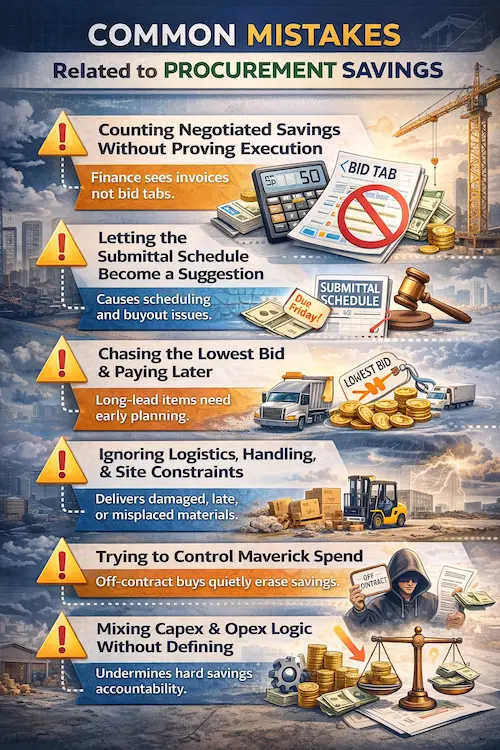
● Counting Negotiated Savings Without Proving Execution
If the deal isn’t used, it isn’t procurement savings. Finance will see the invoices, and not the bid tab.
● Letting the Submittal Schedule Become a Suggestion
As per AIA-oriented guidance, a submittal schedule often indicates poor planning and creates downstream schedule and buyout problems.
● Chasing the Lowest Bid & Paying Later
CMiC emphasizes that procurement and schedule disconnects create blind spots, and long-lead items need early planning. The lowest unit price is irrelevant if the supplier can’t hit the required window.
● Ignoring Logistics, Handling, & Site Constraints
JIT is powerful, but only when planned. If the delivery strategy isn’t part of buying, you can experience flooded sites, damaged material, and labor wasting time moving what shouldn’t be there yet.
● Trying to Control Maverick Spend
Off-contract buys quietly erase procurement savings and reduce buying leverage.
● Mixing Capex & Opex Logic Without Defining
The SIG paper notes hard savings frameworks often exclude capital projects and unique purchases. On construction programs, failing to define how project savings are treated creates endless arguments.
To prove that negotiated deals actually translate into executed savings, teams must establish procurement benchmarks that measure real-world performance against initial bid tabs.
Commonly Asked Questions
1. How to keep procurement savings credible in construction?
To keep procurement savings credible on construction programs, align on three principles:
- Apples-to-apples rules means same specifications, the same scope, same logistics assumptions.
- Documented baseline means work on project estimate, budget, GMP line item, or prior buy history.
- Realization controls mean proof the negotiated deal was actually used with contract compliance, correct pricing, and correct quantities.
When those are in place, procurement savings become something you can defend in an OAC meeting and in a finance review.
2. Is cost avoidance real, or is it just a story?
Cost avoidance can be real value, but it’s harder to prove because it’s based on preventing a likely future cost. ISM notes that finance may not recognize cost avoidance as savings unless invoices and financial reports show it. Best practice is to track it separately from realized procurement savings, with documentation and approval.
3. How do you keep savings from disappearing after signing the contract?
You can avoid this by controling compliance, stopping maverick spend, and invoicing validation.
4. What’s a practical baseline when there’s no prior year for a unique project or new material?
Use a documented market benchmark or the competitive bid range and lock a clear scope definition. Procurement teams often use market benchmarks when no prior reference exists.
5. How do escalation clauses support savings strategy?
They manage risk from volatile materials or labor pricing. Procore describes escalation clauses as allowing adjustments for labor or material price increases over the project life, and ConsensusDocs emphasizes objective index-based adjustments. They’re a risk tool, so coordinate with counsel and the delivery method.
6. Does JIT delivery always save money?
Not always. JIT reduces storage and excess inventory when schedules and suppliers are reliable. It aligns delivery timing with the construction schedule to reduce waste. If the lane is congested due to weather, labor, or inspection issues, overly tight JIT to increase disruption risk.
7. How can BIM actually support procurement decisions?
When modeling standards and responsibilities are clear, BIM-driven quantity takeoff can improve early quantity confidence. NBIMS-US describes an IFC-based QTO exchange enabling quantity assessment and cost projection. Therefore, you need to use it to reduce quantity issues on early release packages and prefabrication planning.
8. Why do hard savings only miss the construction value?
The SIG paper warns that hard savings can exclude strategic areas and unique purchases, creating a bias against innovation and upstream or downstream benefits. It also states that procurement savings calculations often don’t correlate to GAAP or standard FP&A models.
Construction procurement savings often live in:
- Avoided schedule impacts
- Avoided substitution-driven rework
- Logistics and handling reductions
- Better performance from key suppliers
You can track those benefits without overselling them. Separate recognized from managed value.
Conclusion
You can earn procurement savings in construction through disciplined planning, clear bid sets, supplier execution, and credible measurement. When teams align procurement with the submittal schedule, long-lead strategy, and delivery plan, they experience fewer expedite costs, tighter buyout, better schedule reliability, and fewer downstream disputes.
If you want procurement savings that finance respects and project teams actually feel, build the system: baseline, sourcing discipline, compliance controls, and realized-savings validation. And if you need assistance in doing so, you can rely on Pro Procurement. The company supports U.S. construction stakeholders, including project owners, developers, GCs, and trade partners, by focusing on the levers of procurement savings:
- Procurement planning aligned to the schedule
- Bid package strategy and competitive sourcing
- Category-based negotiation
- Supplier governance
- Compliance controls
- Savings measurement you can defend