Here’s the moment I see again and again.
You’re sitting in a meeting. Maybe it’s late. Maybe everyone’s tired. Someone throws out the phrase “procurement transformation” like it’s a magic switch. New software, new process, and problems solved.
And you’re thinking, “Is it really that simple?” Because from where you’re sitting, procurement feels messy and fragmented.
If that sounds familiar, you’re not behind. You’re updating with time.
Procurement transformation isn’t a trend; however, it’s a response to pressure, complexity, and the reality that the old way of buying stuff, when people relied on emails, spreadsheets, and late approvals.
Let’s slow this down and walk through it properly!
Why Procurement Transformation Feels Harder Than It Should
Procurement transformation sounds straightforward on paper, involving new tools, smarter processes, better data, and done. But when you’re inside it, it feels heavier than expected, slower and messier, like you’re pushing a cart with one bad wheel.
Part of the problem is history. Procurement teams have spent years working around broken systems, unclear ownership, and constant urgent requests. You build habits just to survive. Then someone shows up, with everything is getting transformed.
And there’s another layer we don’t talk about enough. Procurement sits between competing priorities. Finance wants control; operations want speed; leadership wants savings; suppliers want stability; and you’re trying to balance all of it, every day.
So if procurement transformation feels harder than it should, that doesn’t mean you’re doing it wrong. It means you’re dealing with reality, and not theory.
What Is Procurement Transformation?
Procurement transformation is the shift from transactional buying to strategic value creation. It’s not just about cost savings; however, it’s about how procurement actually supports the business.
Old procurement focused almost entirely on price. The core question was simple: did we get the lowest possible cost? Success was measured by short-term savings, often without considering the broader impact on operations, suppliers, or long-term stability.
Modern procurement looks at a much bigger picture. The real question now is whether procurement reduced risk, improved speed, supported business growth, and protected margins at the same time. Cost still matters, but it’s no longer the only measure of success.
Today, procurement decisions are judged by how well they balance efficiency, resilience, and strategic value across the entire organization.
That shift touches everything, including people, processes, data, technology, and mindset.
What Procurement Transformation is Not
- Not a one-time project
- Not just automation
- Not something IT owns
- Not something you finish and move on from
What it Actually is
- Redesigning procurement functions to align with business goals
- Embedding data into everyday decisions
- Making suppliers partners, not just vendors
- Turning procurement into a proactive force instead of a bottleneck
Remember that…
Transformation gets messy before it gets better. Processes break, people resist, and old metrics stop making sense. So, you don’t need to worry if the process goes this way since it is normal.

Why Procurement Transformation Isn’t Just a Fancy System Upgrade
When people hear procurement transformation*, they often think it’s all about technology, including new software, dashboards, automation, or a platform. It’s easy to point at tools and call them progress.
But simply upgrading systems without changing how decisions are made is like repainting a house with a cracked foundation. It might look better for a while, but the same issues inevitably resurface.
True procurement transformation is about behavior. It changes when and how procurement gets involved, how trade-offs are evaluated, and what success actually means. Technology can support that shift, but it can’t drive it.
If the mindset stays transactional, the results will stay transactional too, no matter how shiny or modern the toolset looks.
To accurately assess your current standing, you must first evaluate your existing procurement process flow to identify where bottlenecks and inefficiencies actually exist.
About Modern Procurement Functions
If procurement still lives in a corner of the organization, transformation won’t stick. Modern procurement functions are connected, visible, and accountable.
Let’s break down the core pillars that actually matter.
● Supplier Relationship Management (SRM)
Here’s what usually happens. A supplier messes up, and everyone scrambles. Procurement steps in late, negotiates harder next time, and calls it vendor management. That’s not SRM.
Supplier Relationship Management (SRM) is about understanding which suppliers matter, why they matter, and how you work with them differently. Not every supplier deserves the same attention.
Modern SRM focuses on:
- Segmenting suppliers by risk and value
- Collaborating on forecasts and innovation
- Building resilience, not dependency
- Creating shared KPIs instead of one-sided scorecards
The best procurement teams don’t just monitor suppliers; they invest in the right ones.
Effective SRM is no longer just about negotiations; it requires a commitment to sustainable procurement practices that ensure long-term value and ethical alignment with your key partners.
● Procure-to-Pay (P2P) Efficiency
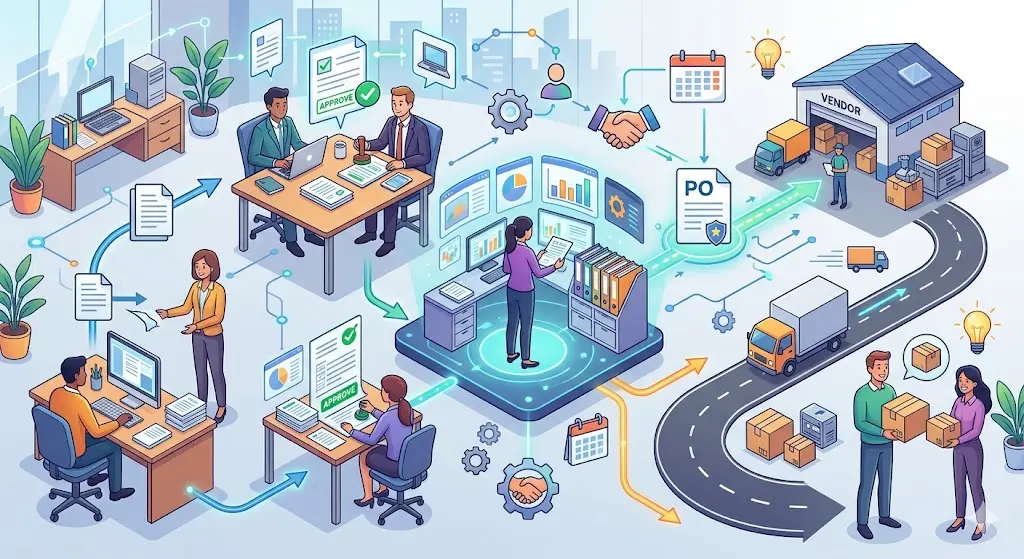
Requisitions stuck in approval loops. Invoices mismatched; payments delayed; finance frustrated; suppliers annoyed; and Procurement blamed. Does this sound familiar?
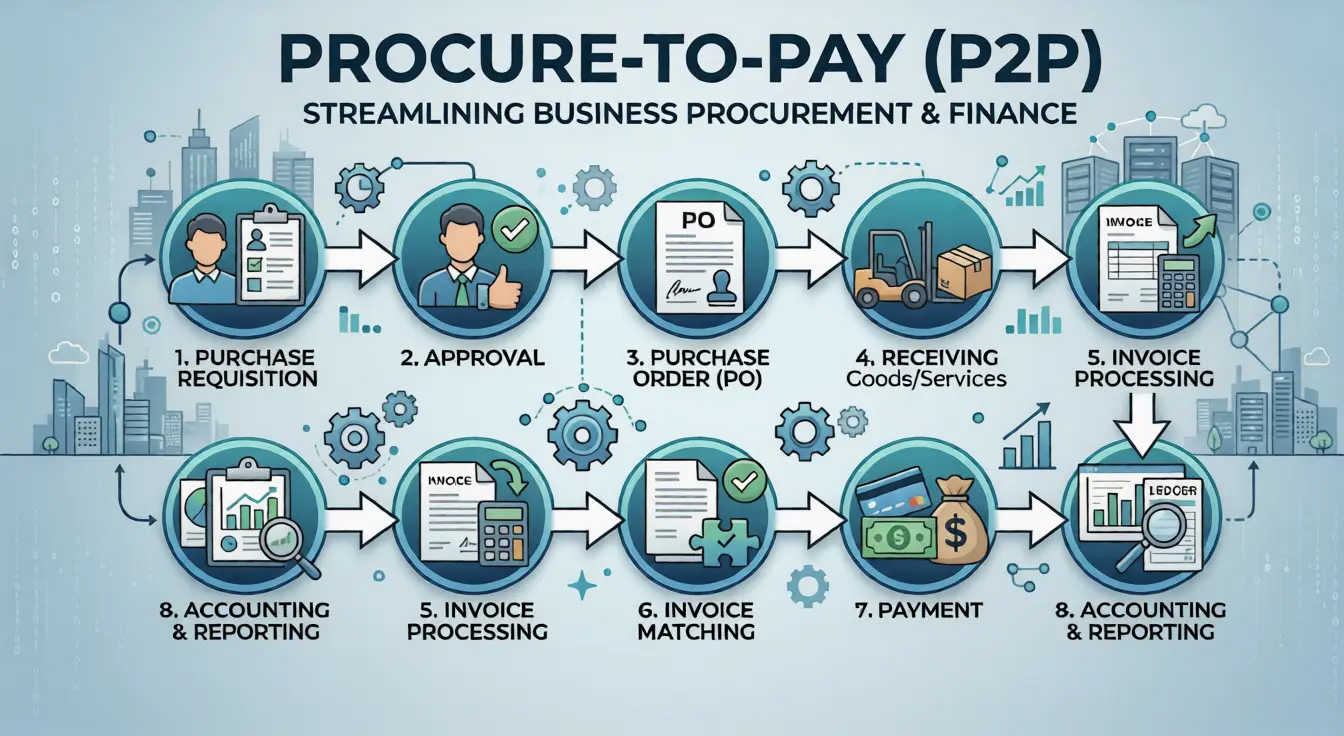
Procure-to-Pay (P2P) efficiency is where transformation becomes real for day-to-day users. It’s not glamorous, but it’s critical.
A modern P2P process:
- Reduces manual touchpoints
- Standardizes approvals without killing flexibility
- Connects purchasing, receiving, and payment data
- Gives visibility into spend before it happens
When P2P works, people stop working around procurement; the goal of the professional teams is.
To truly streamline your P2P cycle, you should look into how AI in procurement can automate manual touchpoints and provide real-time visibility into your spend data.
● Risk Management and Compliance
Risk used to be treated like a simple checkbox, which is something to mark off and move on. Today, it’s existential. Supply disruptions, regulatory changes, cyber threats, and ESG pressures mean that even one weak supplier can send shockwaves through the entire business. Risk is no longer a formality; it’s a strategic priority that demands constant attention. In other words, modern procurement doesn’t react to risk. It monitors it in real time.
That means:
- Continuous supplier risk scoring
- Geographic and tier-2 visibility
- Compliance embedded into workflows, not audits
- Early warning signals instead of post-mortems
In an era of high ESG pressure, modern risk management must include a focus on green procurement to mitigate environmental risks and meet evolving regulatory standards.
When Procurement Finally Gets a Seat at the Table
It’s all about timing. Procurement earns influence when it shows up early with insight, not late with constraints. When it speaks the language of the business, you experience revenue, risk, and continuity, instead of internal policy.
This doesn’t happen overnight. It’s built through consistency. Through saying “yes” when possible and explaining “no” when necessary. Through helping teams make better decisions.
Gaining a seat at the table means moving beyond basic purchasing and mastering strategic category management to prove your department’s value to the board.
The Moment Procurement Stops Being Reactive
There’s a quiet moment in procurement transformation, easy to overlook, when the function starts to feel truly different.
It happens when the procurement team stops scrambling to fix issues after decisions are made. Instead, they’re looped in earlier, not as gatekeepers, but as trusted advisors shaping strategy.
You see it when conversations shift from “Can you approve this?” to “What’s the smartest way to approach this?” This isn’t just a process change; it’s a sign that procurement transformation is creating real trust.
At this point, procurement stops reacting and starts influencing outcomes. Once this shift occurs, everything else, including strategy, technology, and performance metrics, can finally work together to deliver real business value.
How to Build a Robust Procurement Transformation Strategy
This is where most organizations stumble. They jump straight to tools without asking the harder questions. Before strategy decks and roadmaps, you need clarity. 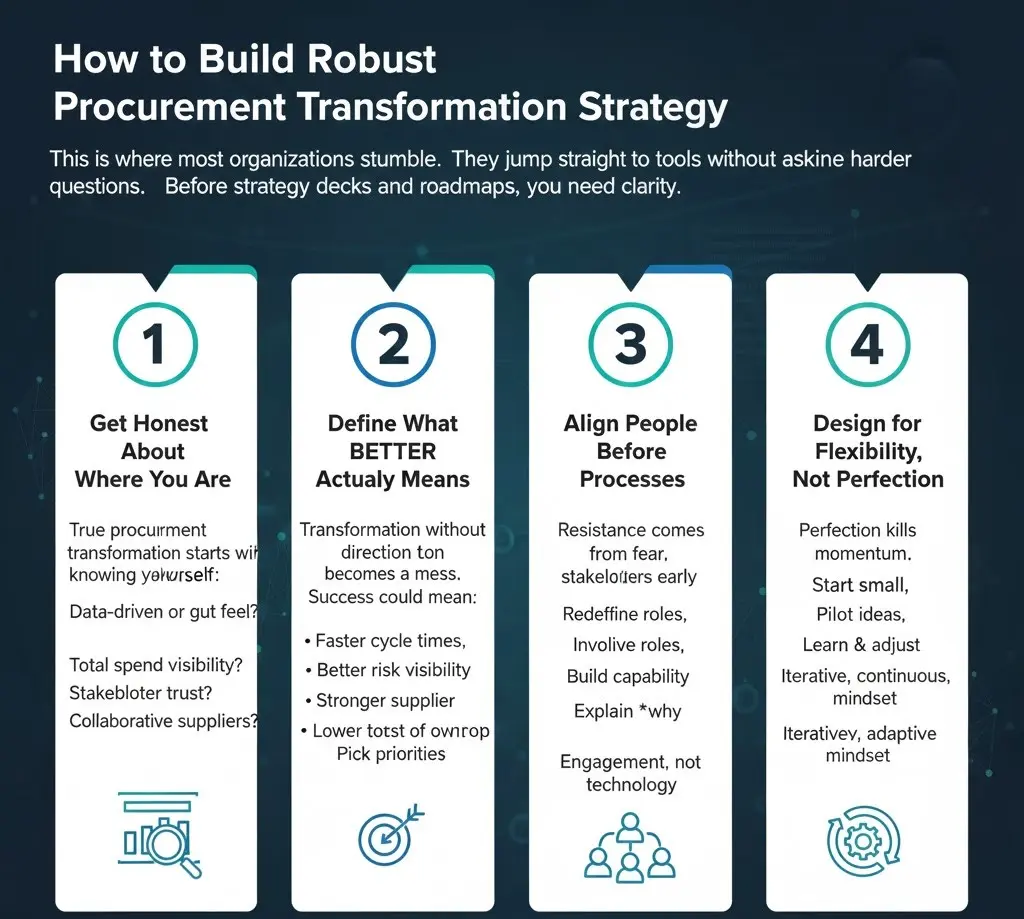
Step 1: Get Honest About Where You Are
Too often, where you think your procurement stands isn’t where it actually is. And the board? They usually have an even rosier view. True procurement transformation starts with knowing your reality.
Ask yourself: Are decisions driven by data or gut feel? Can you see the total spend across all categories? Do stakeholders trust procurement, or bypass it? Are suppliers collaborative or defensive?
This baseline is crucial. Before chasing big ambitions, understanding where you actually are lays the foundation for effective procurement transformation that delivers measurable results.
Step 2: Define What BETTER Actually Means
Transformation without direction becomes a mess. For some organizations, success means:
- Faster cycle times
- Better risk visibility
- Stronger supplier innovation
- Lower total cost of ownership
Pick priorities since you can’t transform everything at once.
Step 3: Align People Before Processes
Resistance rarely comes from laziness; it comes from fear. Fear of losing control, fear of being exposed, fear of stepping into the unknown.
A successful procurement transformation strategy addresses this head-on. It involves stakeholders early, redefines roles, invests in building capability, and explains *why* before diving into *how*.
Because at the end of the day, if people don’t buy in, no system, tool, or process will make a difference. True transformation starts with engagement, and not technology.
Step 4: Design for flexibility, not perfection
Perfection can actually kill momentum in procurement transformation. Waiting for the flawless process or the perfect tool often leads to delays and lost opportunities. The smarter approach is to design processes that can evolve; start small, pilot ideas, learn from real-world results, and adjust along the way.
So, transformation isn’t a single event; it’s iterative, continuous, and adaptive. Embracing this mindset keeps progress moving, encourages experimentation, and ensures that procurement transformation delivers real, sustainable impact over time.
Why Digital Procurement Transformation Fails
Digital procurement transformation fails when technology is treated like a shortcut, when tools are layered onto unclear processes, and when bad data is automated instead of fixed.
You end up with dashboards no one trusts, and systems people quietly work around. Not because they’re difficult, but because they don’t reflect how work really happens.
What actually works is slower and less glamorous, including cleaning data, clarifying ownership, simplifying workflows before digitizing them, and then choosing technology that supports those decisions.
When digital tools reinforce good behavior instead of forcing new ones, adoption stops being a fight.
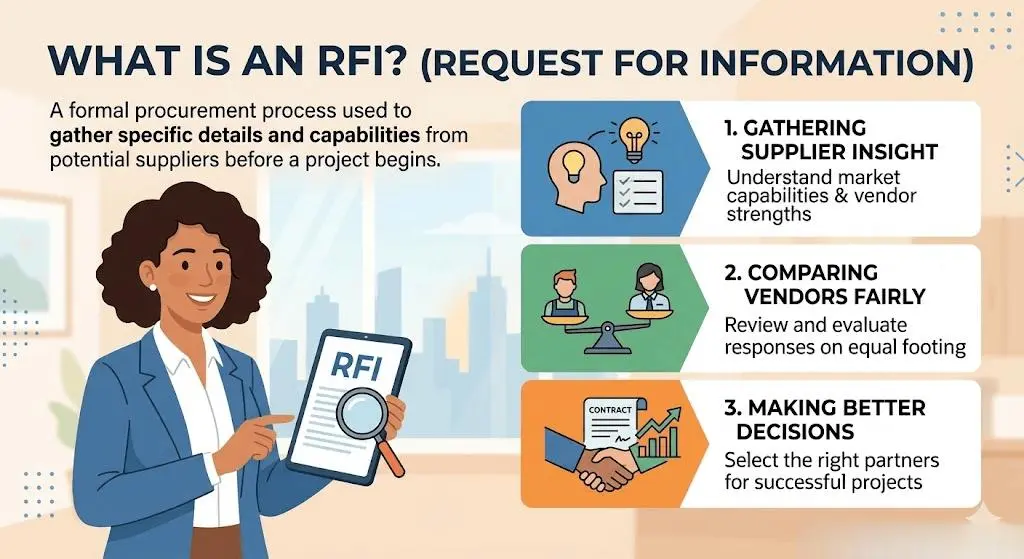
Success comes when you simplify workflows before digitizing them, such as refining your approach to complex requests like a request for proposal to ensure the tool supports a clear, logical process.
The Digital Leap: Solutions & Technology
Digital procurement transformation isn’t about having the most tools. It’s about having the right ones, connected in the right way.
● Technology Exposes Discipline
Technology doesn’t fix discipline problems; however, it shines a light on them.
If approvals are unclear, automation makes the confusion visible faster. If data governance is weak, analytics magnify the gaps. That’s not failure; it’s feedback.
The teams that succeed with digital procurement transformation use technology as a mirror. They pay attention to what breaks, then fix the root cause. Over time, discipline follows.
● Automated Spend Analysis Tools
Modern digital procurement solutions can do impressive things. They clean and classify messy data, reveal hidden leakage, highlight consolidation opportunities, and surface risk concentrations.
But here’s the catch: technology alone isn’t enough. Data accuracy matters far more than dashboards or flashy reports. Feeding bad data into automation only spreads confusion faster. The real power of digital procurement solutions comes when clean, reliable data drives decisions, turning insights into action rather than noise.
● Cloud-Based e-Sourcing Platforms
Sourcing shouldn’t live in email threads and shared drives. Modern e-sourcing platforms:
- Standardize RFx processes
- Improve transparency and auditability
- Enable supplier collaboration
- Shorten sourcing cycles without cutting corners
Digital procurement tools don’t replace negotiation skills; they enhance them. By providing real-time insights, clear data, and risk visibility, these solutions let procurement professionals negotiate smarter, faster, and with greater confidence.
● Real-Time Supplier Risk Monitoring
This is where digital procurement solutions truly earn their keep.
Real-time monitoring:
- Tracks financial, geopolitical, and compliance risks
- Flags disruptions early
- Supports proactive mitigation
- Reduces dependency blind spots
It’s the difference between reacting to a crisis and rerouting before it hits.
Change Management
Most procurement transformations fail here; not because the strategy was wrong, but because change was assumed instead of managed.
People need:
- Clear communication
- Training that feels relevant
- Time to adapt
- Permission to make mistakes early
Leadership can’t just show up for the kickoff. Successful procurement transformation requires consistent involvement, ongoing reinforcement, and visible support. Transformation isn’t a one-time announcement; it’s a continuous, lived commitment.
Why Industry Context Changes Everything
Procurement transformation doesn’t look the same everywhere. And pretending it does is a mistake. Industry context shapes risk, regulation, supplier dynamics, and tolerance for failure. What works in manufacturing might collapse in healthcare. What’s acceptable in retail could be catastrophic in pharmaceuticals.
That’s why industry-specific transformation matters. It respects the constraints teams actually operate under — not the ones imagined in generic frameworks.
Finally, maintenance-heavy sectors must ensure their transformation includes a specialized framework for what is mro procurement to prevent operational downtime.
Industry Focus: Pharmaceutical Procurement Transformation
Pharmaceutical procurement transformation comes with its own weight, focusing on regulations, patient safety, and supply continuity, with no margin for error.
Here’s what makes it different.
- Multi-tier global suppliers
- Strict regulatory compliance
- Cold chain logistics
- Volatile demand patterns
One missed step isn’t just costly, but also dangerous.
What Transformation Looks Like in Pharma
Leading pharma organizations focus on:
- End-to-end supply visibility
- Supplier qualification beyond tier-1
- Integrated quality and procurement data
- Scenario planning for disruptions
Digital procurement transformation in pharma isn’t about speed alone. It’s about control with agility. The best teams balance compliance with responsiveness, which is necessary, too.
How Leaders Know Procurement Transformation Is Actually Working
Not just because costs went down, but because conversations change. Fewer escalations, fewer surprises, and better questions being asked earlier in the process.
Procurement starts getting pulled into planning instead of firefighting. Risk discussions become proactive, and suppliers engage differently.
Those signals show up before the spreadsheets do. And they matter just as much.

ROI Transformation: How to Measure Success
ROI isn’t just cost savings. If that’s your only metric, you’ll miss the point.
Hard Metrics
- Cost reduction and avoidance
- Cycle time improvements
- Compliance rates
- Working capital impact
Soft Metrics
- Stakeholder satisfaction
- Supplier collaboration quality
- Risk exposure reduction
- Procurement’s influence on strategy
The real ROI of procurement transformation shows up when procurement stops being reactive and starts shaping decisions upstream. That’s when leadership notices.
Common Pitfalls & How to Avoid Them
Things that derail transformation:
- Treating it as an IT project
- Over-customizing systems
- Ignoring data governance
- Underestimating cultural change
- Chasing quick wins only
Avoid these to stay ahead of other organizations.
What Happens If You Don’t Transform Procurement
Complexity keeps rising, supply chains remain fragile, and expectations keep climbing, yet procurement is often asked to do more using outdated tools and processes. Not embracing procurement transformation doesn’t freeze risk; it amplifies it, quietly at first, then all at once.
True transformation isn’t about chasing the latest trends or flashy tools. It’s about staying functional, agile, and resilient in a world that never slows down. Modern procurement must evolve to manage risk, drive efficiency, and support growth sustainably.
Conclusion
If you’re still reading, here’s what I want you to take away.
Procurement transformation isn’t about becoming something flashy. It’s about becoming reliable, insightful, and trusted. It’s about fewer surprises, better conversations, and stronger partnerships.
And yes, it takes work. But the alternative is staying stuck in reactive mode while complexity keeps rising.
Start Your Procurement Transformation Journey!
If you’re serious about moving forward, don’t start with software demos. Start with clarity.
Connect with our specialists to assess your procurement maturity and unlock transformation opportunities. We’ll help you understand where you are, where you can go, and what actually makes sense for your organization.
FAQs
What is procurement transformation?
Procurement transformation is the shift from transactional purchasing to a strategic, data-driven function that creates value, manages risk, and supports business growth.
Why is procurement transformation important today?
Because supply chains are more complex, risks are higher, and businesses expect procurement to do more than negotiate price.
What is a procurement transformation strategy?
It’s a structured plan that aligns people, processes, technology, and governance to improve procurement performance and impact.
How does digital procurement transformation help?
Digital tools improve visibility, efficiency, compliance, and decision-making when implemented with the right strategy and data foundation.
How long does procurement transformation take?
It’s not a fixed timeline. Most organizations see phased improvements over 12–36 months, depending on scope and maturity.
Is procurement transformation only for large enterprises?
No. Mid-sized organizations often benefit faster because they can move with fewer layers of resistance.