Imagine your repair and maintenance items are all unnecessarily stocked up for months. Now, this is a clear wastage of materials that are going to be damaged over time! That’s exactly where MRO procurement plays the part.
MRO procurement helps you evaluate exactly how much you are spending on your maintenance, repair, and operation-related items. Ensuring that a balance is kept while making the MRO purchases. Real-time forecasts are made. This ensures that you purchase only what is actually required, rather than just overstocking.
MRO Procurement has always been a crucial aspect for businesses to manage supply chain disruptions, stockouts, and save money on overspending.
Having MRO managed for large-scale industry and business inventories ain’t just a walk in the park. Here’s a complete guide to what MRO is in procurement, and the different challenges the MRO category managers face. Helping them out with the key strategies, best practices, and future trends towards streamlined operational workflows.
What is MRO Procurement
MRO procurement or purchases refers to the sourcing and purchasing of the materials and services required for maintenance, repair, and smooth operation.
These materials are not linked to the delivery of the final product. However, mro category management is essential to enhance the operational efficiency of the business.
It’s not as simple as it looks! Repair and maintenance equipment are very crucial. It helps in preventing downtime and improving your business turnover.
Here’s why effective MRO procurement is the key to your business or industry success.
The Significance of MRO Procurement
1. Ensures Smooth Operations 24/7
Imagine a chemical factory being short of gloves or respirators in the middle of the workday! Think of a factory where a conveyor belt suddenly stops working, and you just don’t have a lubricant or the required motor for repair. A major operational downtime? Well, that’s exactly what reliable MRO procurement management helps you with.
It enables every aspect of business to run smoothly 24/7. Everything you need, like equipment, repairing tools, spare parts, lubricants, chemicals, and safety equipment, is available at its proper time.
With no risk of your business running out of supplies, you can not only avoid pricey downtimes but also increase productivity significantly.
2. Quality Cost Control
Without an effective MRO purchasing plan, you’re just going to drain your profits. That’s called invisible spending. You may have some bulk of materials that you don’t want, or you just don’t have the material on time, causing you costly disruptions.
Not just that! You may not be in touch with the right vendor, who supplies items at minimum cost. Now this is where MRO procurement results as a lifesaver. How’s that? Well, an MRO procurement manager ensures sourcing to the right supplier that balances cost efficiency with quality.
He makes a top-tier MRO purchasing strategy that involves predicting scenarios and tracking inventory all the time, allowing you to save money by avoiding material wastage and surprises.
3. No Supply Chain Disruptions
A reliable supply chain is the lifeline for top-notch MRO management. MRO procurement managers ensure that all the key supplies are kept in flow. This is how you could prevent any hurdles in the business operations.
A reliable MRO procurement manager would have automated systems in place. Constantly tracking all the essential items, it provides timely alerts during material shortages.
Moreover, it ensures you are connected with multiple vendors and suppliers. This is how MRO procurement helps you keep your organization always resilient to supply chain risks.
4. Boost Stakeholder Confidence
Your business stakeholders’ and investors’ confidence can be boosted significantly with a robust MRO strategy. With secure and reliable suppliers and on-time MRO tracking, you can ensure uninterrupted business continuity.
It doesn’t stop there! MRO strategy helps you save considerably on your storage costs and prevent costly workflow hurdles—a cornerstone for your business, streamlined success.

Key Components of an Effective MRO Procurement Plan
Ready to streamline your business operation? Key components of MRO category strategies include in-depth market analysis and a criteria for choosing the best vendors, allowing you to ensure tailored business success.
1. Analyze Your Current MRO Spending
Analyzing how much you spent on maintenance, repair, and operational efficiency of your organization is the key to a procurement strategy. That’s how you understand where you are overspending, which materials are overpriced, or whether you have been making smarter purchasing decisions.
Your expenditure insights also help you understand contractual negotiations. This is how you optimize your costs and ensure supplies are always available.
2. Categorize Items Based On Needs
Always categorize your MRO items according to their importance, common usage, and type. Spare tools, safety tools, chemicals, and more must have all their items listed according to their category.
Choose a trustworthy supplier for each category. With these MRO category strategies, you could ensure spending on critical items is effective, prevent overspending, and prevent stockouts.
3. Constantly Study the Market
MRO material prices are always fluctuating. You must be updated with the market conditions, new suppliers in the market offering competitive pricing, and the latest maintenance solutions.
It helps you control the cost of materials, outsource to the right supplier, and adapt to the constantly changing industry trends.
4. Look for Improvements
Track your MRO procurement performance over the months. Understand how reliable and efficient your suppliers have been. Also, examine the different policies you have undergone and how it had affected cost savings with MRO procurement.
Make sure that your MRO strategy scales with your business operational requirements. Implementing new systems and processes will help you improve operational efficiency extensively.
5. Take a Technology-Driven Approach
Manual MRO processes are quite a headache. Always switch to better technology. Businesses have moved to predictive maintenance. Allowing them to predict component failures before they even occur.
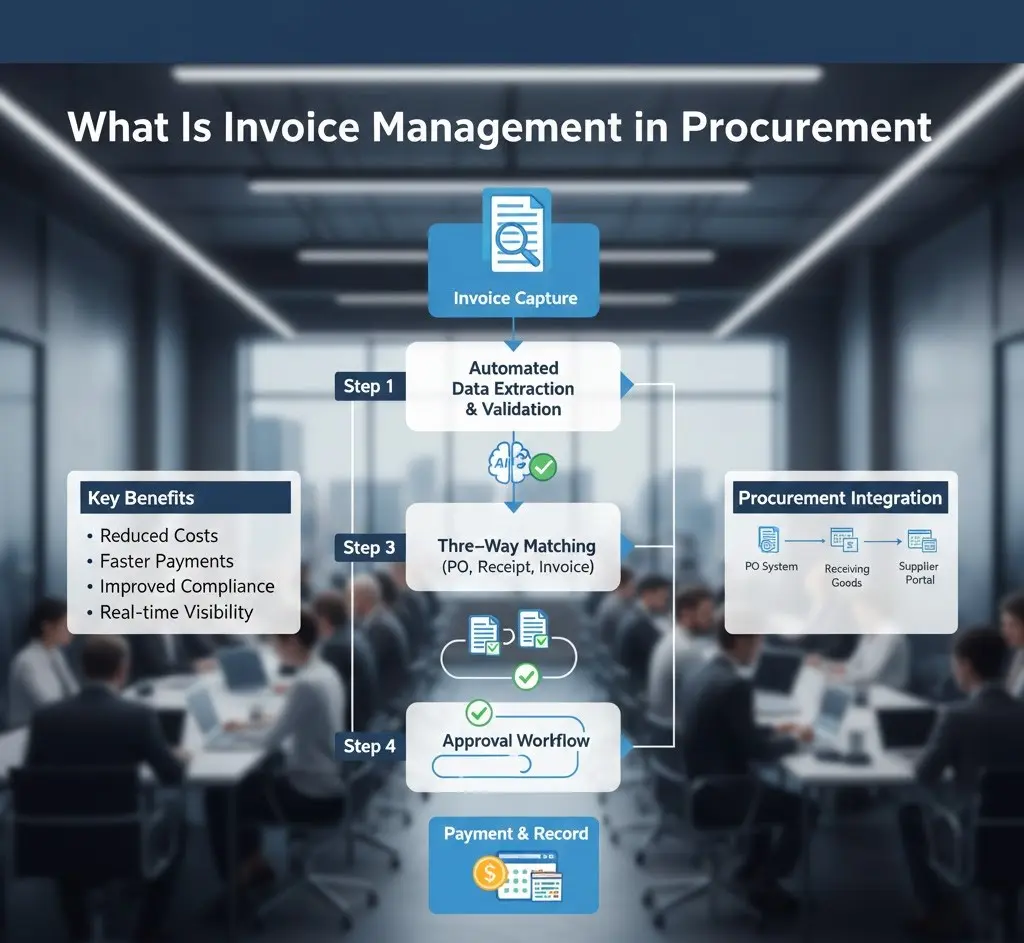
Moreover, switch to an automated process. Systems like ERP will help you with just that. It enables you to monitor orders, track inventory, and ensure that your supplier contracts are compliant. Making MRO procurement faster and safer for businesses.
Ready to optimize your MRO procurement? Contact us today to transform your maintenance and operational efficiency.
The Role of MRO Category Management
MRO Category management is the process of grouping MRO Items. The MRO Procurements are segmented according to their types, criticality, spend analysis, function, etc.
This also involves optimizing the suppliers for all those categories and strategic sourcing for intended operational efficiency.
Usually, an MRO category manager is hired for each category in large-scale industries with multiple assets. Dedicated to his category, he brings out key MRO responsibilities like strategic sourcing, cost management, inventory planning, and more.
Common Cost Saving Approaches to MRO Procurement
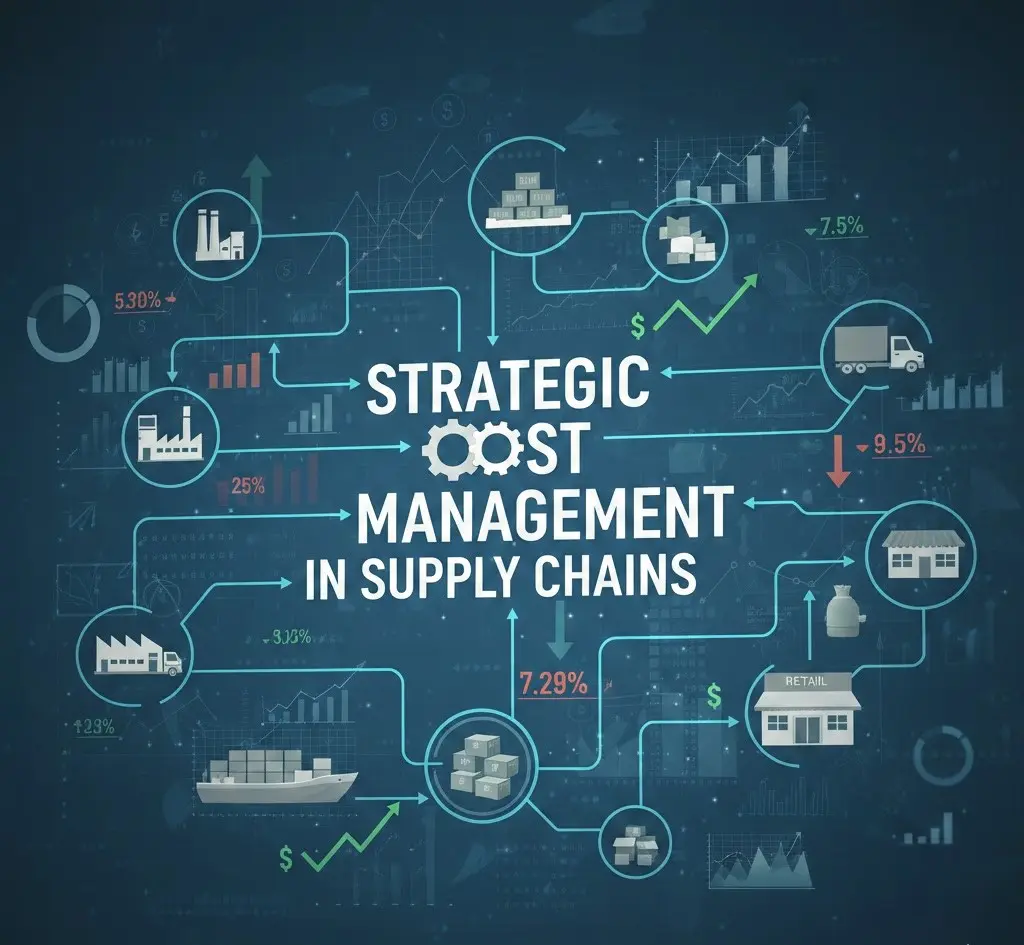
Cost savings are the core of business growth and success. With key MRO procurement practices, you can impact your business’s bottom line and improve turnover. Discover how you can maximize cost savings for businesses with MRO procurement.
1. Examine Your Expenditure
Expenditure analysis is the most crucial step towards optimizing your MRO procurement cost. Understand which MRO material your business has the highest expenditure on. Identify suppliers that are overcharging for certain materials and survey the market for the most competitive prices.
Get contracts negotiated again according to the standard market prices. Moreover, try to negotiate better rates with the suppliers and seek discounts, allowing you to save significantly.
2. Refurbishment of components in the MRO category
Refurbishing material is a good way to reuse the material instead of completely discarding it. Refurbishment plays a key role in saving costs for most of the business’s MRO costs. This accounts for 30-60% in some cases.
Refurbishing MRO plays a key role in avoiding inventory shortages and saving significant costs..
3. MRO Supply Model That Works
There are three major types of MRO supply models. Understanding the correct one for your business delivers the greatest impact on cost savings. The models include the hybrid model, integrator model, and the specialist model.
The integrator model includes sourcing all your MRO procurement to a single primary distributor. The distributor can either manage all the supplies himself or outsource them to third-party suppliers.
The Specialist model involves hiring separate suppliers for each category. The hybrid model involves using a single supplier for most categories. However, only a few technical categories have a special supplier based on the unique business needs.
Businesses that have critical categories that greatly impact their business operation opt for a hybrid or specialised model. Large industrial businesses with a high number of non-technical categories may benefit from the integrator model for simplified supplier management.
4. Review Existing Contracts
Review your previous MRO procurement contracts from time to time. Sometimes, if the contract hasn’t been reviewed for quite a period, you may be purchasing at the historical price.
You need to negotiate those contracts again and may land on more budget-friendly prices than what was previously agreed.
5. Regularly Monitor Your Inventory
Making purchases at the last minute is quite a headache. You may end up paying even more than the standard rates in the market. Be safe from greedy opportunists and plan. Look out for items that are nearly out of stock. Purchase them on time and at a low cost.
Best Practices for MRO Purchasing
● Integrate MRO into a Core Process
Make your organization’s executives connect with MRO procurement. This is how you can impart value to your MRO procurement strategy. Allowing your executives, acknowledge and endorse the key MRO policies being implemented is what could further enhance the enthusiasm and dedication of staff.
Aligning executives with your MRO policies and procedures brings better MRO procurement insights. It allows you to negotiate better contractual terms, avoid downtimes, and ensure the timely accomplishment of maintenance requirements.
● Manage Centralized Inventories
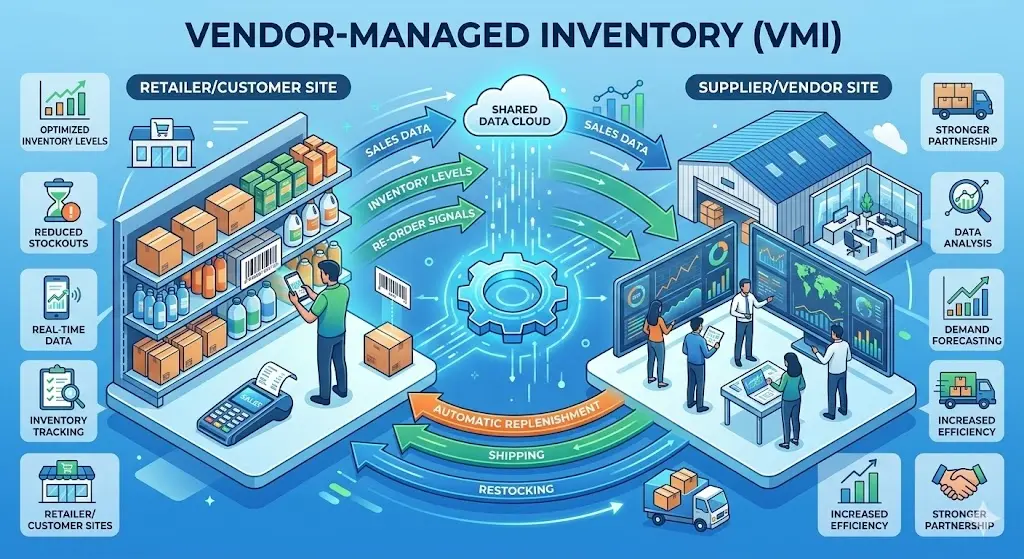
Always look for centralizing your inventory management in one place. This brings countless benefits like reducing costs and avoiding operational risk. Centralized inventory monitoring brings better coordination and a timely response time for repair and maintenance needs.
Suppose you have single MRO warehouses for multiple business locations. Purchasing bulk goods at a discount will be so easy. Moreover, this allows you to have tighter control over what comes into the inventory and what goes out. This enables you to have only the exact amount of stock that you require for all locations combined.
● Outsource Multiple Suppliers
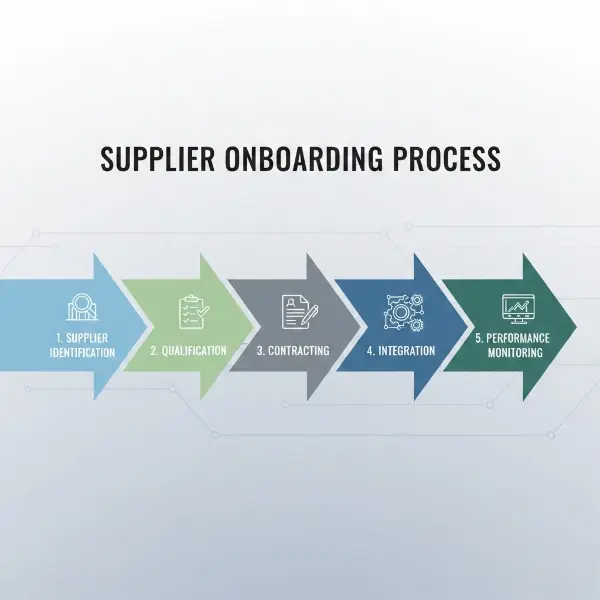
Sourcing suppliers for MRO procurement must be done smartly. Always have multiple vendors and suppliers as a backup. You shouldn’t always be dependent on a single source. If the stock is unavailable or the supplier is facing logistical issues, you must have alternative suppliers to assist you.
That’s how you ensure that the supply chain is never disrupted and you’re always protected from stockouts.
● Utilize E-Procurement and Automated Systems
Make use of e-procurement systems for your business. About 50% to 80% of all procurement tasks can be automated. These automated systems track every repair and maintenance item. They allow automated reorders whenever you’ve been out of stock.
These systems make use of real-time data to make crucial MRO purchasing decisions. It ensures that your inventory is maintained as intended, reducing redundancies and over expenditure.
Challenges in MRO Procurement
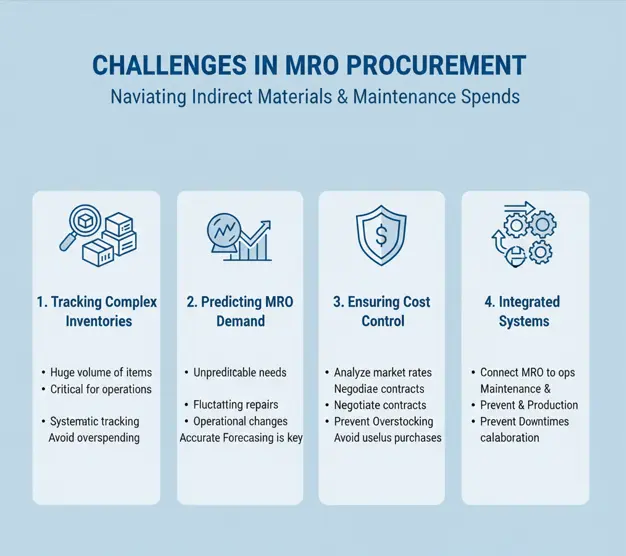
Managing Indirect material procurement is challenging. With such huge categories to look after and recognizing the critical maintenance material is quite a challenge. An MRO procurement manager requires diligence, expertise, and make use of advanced procurement tools for quality outcomes.
● Tracking Complex Inventories
The most difficult aspect of managing MRO procurement is monitoring the large volumes of items that are crucial for running business operations smoothly. You must make sure that every item is tracked systematically and purchased on item, without causing unnecessary burden on the capital.
● Predicting MRO Demand
For any business, the need for MRO items is always unpredictable. The repair and maintenance items may fluctuate at any time. You may at some time have one item in demand due to consistent equipment repair needs, and changes in operational processes may make the need for some material completely useless.
Therefore, forecasting scenarios while considering the operational processes is the key to quality MRO procurement management.
● Ensuring Cost Control
Managing expenditure in MRO purchasing is highly challenging. You need to analyze the market insights carefully. Getting the latest item rates and effectively negotiating contracts with suppliers for high cost savings.
Moreover, avoiding overstocking is also crucial to reducing your business turnover. This material may be rendered useless, sitting in storage for months, without any use. That’s what a MRO procurement manager has to look after to prevent useless, costly purchases.
● Integrated MRO Procurement Systems
Integrating the MRO procurement with the business’s operational process is the most important yet challenging aspect. Integration of maintenance processes, production cycles, and MRO procurement processes is essential to prevent downtimes and disruptions. Effective collaboration is required to be maintained between the procurement and maintenance teams for timely MRO procurement decision-making.
Future Trends in MRO Procurement
The modern IT solutions and technology have turned out as a major factor shaping the MRO procurement. The recent innovations of predictive maintenance in MRO make use Iot sensors and comprehensive data analytics. With updated data, the predictive maintenance systems can forecast system failures before they even occur. This is how critical MRO items can be made available on time.
Studies show that these systems are capable of reducing unexpected downtimes up to a staggering 70%. The technology doesn’t just stop there! The cloud-based MRO management systems have also made inventory tracking and compliance even more efficient than ever before.
These technologies may even optimize MRO procurement processes to a great level; however, they show a heightened cyber threat to business-critical data. Robust IT security measures and cyber solutions are also being implemented to combat such instances and ensure fast, secure, and seamless MRO management.
Conclusion
MRO procurement management is one of the most essential factors of business success. Even if it focuses on the MRO items that are not related to the core product, the impact of poor MRO procurement could be devastating.
With effective MRO purchasing, costly downtimes, reduced productivity, and hindered operational workflows can be significantly prevented. The latest technology is greatly impacting the procurement market. Adapting with such tools allows you to automate processes and forecast scenarios for hurdle-free workflows, greatly.
Ready to optimize your MRO procurement and strategize your sourcing? Pro Procurement is your trusted MRO procurement outsourcing partner for businesses of all scales.
FAQs
What is MRO in procurement?
MRO procurement is the process of sourcing and buying goods and equipment for maintenance and repairs. MRO items involve those items that are not related to the final product. However, they ensure that the materials essential to make facilities and machinery run are readily available.
What are the main categories of MRO items?
There are three main categories for MRO items. Here’s what each item includes:
- Maintenance items: These items are used to keep the equipment and machinery running smoothly.
- Repair items: These items involve tools required to repair the machinery or equipment.
- Operation items: They include daily operational items like safety gear, office supplies, etc.
How can MRO procurement reduce downtime?
MRO procurement can reduce downtime by making sure that all the items required for maintenance and repairs are timely available. By forecasting equipment failures and timely purchasing material to prevent stockouts, MRO procurement assists in preventing costly downtimes in a business.
What is MRO category management?
MRO category management involves categorizing MRO items depending on their types and needs. This structured MRO management helps in easy tracking of procurement and timely purchases, increasing transparency, and making smarter decisions.
What has been the role of technology in MRO procurement?
Technology has been evolving MRO procurement very rapidly. With ERP systems, predictive maintenance, e-procurement, and other latest technologies has made procurement simplified for large businesses. Allowing organizations to automate processes, bring data-driven forecasts, and coordinate more effectively for improved operational efficiency.