On construction projects that run on narrow margins and tighter sequences, supplier onboarding is not an HR checkbox; it is an operational defense mechanism. In the field, a missing endorsement or an incorrect Employer Identification Number (EIN) can stop fabrication, delay shipments, and create schedule impacts that cost of the project.
For construction procurement teams, including general contractors (GCs), specialty subcontractors, and developers, supplier onboarding serves 3 practical purposes:
- It manages legal and insurance exposure.
- It stabilizes payment and tax flows.
- And it protects schedule commitments.
Treating supplier onboarding as mere data entry welcomes risk; treating it as a controlled, auditable process helps you avoid many common failures in construction delivery.
Let’s explore more about supplier onboarding!
What Is Supplier Onboarding?
Supplier onboarding is the formal, documented sequence of checks and system integrations that qualify a vendor to do business with your company and your project. In construction, the scope of onboarding extends well beyond a single W-9 or bank form; it includes:
- Insurance and endorsement checks
- License verification
- Safety program reviews
- Bonding validation
- Contract alignment
- ERP/vendor master setup
A supplier may be acceptable for a small private tenant improvement but fail to meet a state Department of Transportation’s (DOT’s) insurance or registration rules for public work. That variance makes the onboarding project-specific.
The team should take onboarding as a door. Once the suppliers enter the door, they gain access to purchase orders, payment methods, and site reach.
Note: Failures or gaps discovered after gate passage are expensive and politically fraught.
From the field perspective, onboarding is also a communication moment. It’s where expectations for delivery, quality, and safety are clarified. When procurement teams combine technical qualification with clear contractual expectations during supplier onboarding, trade partners understand accountability earlier, and projects run smoothly.
Supplier onboarding works best when aligned with a structured end-to-end procurement strategy.
The Supplier Onboarding Process
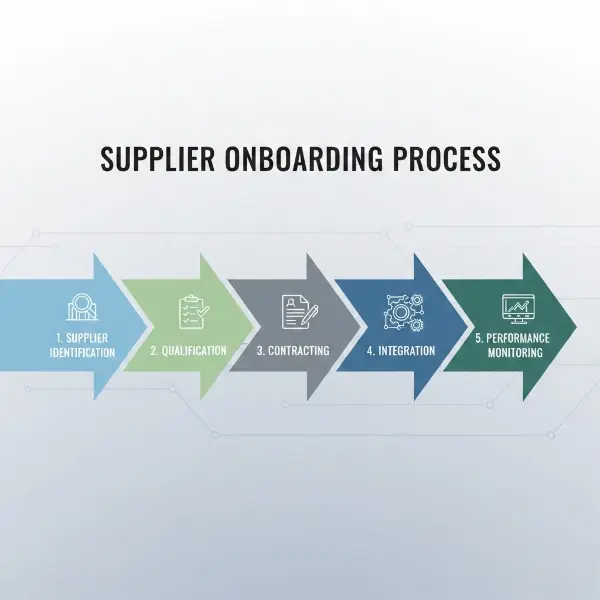
Professional procurement teams use a 5-step process for supplier onboarding. Each phase has its own decision criteria and risk controls. Below are the details:
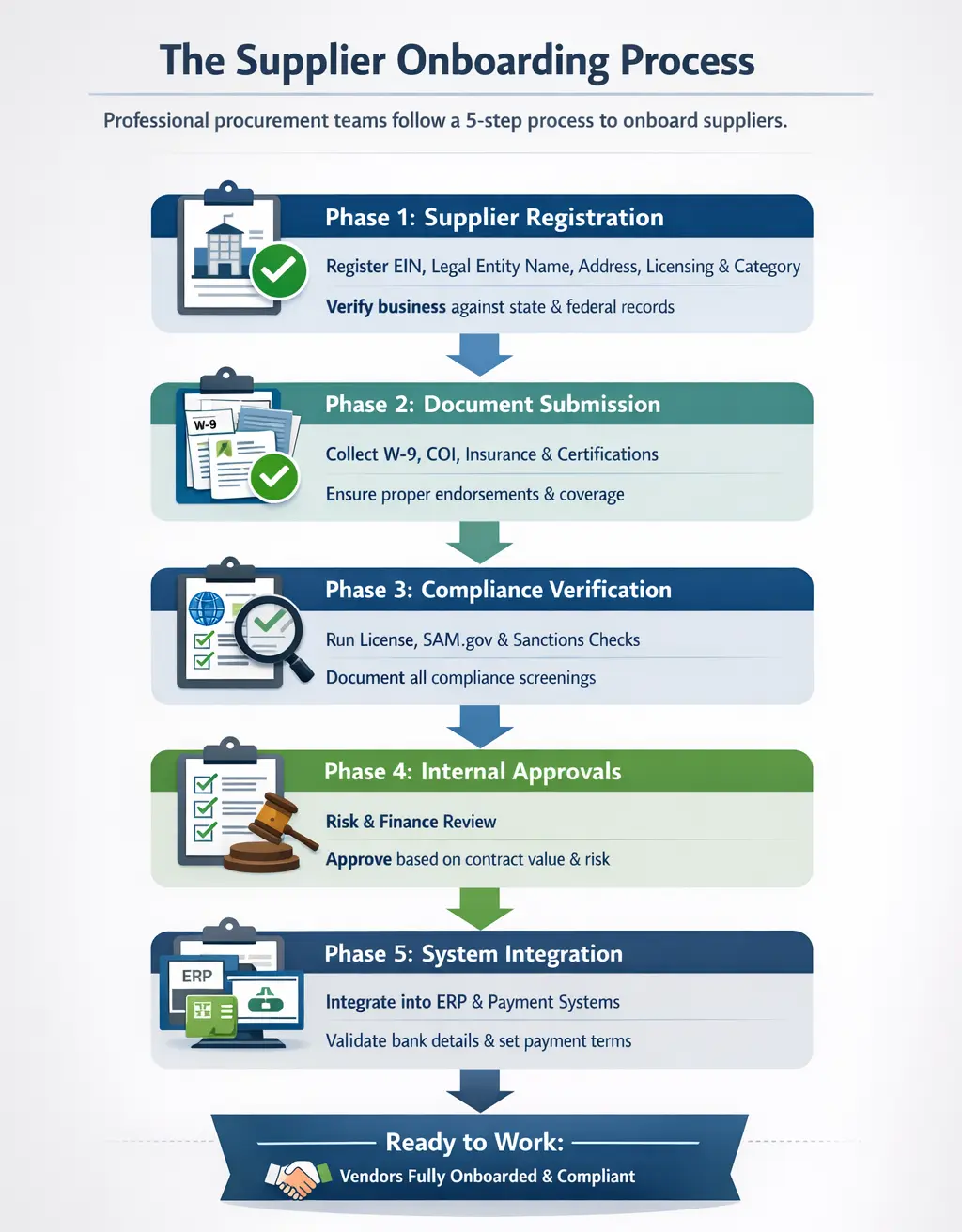
Phase 1: Supplier Registration
Registration is the supplier’s first formal declaration of identity and intent. Professionals ask vendors to get registered through the official portal whenever possible because this registration eliminates email errors and keeps records perfect.
What’s included in the registration?
- Legal entity name
- EIN
- Business address
- Primary contact
- Licensing details
- NAICS or trade category
In practice, professionals verify the legal entity against state filings and federal records during registration.
Here is an example:
While working on a big healthcare project, a vendor registered under a Doing Business As (DBA), while invoices used the legal name. This mismatch almost blocked a 1099 filing and required a mid-project vendor merge in the ERP.
This means that if EIN and the supplier’s legal name don’t public filing, you should stop onboarding until correctness.
Phase 2: Document Submission
Document submission is where many projects fail to control risk. Therefore, experts ask for, at a minimum, including:
- W-9, Certificate of Insurance (COI) with relevant endorsements
- Workers’ compensation certificate
- Evidence of bonding, if required
- Any specialized licenses or certifications specific to the trade.
In construction, not all Certificates of Insurance (COIs) are created equal. Teams check the COI for:
- Additional insured endorsement naming the GC and owner (if contract requires)
- Primary and non-contributory wording to ensure the vendor’s policy responds first
- Waiver of subrogation if the contract requires it
Let’s explore an example! On a mid-rise residential job, a veneer subcontractor’s COI showed $1M limits but lacked the additional insured endorsement. The vendor was allowed on-site pending an updated COI and insurance carrier endorsement. Still, the delay in issuing site permits cost the project two days, plus administrative time chasing the carrier.
Results: if endorsements are missing or puzzling, do not issue site-access permits or POs until they are resolved.
Phase 3: Compliance Verification
Compliance verification covers legal and regulatory eligibility that could disqualify a supplier from public or private work.
The following checks are run as part of onboarding:
- State license verification (cross-state when the supplier will operate in multiple jurisdictions)
- SAM.gov checks for federal projects and debarment lists for public contracts.
- OFAC and sanctions screening for international vendors or payments
- Tax ID validation (EIN match) and 1099 classification review
- OSHA or safety program validation for high-risk trades
You must understand that ignoring producing a timestamped compliance record can increase the risk factor in the project. This causes problems during audits or funding reviews.
Here is an example:
A team was auditing a state-funded school. For the project, procurement had to produce evidence that subcontractor licensing was current at the time of contract execution. The check was documented in the vendor portal, so the audit closed in a short time.
Hence, compliance verification needs to be recorded in an auditable format.
Phase 4: Internal Approvals
Onboarding approvals should reflect risk tolerance. For low-dollar material suppliers, procurement plus finance approval is often sufficient. However, for high-value subcontractors or trades with specialty risk, like structural steel and heavy crane operations, approvals must include risk management and legal review. Therefore, professionals use approval thresholds tied to contract value and trade risk.
Furthermore, the approval path should be automated where possible. Email approvals create trail gaps and slow down execution. For example, one large developer reduced vendor setup time by 30% after implementing an approval matrix integrated with their ERP.
Outcomes: So, map approvals to quantifiable risk related to contract value, trade risk, and regulatory complexity.
Phase 5: System Integration
Complete onboarding creates an active vendor profile in your operational systems: ERP, accounting, procurement, and field systems (e.g., Procore, Viewpoint, Sage).
Do you know that full-and-final onboarding creates an active vendor profile in your operational systems? This includes:
- ERP
- Accounting
- Procurement
- Pield systems
Integration includes bank account validation for ACH payments, applying tax codes, and setting up the vendor’s payment terms.
Regarding security control, any vendor bank detail change must be verified by a second party through a known contact method, and not via the same email thread that requested the change. Automated Clearing House (ACH) fraud is a persistent threat in construction; verification controls are non-negotiable.
Note: Do not release a purchase order until the vendor is visible as Onboarded in the ERP with a compliance package that meets project requirements.
Accurate supplier registration supports structured procurement process flows and prevents downstream compliance issues.
Supplier Onboarding Checklist for Procurement Teams
Using this supplier onboarding checklist, you can keep teams consistent and defensible.
1. Business Details Verification
Validate the legal entity name against state registrations and the EIN. Confirm the trade name (DBA) aligns with invoices and contracts. Record the vendor’s taxonomy (trade, NAICS) for future spend analytics.
This matters because mismatched legal names create tax filing errors and duplicate vendor records that complicate payment and audit trails.
2. Tax and Legal Documents
You know that misclassification can generate penalties and tax liability downstream. So, obtain a current W-9 and document 1099 classification. For contractors that qualify as independent subcontractors vs. corporations, confirm tax reporting implications before awarding a PO.
3. Banking Information
According to studies, ACH diversion fraud has cost construction firms and owners significant sums. Therefore, this demands that prevention be straightforward when enforced.
What you can do is to collect an ACH authorization and a supporting bank letter or voided check. Require two-factor verification for any bank detail changes, including a phone call to a known contact or a verified electronic signature. Also, log bank details securely and restrict who can change them.
4. Certifications and Insurance
Verify COI limits and endorsements. For trades requiring bonding, obtain the bonding letter and confirm the issuer’s rating. Log expiration dates and set automated reminders well before expiry. If you are thinking about its importance, you must understand that insurance and bonding gaps create direct financial and schedule exposure. And remediation after the fact is costly.
5. Contract Review
Do you know what leads to a confusing scope of work and late payment claims? It is unclear language in contracts. To avoid this, you must confirm the contract template, work scope, payment schedules, and holdbacks. Including this, you should ensure that the vendor is clear about the change order process and reporting.
6. Safety & Site Access
You know how safety performance affects schedule, premium insurance experience modifications, and on-site morale. Therefore, you need some smart strategies.
For site work, review the supplier’s safety program, Occupational Safety and Health Administration (OSHA) logs (if applicable), and site-specific orientation requirements. Also, confirm the site supervisor contact and emergency response procedures.
7. System & Reporting Setup
Last, the field coordination depends on consistent vendor data between the office and the site. So, create the vendor in ERP with correct tax classifications, assign payment terms, and configure Purchase Order (PO) approval paths. Ensure the vendor is enabled for field tools if they need to submit daily reports or RFI responses.
Supplier Onboarding Best Practices
A good balance between control and speed leads to a smooth onboarding. Here are some of the professionals’ practices:
● Standardized Workflows with Project Sensitivity
Standardization doesn’t mean one-size-fits-all. It means a repeatable core process with configurable project rules. For example, the core supplier onboarding workflow might be identical across projects, but insurance thresholds and license requirements are adjustable based on whether the work is private, public, or federal.
Operationally, you should maintain a single official onboarding flow with a rules engine that applies project-specific thresholds. This reduces errors and makes audits straightforward.
● Use Automation and Vendor Portals
When suppliers can upload documents to a portal and see their onboarding status, two things happen:
- Administrative cycles shrink
- Data quality improves.
Furthermore, automated COI parsing tools can highlight missing endorsements and send renewal reminders, which reduces last-minute site stoppages.
What you can do is to integrate vendor portals with the ERP. This will ensure that the approved supplier records automatically flow into accounting and field systems.
● Clear, Early Communication
Communicate onboarding requirements as early as the prequalification or bid stage. There are some real-world examples that show fewer insurance and bonding surprises when subcontractors receive an onboarding packet with specific thresholds and sample COI language before bid submission.
So, treat onboarding requirements as part of the procurement package. That way, the supplier knows expectations well before contract award.
● Self-Service Where Practical
Self-service reduces friction for both parties. Suppliers prefer portals where they can upload updated COIs, manage banking info securely, and track pending approval items. Self-service also reduces repetitive emails and increases transparency, which frees procurement professionals to focus on exception handling.
● Defined Approval Timelines and Escalations
Set measurable Service Level Agreement (SLA) targets for onboarding; for example, 3 business days for low-risk suppliers and up to 10 days for complex subcontractors requiring bonding and legal review. Most importantly, define an escalation path for vendors that fail to meet the SLA so field teams are not left chasing approvals without recourse.
Automation and vendor portals are increasingly powered by AI in procurement to reduce manual checks and delays.

Supplier Onboarding vs. Supplier Performance Management
Supplier onboarding is the doorway; however, supplier performance management (SPM) is the ongoing evaluation of how vendors perform relative to the commitments established during onboarding. Both are parts of a supplier lifecycle, and both drive procurement strategy.
Why Keep Supplier Onboarding & Supplier Performance Management Separate?
Onboarding confirms eligibility and mitigates execution risk before work begins. On th other hand, performance management evaluates whether the supplier delivers on schedule, on quality, and with acceptable safety and change order behavior.
From a practical standpoint, onboarding metrics are binary (pass/fail or conditional pass). Performance metrics are continuous, focusing on on-time delivery rate, change order frequency, defect rates, and safety incident frequency.
How to Tie Supplier Onboarding & Supplier Performance Management Separate?
An effective lifecycle process ties onboarding records to performance dashboards. For example, a supplier whose initial onboarding showed weak safety documentation but who then demonstrates measurable safety improvements should have their profile updated. That improvement should be reflected in consideration for preferred vendor lists.
Conversely, feed back recurrent performance issues into prequalification rules. If a supplier shows constant schedule issues, procurement should add more strict pre-award checks. One can also consider alternate suppliers in the future.
Ethical and performance standards should reinforce requirements outlined in the supplier code of conduct.
Common Supplier Onboarding Challenges & Solutions
Here are the most common challenges (and their solutions) you can face:
● Incomplete or Inaccurate Documentation
Smaller subcontractors often lack a dedicated administrative function and will submit incomplete COIs or outdated W-9s.
Solution:
You need to provide a starter packet that lists exact insurance language, sample COI clauses, and a fill-in checklist. When onboarding documentation is explicit and easily consumable, submission quality improves dramatically.
● Insurance Endorsement Ambiguity
Certificates that show limits but lack required endorsements are common.
Solution:
Require the insurance broker to issue an endorsement form or a carrier letter that explicitly names the GC and owner as additional insured with primary and non-contributory language where contractually necessary.
● ERP Duplicate Vendor Records
Duplicate records often arise when DBA names differ from legal names.
Solution
Enforce EIN-first vendor creation rules. If the EIN exists, merge or block the duplicate. A one-time cleanup project followed by strict EIN validation at registration avoids future duplication.
● ACH and Payment Fraud
Email-based requests to change bank details are a serious vulnerability.
Solution:
Implementing a requirement that the request originates from the registered user account (with multi-factor authentication) adds another layer of defense. So, any bank-change request must be verified by contacting a known procurement or finance contact (phone call to the number on file) or by requiring a bank-signed letter.
● Approval Bottlenecks
Approvals that route through multiple stakeholders can delay projects.
Solution:
Define clear approval matrices with time-bound SLAs and an automatic escalation path. When stakeholders know their SLAs and the system escalates automatically, decisions happen faster.
Practical Templates and Workflows
To run supplier onboarding in a way that earns trust from site teams and auditors, use templates that align with legal details and practical field controls.
Below are two templates you can use:
Template A: Standard Vendor Onboarding
When a new vendor is identified, procurement issues the vendor a registration link.
- The vendor completes the legal name, EIN, trade category, and primary contact.
- The vendor uploads W-9 and COI.
- The portal parses the COI and flags missing endorsements.
- Procurement reviews compliance items and routes for approvals based on preconfigured rules.
- Finance verifies bank details via ACH form and phone confirmation.
- Once approvals are complete, ERP setup happens automatically, and the vendor is marked Onboarded. The field is notified that POs can be issued.
Pro Tip: For fast-moving material buys, have a conditional onboarding status. This allows limited purchase orders for non-site-affecting goods, e.g., off-site materials, while requiring full onboarding for site work. This reduces schedule issues while supporting risk controls.
Template B: High-Risk Subcontractor Onboarding
Subcontractors performing critical structural or mechanical scope require pre-award qualification.
- Start with prequalification questionnaires during bidding to capture insurance carriers, safety program summaries, welding certifications, and past project references.
- After the award, require full COI with endorsements, performance bonds (if applicable), OSHA and safety manuals, and a readiness call between the superintendent and subcontractor foreman. Legal reviews contract language for indemnity and change order pathways before execution.
Pro Tip: On vertical projects with complex interfaces, a pre-mobilization readiness checklist, which is verified by a superintendent, eliminates the chances of late mobilization and rework.
Why Invest in Onboarding Controls?
Some organizations treat onboarding as a cost center. However, professionals approach it as a value-preserving activity whose ROI shows up in reduced claims, faster payments, and more predictable schedules.
A few practical ways to assess value:
● Schedule Protection
Onboarding that catches insurance gaps avoids site work stoppage that could cost a day or several days of schedule float. For critical-path trades, a single day saved is often worth orders of magnitude more than the administrative cost of vendor setup.
● Claims Avoidance
Clear contract terms and verified endorsements reduce liability when defects or incidents occur. Insurance gaps increase owner exposure and can lead to costly litigation.
● Cashflow Predictability
Validated banking and tax setup reduces the likelihood of payment disputes that trigger stop-notices and lien filings. Avoiding a lien has tangible costs and reputational benefits.
Strong onboarding controls help reduce procurement costs tied to claims, delays, and rework.
Technology That Improves Accuracy and Speed in Supplier Onboarding
Technology does not replace judgment, but it improves control. A few categories of tools reliably improve onboarding outcomes:
- Vendor management platforms: Allow suppliers to self-service document uploads and provide an auditable onboarding history.
- COI & insurance automation: Analyze COIs and verify endorsement language, highlighting missing items automatically.
- ERP integrations: Automate vendor creation and ensure consistent data across accounting and procurement modules.
- Compliance and screening tools: Automate SAM.gov and OFAC checks and log results with timestamps.
- Secure banking verification: Services that interface with the supplier’s bank to confirm account ownership.
Implementation note: Prioritize tools that integrate with your ERP and field systems. Individually operated tools generate reconciliation work and reintroduce risk.
KPIs for Supplier Onboarding and Ongoing Management
To measure onboarding efficiency and supplier quality, experts track a small set of KPIs that inform daily decision-making. These KPIs include:
- Average onboarding cycle time
- Percent of vendors with expired COIs at the time of PO
- Number of duplicate vendor records created per quarter
- Percentage of onboarding approvals that exceed SLA
- Supplier performance index
Ensure that these KPIs are meaningful and actionable. Weekly or monthly dashboards that highlight exceptions allow procurement leaders to focus on remediation rather than getting slow in a mess.

How to Integrate Supplier Onboarding with Contracting and Risk Teams
Procurement cannot own onboarding alone. On projects with significant risk, contracting and risk management must be part of the onboarding workflow.
Therefore, you must include contracting and risk in the approval matrix for trades that trigger insurance, security, or bonding exposure. You can also create rule-based triggers in the onboarding system to route vendors for legal review when thresholds are met automatically.
For example, any subcontractor over a specific contract value or performing structural scope should automatically require contracting review before an Onboarded status is granted. This reduces last-minute legal interventions and clarifies responsibilities.
Supplier Onboarding and Compliance on Public Projects
Public projects introduce additional requirements:
- gov registration
- Prevailing wage considerations
- Public procurement audits
- Stricter insurance wording
For public work, you need to start onboarding well before contract award. SAM.gov and other federal registrations can take time to activate. And contractors often underestimate the time needed for compliance checks and background screenings.
Pro Tip: Build a public-project onboarding playbook that lists mandatory documents, lead times for each registration type, and process owners for completion. That playbook becomes essential during procurement and audit windows.
Align procurement, contracting, and risk teams early to eliminate delays, reduce compliance gaps, and protect high-value projects.
Commonly Asked Questions
What is supplier onboarding, and why does it matter for construction procurement?
Supplier onboarding is the structured process to verify and approve vendors for project work. It matters because it catches insurance and compliance issues before they affect schedule, payment, and safety.
How long should supplier onboarding take?
With complete documentation and an automated workflow, many suppliers can be onboarded in 3–7 business days. Complex trades or public project registrations can extend this timeline.
How can automation tools help with onboarding?
Supplier onboarding software can be a game-changer. It provides secure online forms for data entry, automatically validates tax IDs and bank details, routes documents for the correct approvals, and integrates approved data directly into ERP or accounting systems. In short, it eliminates much of the manual work (emails, spreadsheets) and creates an audit trail of every step. This results in much faster onboarding: one report noted automated onboarding cut processing time by over 60% compared to manual methods.
Conclusion
Supplier onboarding is a foundational control that reduces downstream risk, supports cash flow reliability, and protects project schedules. For U.S. construction procurement teams, the best onboarding frameworks are practical, documented, and integrated with ERP and field systems.
The playbook you implement should be repeatable yet flexible: enforce the same core checks across projects, but allow threshold configuration for public versus private work. Use automation to remove friction; use human review for exceptions. Tie onboarding outcomes to supplier performance data so that historical delivery and safety records inform future prequalification.
Make onboarding a visible procurement capability, one that your site teams trust and auditing stakeholders respect. When that happens, procurement becomes a proactive partner in project delivery rather than a bureaucratic step.
If you need professional assistance for procurement or supplier onboarding, Pro Procurment’s team is here to assist. Explore services, reach out to our team, and put your needs on the table, so we can give you the best solution possible. Contact us now!