Are you new to the procurement field and looking for clarification about procurement and supply chain management?
Many new professionals get confused at the start of their career due to the similarity between these services. A clear understanding of the difference between procurement and supply chain management is essential to be the master of this field. Businesses should also know the key differences and synergy between these two processes to clearly perform their functions.
This guide is designed for beginners so that they can understand that under the hood, there are major differences between these processes. Let’s read in detail.
Importance of Procurement and Supply Chain Management for Businesses
Behind every product made in a company is the struggle of sourcing materials, manufacturing, and coordinated efforts. The perfection in products depends on the efficient and quality procurement and supply chain process. This is why business owners prefer to hire these services to build their brand image, reduce operational costs, and ensure smooth production.
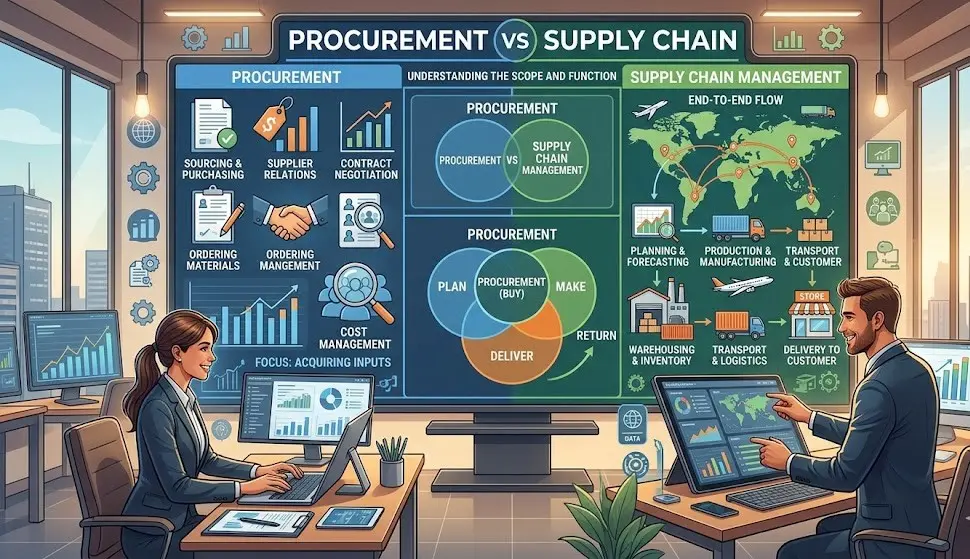
Both procurement and supply chain look similar, but their methodology and purposes are different. Procurement is a subset of supply chain management, not an alternative to stay ahead and satisfy customers with the goods. But first, you need to understand what they do and how. For that, let’s take a look in detail to know in-depth details for procurement and supply chain management.
What Is Procurement?
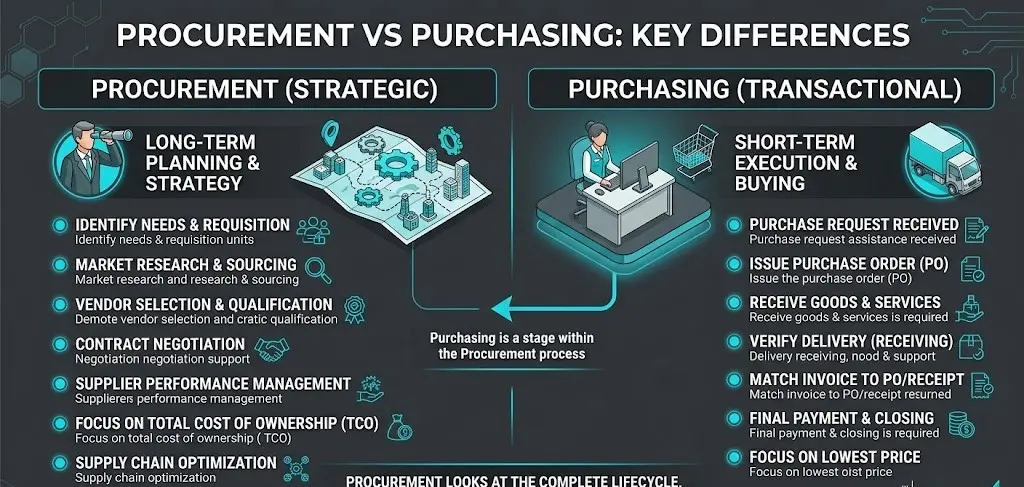
Procurement is the strategic planning for finding reliable suppliers, focusing on negotiating contracts, and purchasing required materials while maintaining material quality and relationships with suppliers.
What Is Supply Chain Management?
Supply chain is a comprehensive mechanism for creating and selling products that includes manufacturing, warehousing, transportation, and delivery. It is helpful to enhance efficiency and meet clients’ demands.
Let’s discuss the objectives and workflow of both processes in detail for a better understanding.
How Procurement Works?
Procurement is a process that consists of several steps. Let’s discuss these steps in detail.
Objective of Procurement
The procurement’s objective is to find out the best reliable suppliers, negotiate, order management, and ensure the timely delivery while maintaining strong relations with the supplier.
Workflow of Procurement
The following steps are involved in the procurement process.
Finding Supplier
The procurement manager will identify the optimal supplier after evaluating the requirements of the company that can supply the goods needed in the organization within the organization’s budget.
The procurement department issues an RFI (Request for Information) to learn more about the supplier’s work and delivery capabilities, and help in selecting the most credible source. Then, they introduce a request for proposals (RFP) with the description of all the required documents, rules, and regulations.
Negotiation And Purchasing
The next step is negotiation with the supplier and preparing a purchase order in which the procurement team enlists the prices and quality of the goods. They also discuss the payment method and delivery time.
Receiving And Record Keeping
The final step is receiving the deliveries, ensuring that the delivery goods and raw materials are of the committed quality and there are no flaws in them. After this, they perform detailed research to provide reports regarding the cost optimization and the probable advantages in exchange for efficient procurement. After that, they keep track of all contracts, purchase orders, and invoice management to guarantee efficient communication and future decision-making.
Benefits of Procurement
If the procurement process is carried out with responsibility and efficiency, it brings many benefits for an organization.
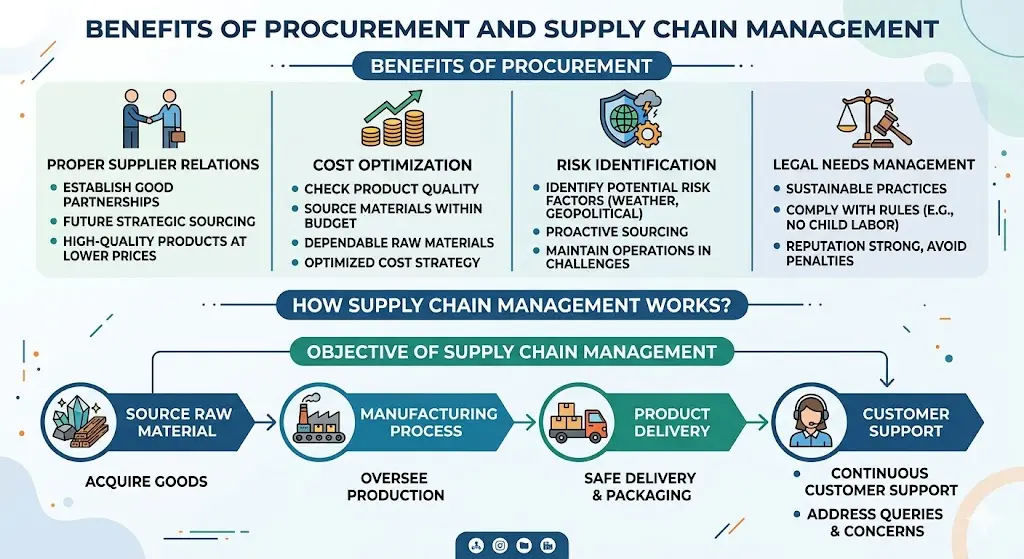
Create Proper Relations with the supplier.
The procurement team can establish a good relationship with the suppliers by explaining that they apply good strategies, and the company can work with them in the future. This is also important in future strategic sourcing. Moreover, by developing a long-term relationship with your supplier, you may have high-quality products at lower prices.
Cost Optimization
The procurement team’s responsibility is to check the quality of the products and find out the sources that deliver desired materials within the budget so that the company can get dependable raw materials and products with an optimized cost strategy.
Risk Identification
The procurement team identifies the potential risk factors, such as weather, geopolitical conditions, or any emergency, that can affect the procurement process. After identification, they can source in a more efficient and better way. This proactive strategy is helpful for businesses to maintain their operational activities even in a challenging environment.
Legal Needs Management
Procurement is not just about sourcing and getting quality goods; instead, it is about getting quality products with sustainable procurement practices while complying with all legal rules and regulations, such as avoiding child labor, and fulfilling the needs of labor, etc. Fulfilling all these needs keeps the business reputation strong and prevents penalties and fines.
How Supply chain management works?
Supply chain management workflow is similar to procurement, but with some additional duties. Let’s have a look in detail.
Objective of Supply Chain Management
The objective of supply chain management is to source the raw material, oversee the manufacturing process, ensure the safe delivery of the products with effective packaging to the customer, and provide continuous customer support by addressing their queries and concerns.
Workflow of Supply Chain Management
Supply chain management workflow consists of the following steps.
Sourcing
The supply chain management process’s first step is sourcing reliable vendors for the import of quality raw materials.
Purchasing
After the agreement with the vendor, the next step is purchasing this raw material with cost-optimized strategies and ensuring that the materials are of good quality.
Manufacturing
The next step for supply chain management professionals is to oversee the manufacturing of the products from the imported raw materials. The SCM professional has to oversee the whole process of manufacturing, such as testing, inspection, and packaging, to ensure that the final products meet the brand identity.
Delivery to Customers
The next step of the SCM process is to oversee the packaging process to ensure that products are carefully packaged as per the brand’s demands and delivered to the client at the distribution centers of brands by fulfilling all rules and regulations.
Customer Service Support
The next and final step of the SCM process is maintaining good relations with the customer by addressing their queries and concerns at the appropriate time.
Addressing the customer return and identifying the issues that cause the return helps the organization to improve the manufacturing process better. Furthermore, getting the feedback from the customer is also a step of the SCM process workflow.
What Organizations Get After Efficient Supply Chain Management
The organizations get the following benefits.
Strategic Sourcing
Through an effective supply chain, businesses get strategic sourcing for raw materials.
Improve Product Quality
As the supply chain management oversees the manufacturing process, by sourcing quality raw material and through a supervised manufacturing cycle, the organization gets improved products with higher quality that meet the demands of the clients.
Cost Control
SCM also helps to control the manufacturing cost by detecting risks and solving them with possible solutions.
Customer Engagement
Effective supply chain management establishes the relationship with the vendor and customers. It controls the cooperation between contractors, stakeholders, and clients.
Understanding of Procurement Vs Supply Chain Workflow with an Example
Let’s explain with an example how procurement and supply chain management work from quality production to safe delivery. Imagine a company that manufactures bicycles; behind each of their bicycle creations, there is a story of struggle. Like, before they can start, they need materials. For this, the procurement team first analyzes what type and size of materials the company needs. In addition to saving money on extra transportation, they find the best transportation means. They then contact the vendors that have reasonably priced frames, chairs, chains, bells, and wheels.
After the order is placed, the procurement team keeps an eye on it, confirms the logistics, and ensures that the goods reach the warehouses on time. When all materials arrive, the supply chain process begins as its job is to supervise the manufacturing process and timely check the inventory management so that the manufacturing team can confidently make a bicycle. Once the bicycles are ready, they distribute them to different retailers for sale.
Now you can easily understand how procurement and supply chain are interlinked and play their role to deliver quality materials, improve productivity, and satisfy customers.
Supply Chain Vs Procurement: A Brief Comparison Table
| Aspects | Procurement | Supply Chain |
| Goal | Acquire goods and cost-optimized, reliable sourcing | Manage end-to-end product flow efficiently from the supplier to customers |
| Scope | They select the best supplier and purchase the material | SCM managers handle everything from procurement and production to distribution |
| Key Stakeholders | Procurement managers and suppliers | Their team oversees manufacturers, logistics providers, distributors, retailers, and customers. |
| Primary KPI | Cost savings, supplier performance, purchase price variance, and contract compliance | Delivery time, supply chain cost, order fulfillment rate, and customer satisfaction |
Strategic vs. Tactical Roles of Procurement And Supply Chain Management
As procurement and supply chain serve different purposes, they require specific strategies and plans. Procurement uses the strategy of recognizing suppliers, long-term contracts, and good relationships that can manage the cost and make the processes efficient. However, buying tactics to monitor deliveries and inventory control (SCM) make sure that the daily processes and procedures are effective and sustainable in the long term.
The Connection Between Procurement, Logistics And Supply Chain Management
They are all deeply interlinked in the process of obtaining materials and serving customers. Each factor has its own responsibility, but the important thing is integration to avoid any kind of defects and material losses.
Buying products from suppliers, and effective logistics ensure that necessary components are transported without issues, and the supply chain oversees the whole process from production to delivery. A flexible supply chain and effective workflow depend heavily on integration among all three factors.
What Similar Functions Perform SCM And Procurement?
If procurement and supply chain management work collaboratively, they can bring long-term benefits to a business. The following are the similar objectives of both processes for which both teams have to cooperate with one another to bring more accuracy for product quality and customer satisfaction.
Cost Optimization
Procurement and SCM play a crucial role in the cost optimization for a company. Although their roles and processes slightly differ, their objective is the same, which is to control the cost. Procurement professionals identify the suppliers, negotiate with them to get the goods and products at an affordable rate while staying within the company budget.
On the other hand, SCM ensures that the material purchased by the procurement is transported with affordable means of transportation to the inventory, and there are enough resources for the manufacturing of the products.
Data-Driven Decision
Procurement teams keep the record of all invoices, order management, and purchase orders, while SCM relies on the data managed by the Procurement teams. Coordination between procurement and supply chain teams for data-driven analysis helps them to make informed decisions for the future.
Effective Sourcing
Strategic sourcing involves the identification of stable suppliers that are long-term useful to the company. The suppliers are determined by the procurement teams based on previous work, production capacity, and financial stability. In contrast, the SCM team analyzes how the selection of suppliers affects the inventory management.
The SCM team analyzes their on-time delivery, transportation routes, and many other factors, and their alignment with the company’s budget. When both teams cooperate on strategic sourcing, they can produce more quality products and choose more trustworthy vendors that help to establish a smooth supply of the material.
Relationship With Suppliers
Procurement teams are directly involved in establishing a strong relationship with the suppliers because they are in contact with them at the earliest stages, such as for purchase, management, and negotiation.
By examining their delivery schedules, transportation logistics, and making sure that suppliers’ production and delivery of goods satisfy manufacturing requirements, SCM teams make sure the supplier selected by the procurement team is dependable. When both teams work together, they may create a safe collaboration with certain suppliers that will benefit the company in the long run.
Procurement, Logistics, and Supply Chain Management Integration in the Future
Businesses are increasingly embracing supply chain and procurement to simplify their operations in order to deal with shifting material prices, consumer expectations, and product quality. These techniques include AI and cloud-based solutions that emphasize order tracking, efficient delivery, and solid teamwork that reduces stress. You also make quick decisions to capitalize on cost-effective opportunities and business growth. This helps you save more money and satisfy your customers with your goods and services.
Since the procurement and supply chain managers manage the goods once they have been ordered, it assists in identifying the supply chain obstacles and solves them within a short time, and enables deliveries to be more secure. Through contracting procurement or supply chain services, you will be able to keep within budget, keep your brand image, and provide better service to your customers.
Streamline your procurement and supply chain processes with expert-driven strategies that reduce costs and boost efficiency
Conclusion
Procurement and supply chain management are crucial for any business’s success. They always go hand in hand, but there are minute differences that are necessary to understand. For a professional, it is essential to understand these differences and the similar points between these processes so that they can work best for their organization and bring long-term benefits.
Frequently Asked Questions
What are the stages of the supply chain process?
The supply chain includes all the steps that are important to delivering a product to customers, from raw materials to final creation, such as sourcing, manufacturing, logistics, and delivery.
How does purchasing improve operational efficiency?
Effective procurement enables you to easily get materials on time and at competitive prices without delays or stock shortages. This helps improve operational efficiency and enhance customer experiences.
Do small businesses need procurement and supply chain?
Yes, even small businesses need supply chain and purchasing to manage supplies, maintain product quality, and control costs.
What is the main difference between procurement and supply chain management?
The procurement process involves strategic sourcing, meeting all relevant rules and regulations. Meanwhile, the supply chain process ensures end-to-end support, from sourcing raw materials to manufacturing and delivering products to clients.
How does the supply chain team reduce costs?
Supply chain professionals are responsible for checking the manufacturing cycle of the product and finding out the reasons for returns of products from customers. This helps them to mitigate the risks and possible issues in the product, and they improve the manufacturing process. Further, they also reduce the material wastage. Both these practices reduce the cost.