A lot of businesses mix up procurement and purchasing. People are so unbothered about knowing the real meaning and differences between the words. They just use them as they have the same meaning. And no listener tries to correct them or tell them the correct meaning.
But the difference actually matters.
- It affects how a company spends money.
- It affects how suppliers are chosen.
- It affects long-term costs.
Purchasing is simply buying something when you need it. Procurement is everything that happens before and after that buying decision.
If a company only focuses on purchasing, it usually reacts to problems. Something is needed; it simply gets ordered, and that’s it.
No problem is complicated when you glance at it for once; it always starts to get complicated over time. Companies that treat procurement as just “placing orders” often overpay, work with the wrong suppliers, or deal with contract issues later. Companies that treat procurement as a strategy usually have more control and fewer surprises.
Introduction to Procurement and Purchasing
Procurement and purchase are the core elements in the business that help it to grow reliably and without causing any chaos. They help the companies to get the actual product on time and within budget. Here is the detailed information one needs to understand and distinguish between these two concepts.
What Is Purchasing?
Purchasing means when a person buys something.
When a specific department wants something according to their needs, they specify the need, place the order, the supplier delivers the required product to them, and eventually, they get the invoice.
It is mostly operational work, the flow is smooth, and it also makes sure that the material is available when required at the hour of need. When a person is purchasing something, these are the things to keep in mind:
- Is the order accurate?
- Is the price correct?
- Was it delivered on time?
- Does the invoice match the order?
It is important work, but it is mostly about handling transactions properly.
What Is Procurement?
Procurement includes purchasing, but it doesn’t mean simply placing orders haphazardly. It involves thinking carefully before spending money. When a company needs something, procurement does not jump straight to buying it. The team first asks simple questions. Do we really need this right now? Will we need it again next month? Are we already buying the same thing from another supplier? This step helps avoid waste.
Procurement looks at these details before money leaves the company account. Then comes negotiation. Contracts are also part of procurement. The terms are written clearly to make sure the delivery meets the deadline and the quality of the product. If something goes wrong, both sides know what was agreed.
Procurement is simply being careful and organized before spending. It protects the company from repeat mistakes and poor supplier choices.
Why the Difference Matters
This is not just about definitions. When procurement is handled properly, companies avoid rushed decisions. They avoid working with unreliable suppliers. They avoid paying more than necessary.
When everything is treated as simple purchasing, decisions are often quick and reactive. There won’t be much time for a person to plan, negotiate, and settle the scores properly. Over time, that costs money.
Procurement helps companies to minimize any risk of loss. It helps them keep a check and balance on their spending and maintain good relations with their suppliers. Rushed decisions are always risky; procurement helps you make more pre-planned decisions.
What Is the Purchasing Process?
Now let’s talk about the purchasing process in simple terms. The purchasing process is the step-by-step way a company buys something. It keeps things organized and controlled.
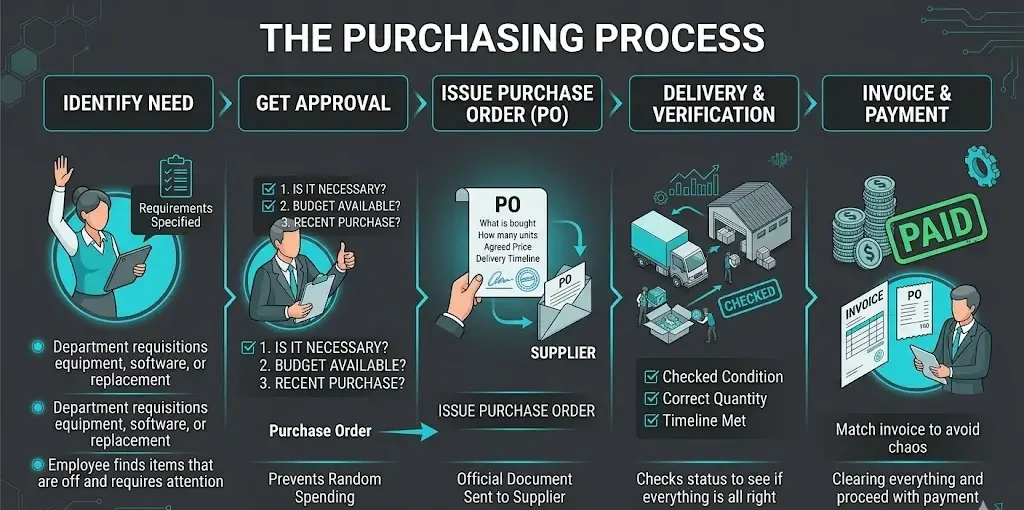
Someone Identifies a Need
When a department feels the need for something, they specify their requirements, whether teams need new updated software or whether already existing equipment needs to be replaced. When an employee finds something is off and requires management attention, they submit a request and explain what is needed.
Approval
The request goes to a manager. The manager checks:
- Is this necessary?
- Is there a budget available?
- Has this already been purchased recently?
Approval matters because it prevents random spending.
Purchase Order
Once approved, a purchase order is created. This is an official document sent to the supplier.
It clearly states:
- What is being bought
- How many units
- The agreed price
- Delivery timeline
Delivery and Verification
The supplier makes a delivery to the mentioned address. The company checks the status to see if everything is all right or if there’s something wrong and needs correction. They correct the things before the payment process proceeds.
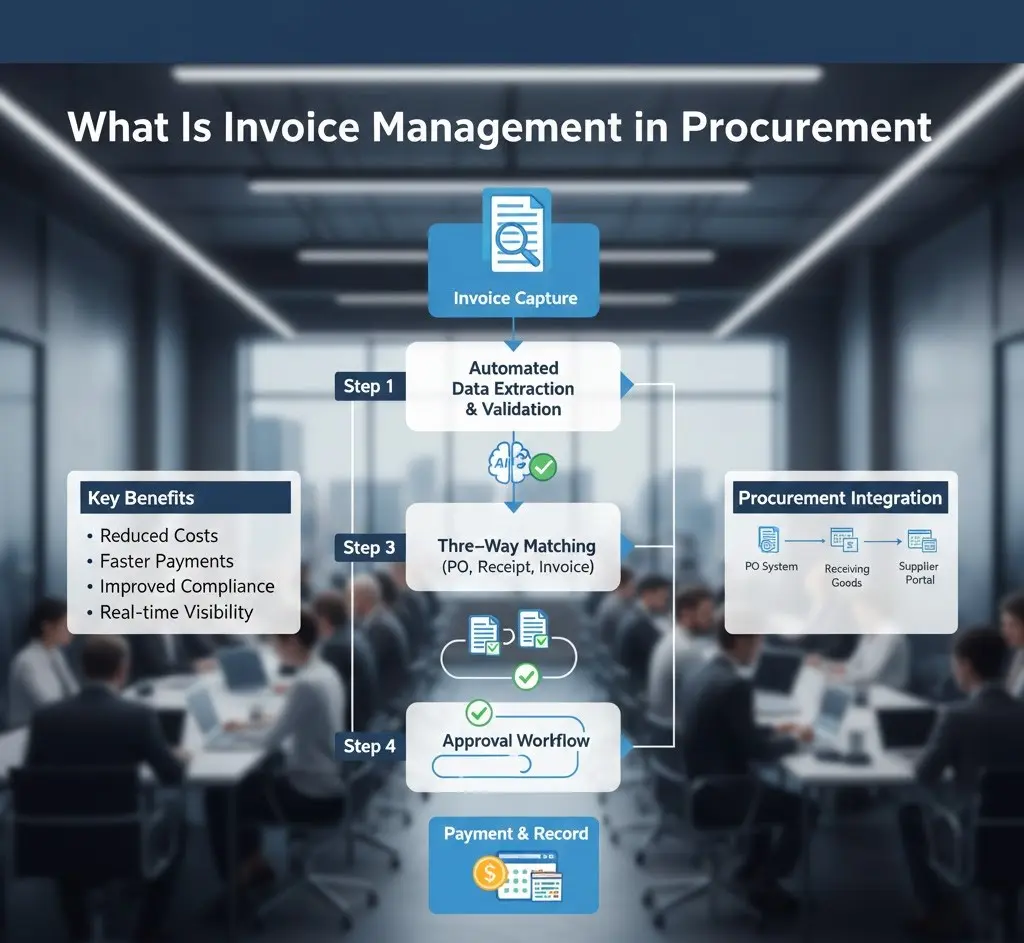
Invoice and Payment
When the supplier is done with his job of supplying goods, he sends the invoice.
Then the finance department matches the ordered and received items from the invoice to avoid any chaos and keep things on track. After checking and clearing everything, the team then finalizes and proceeds with the payment.
What the Purchasing Process Does Well
The purchasing process keeps spending controlled. It helps in managing the proper documents, keeps them organized, and helps in avoiding any unnecessary hassle. But here’s the important part. The purchasing process does not deeply question whether:
- The supplier was the best option
- The contract terms were strong
- A better long-term deal was possible
It handles the transaction. It does not always handle the strategy. That is where procurement comes in.
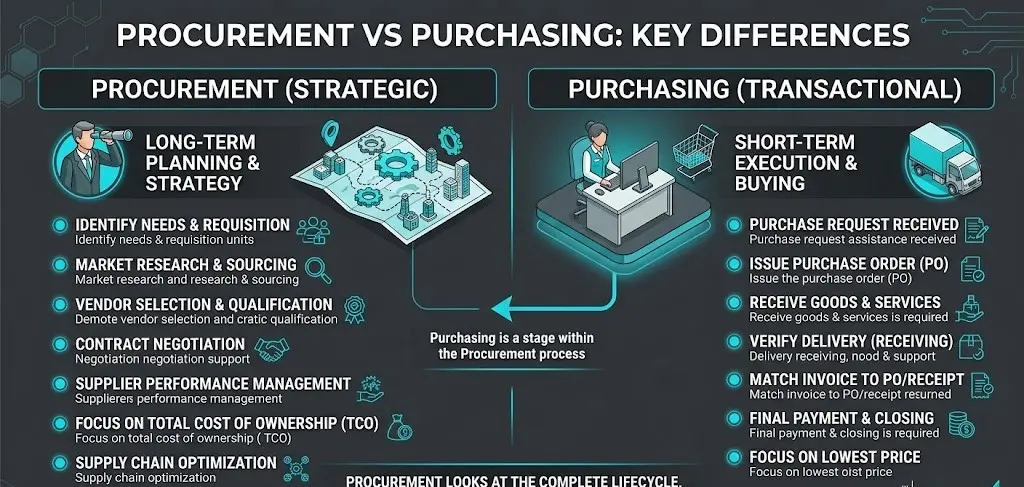
Procurement vs Purchasing
Now let’s make it simple. Purchasing is the act of buying. Simply, when a person feels the need for something, let’s suppose a chair, he orders the chair, gets it from the supplier, and an invoice is generated. Procurement starts earlier. It asks, “Why are we buying these chairs? Are we expanding? Replacing broken ones? Do we already have a supplier contract for furniture?”
Purchasing handles the transaction. Procurement handles the thinking behind the transaction.
Purchasing focuses on getting the item delivered. Procurement focuses on the overall procedure of where we buy, what the need of this purchase is, and how it’ll benefit the company for a long period of time.
Purchasing looks at the price in the quotation. Procurement looks at the higher cost, delivery charges, warranty, service support, and replacement policy.
Purchasing deals with one order at a time. Procurement builds ongoing relationships. It keeps records. It reviews supplier performance. It notices patterns like late shipments or price increases.
Both roles are needed. A company cannot run without purchasing. But without procurement, buying becomes reactive. Different departments choose different vendors, and prices vary. Procurement brings structure, whereas purchasing executes it.
| Basis of Comparison | Procurement | Purchasing |
| Definition | Procurement is the complete process of planning, sourcing, negotiating, and managing suppliers. | Purchasing is the process of ordering and paying for goods or services. |
| Scope | Procurement is widely used in businesses. It covers everything from identifying needs to managing supplier performance. | Purchasing focus is limited in today’s world. It focuses only on the buying transaction. |
| Focus | Deals with a proper strategy. It looks at long-term value and overall cost control. | Purchasing is more focused on operations. It focuses on completing purchases correctly and on time. |
| Timing | Starts before buying and continues after the purchase is completed. | Begins with a purchase request and ends with payment. |
| Cost Approach | Consider the total cost of ownership, including long-term expenses. | Mainly considers the price at the time of purchase. |
| Supplier Role | Builds and manages long-term supplier relationships. | Handles order placement and delivery confirmation. |
Why Businesses Get Confused
Why is there this confusion between these two terms, and nobody bothers to make things clear? Actually, everyone is so busy with their business and day-to-day most important tasks that they don’t mind checking or researching them. Here is the smallest confusion in understanding this concept, which makes a big difference in its meaning.
When a person places an order, people say they handled a procurement. Whereas, when someone tries to negotiate price and handle things as if they had proper planning in their mind, such as how much they can spend on this thing and why they need it, then people consider it a purchase. That’s a small boundary line difference, and those people don’t know about it.
In small offices, one person may handle everything. They simply contact the suppliers, discuss things, place the order, and receive it. Later, they approve the invoice. For them, it is all just “buying stuff for the company.”
No one stops to separate strategy from transaction.
Another thing is when you don’t pay attention to things in their earlier stage, and when the actual time comes, you sense the feeling of urgency, then they mostly prefer ‘just get it done.’ In those moments, nobody thinks about long-term supplier plans or better contract terms. Over time, buying becomes routine, and planning gets ignored.
When that happens, costs slowly increase. Every department’s needs are different, and so are the prices of the material required by the specified department. Contracts are not reviewed. And at the end, when they feel their budget is getting tight because they didn’t pay attention to the details at the start.
How to Optimize Your Procurement Purchasing Strategy
Optimizing a procurement purchasing strategy means improving the overall process of buying products and services in order to reduce costs and increase efficiency. Companies typically use two main approaches to optimize their procurement strategy.
- Procurement Automation
- Shifting from Lowest price to TCO
Automation in the Purchasing Process
Automation means using digital tools and software to complete tasks faster, more accurately, and with greater efficiency. Automation in purchasing includes getting the purchase orders (PO), then researching the best suppliers and comparing the best available options, getting approvals, and finally processing the invoices.
Research shows that automation in the purchasing process is transforming the whole procedure and making it more effective for business growth.
| Note |
| 2026 is not the start of automation in procurement. As of 2025, 66 percent of businesses witnessed an increase in total revenue after using AI applications. If you are thinking about using AI in your procurement or supply-chain model, now’s the time! |
This is not about getting a good price for a certain product using AI. Automation involves the use of digital forms and automated/cloud-based routing of requisitions to the right personnel. Moreover, it helps in streamlined PO generation and receipt analysis without a manual workforce. All of this helps improve approval rates and reduce the overall hassle of purchasing goods.
Automation has replaced manual labor with its more reliable services. Companies are taking advantage of using software, as the data processed by them is error-free, and most importantly, it improves the complete transaction process as well.
Shifting from Lowest price to TCO
TCO stands for Total Cost of Ownership. A few years ago, firms often confused TCO with the lowest purchase price. However, modern procurement practices recognize that these two concepts are different. Organizations now prefer total cost of ownership over the lowest purchase price. There are several reasons why TCO is preferred. Unlike the lowest purchase price, TCO considers the total cost incurred throughout the lifecycle of a product or service.
This includes transportation, installation, service maintenance, operational, and processing costs. Additionally, it also includes repair costs in case the product is damaged or does not meet the claimed quality. This shows that if a business relies solely on the lowest purchase price, it may face other hidden costs such as transportation, installation, maintenance, energy consumption, and replacement costs if the product needs to be replaced.
Therefore, companies choose the TCO approach because it prioritizes suppliers who provide the best long-term value rather than focusing only on the lowest purchase price.
Why This Difference Matters for ROI
When a company understands procurement vs. purchasing, it becomes more careful with money. Procurement makes people think before spending, and it alone helps in reducing waste.
Better planning often leads to better contracts, and better contracts mean stable prices. Stable prices make budgeting easier, and strong supplier relationships also reduce stress and any unexpected delays.
Return on investment is not just about increasing sales. It is also about protecting profit. When spending is organized, the company keeps more of what it earns.
Conclusion
Purchasing is simple. You need something; you ask the management to order it. They place the order for you and get it received from the supplier. Procurement is the thinking behind that order. It asks why, how, and from whom. If a business ignores procurement, buying becomes random.
If it handles procurement properly, spending becomes controlled. The difference may not look dramatic on paper. But in daily business life, it changes how stable and organized the company feels.
FAQs
1. What does “procure” mean?
Procurement means thinking carefully about spending before placing an order. It involves proper sourcing and planning before purchasing a product, including identifying what is required, how much is needed, why it is needed, and when it must be purchased.
2. What is the difference between buying and procurement?
Buying is a direct process; a person feels the necessity of a thing, they go to the store, grab the product, pay for it, and receive the item.
Procurement is a lot more than this. It requires pre-planning and knowing what exactly is required, its quantity, and the timeline to get it before that. Not only this, but also negotiating, placing the order, dealing with the contract, and at last reviewing the product.
3. Is purchasing part of procurement?
Yes, purchasing is a part of procurement. Purchasing is one of the steps that come in the whole process of procurement. Purchasing is one step in the whole process.
Procurement plans. Purchasing executes it.
4. Why do companies need a procurement strategy?
Companies need a procurement strategy because there is no clear path without clear planning. When a need arises, departments buy from different suppliers, not knowing the price differences, and in the end, the company faces a loss. A strategy brings some control and keeps things organized.
5. Can small businesses benefit from procurement planning?
Definitely, even a small company can lose money through poor buying decisions. When purchases are planned, budgets are easier to manage.