On jobsites, you see procurement issues in different forms: labor sitting idle; teams waiting for materials; the mismatched anchors available on site (no use). All these issues can increase the project timeline.
When it comes to construction, inventory behaves differently. Teams distribute the materials across shifting laydown areas and temporary storage, which is exposed to weather and theft risks. Furthermore, teams consume materials in a strict sequence where one late item can make others temporarily useless. That’s why vendor-managed inventory (VMI) is getting serious attention.
The goal isn’t to hand your jobsite over to a supplier; however, it is to build a controlled system where the right party takes the lead on managed inventory, while the contractor keeps governance, transparency, and cost control.
This article breaks down the details of VMI. Let’s read together!
What Does VMI Stand For?
VMI stands for Vendor-Managed Inventory. In many business contexts, you’ll also hear it called Supplier-Managed Inventory.
What is VMI?
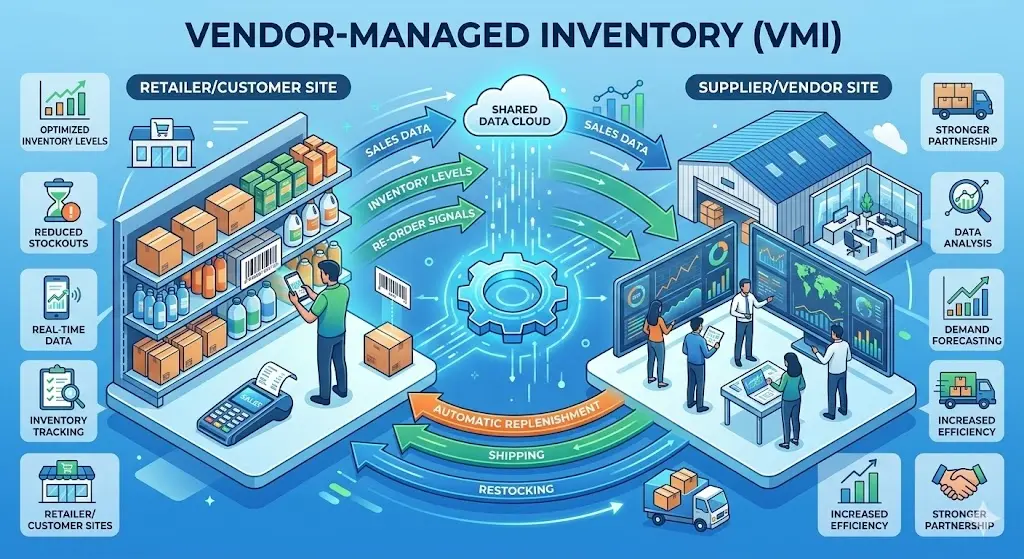
It is a collaborative inventory model where the supplier monitors the buyer’s inventory levels, using shared data, and initiates replenishment to keep stock within agreed targets.
As per NetSuite, VMI is a strategy where suppliers assume responsibility for managing and replenishing customers’ inventory, using access to the customer’s inventory data to decide when and how much to replenish.
SAP similarly highlights that VMI depends on synchronized data and formal agreements that cover delivery schedules, replenishment levels, and integrated technology; the supplier is responsible for managing inventory using real-time information.
The Role of VMI in Supply Chain
From a supply-chain mechanics standpoint, VMI changes what the supplier reacts to. In traditional replenishment, upstream partners often see purchase orders, which are already a distorted demand signal. A study describes how demand information transferred as orders can become distorted as it moves upstream, leading to bigger swings in production and inventory than the actual end demand.
In VMI, the supplier can instead react to inventory position, consumption or sales signals, and shared forecasts. This reduces avoidable variability and improves replenishment timing.
VMI Role in Construction
Construction is project-based, with uneven consumption patterns driven by sequencing, mobilizations, inspections, and rework. That’s precisely why replenishment needs to be tied to real usage and what’s scheduled next. A construction guidance describes just-in-time (JIT) as aligning the schedule and material transportation to reduce waste.
VMI can become a practical method to support JIT, especially for repeatable, high-frequency items. It makes replenishment less dependent on manual reordering and more dependent on controlled consumption signals.
Benefits of Vendor-Managed Inventory
Vendor-Managed Inventory is often described as a data-driven initiative where suppliers manage inventory levels of their own products at the customer site, or another agreed location, to reduce shortages and surpluses. For construction teams, the value is more about predictable field execution.
Below are the benefits of VMI:
● Streamlined Inventory Management
VMI reduces the contractor’s time spent on routine reordering by shifting replenishment planning to the supplier. All is done by defining the replenishment rules and service levels up front.
In practical terms, project engineers can spend less time chasing routine POs for consumables and more time on submittals, long-lead expediting, and coordination issues that actually drive schedule risk.
● Reduced Inventory Carrying Costs
A core promise of VMI is improved alignment between stock and actual demand, which can lower excess inventory and associated carrying costs. This aligns with lean or JIT principles of reducing waste by avoiding unnecessary inventory and movement.
● Precise Production and Delivery Scheduling
When suppliers see consumption and forecast signals earlier, they can plan production and deliveries more accurately. A study on VMI emphasizes shared data and closer collaboration to improve supply chain responsiveness and reduce reactive conflicts.
● Timely Replenishment and Higher In-Stock Confidence
VMI is designed to increase availability by letting suppliers monitor stock levels and replenish based on agreed thresholds and shared data. It has eliminated the need for waiting for the contractor to notice shortages.
In construction, this is most valuable for stop-work items like fasteners, abrasives, drill bits, or PPE. They can shut down productivity disproportionately to their unit cost.
● Better, More Collaborative Working Relationships
VMI requires a partnership mindset of shared visibility, agreed KPIs, and reliable information exchange. Professionals consistently frame success as dependent on clear KPIs, timely data sharing, and service-level agreements (SLAs).
● Optimized Inventory Levels Using Real Consumption Signals
Many VMI models rely on point-of-use consumption capture instead of a lumpy purchase order history. Practically, that means scanning, RFID, weight sensors, or controlled dispensing can produce higher-quality signals than monthly PO volume.
● Resilience and Risk Reduction
Contractors adopt VMI because it reduces job risk. In other words, you experience fewer shortages, less rework due to wrong items, better visibility into what’s actually on site, and fewer emergency orders. As per a construction inventory guidance, inventory control is essential to keep projects on schedule while avoiding waste or loss.
● Supplier Benefits
A supplier that gets earlier, cleaner signals can plan replenishment routes, warehouse picks, and production capacity more effectively. A study says that data sharing and partnerships are the backbone of the model.
How Does Vendor-Managed Inventory Work?
VMI is a collaborative operating process built on governance, technology, and performance measurement. Below is the detailed process: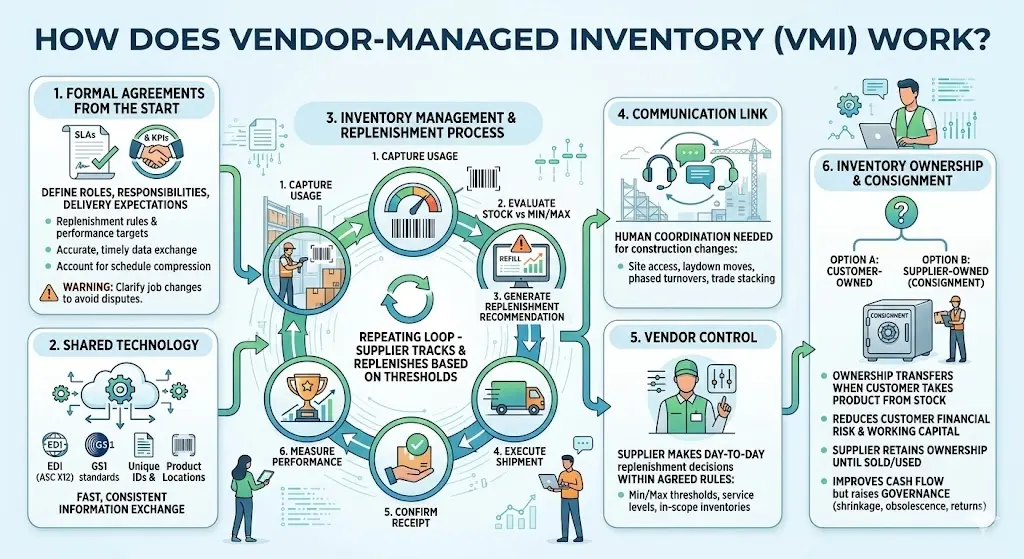
● Formal Agreements from the Start
Best practice is to contractually define roles, responsibilities, delivery expectations, replenishment rules, and what constitutes success. In other words, you must factor in SLAs and agreed KPIs, along with the need for accurate, timely data exchange.
Note: If you don’t define what happens during schedule compression, you’ll fight about supplier performance when the job changes, but the SLA didn’t account for it.
● Shared Technology
VMI depends on fast, consistent information exchange. On large U.S. supply-chain programs, Electronic Data Interchange (EDI) remains a common mechanism for standardized B2B document exchange, and ASC X12 is a major U.S. EDI standards body (chartered by ANSI) that develops and maintains EDI standards used to run business processes.
Separately, GS1 standards focus on uniquely identifying products/locations/assets and automatically sharing information. It is foundational when multiple parties must agree on what an item is across systems.
● Inventory Management and Replenishment Process
Most mature VMI processes follow a repeating loop:
- Capture usage
- Evaluate stock position vs min or max
- Generate replenishment recommendation
- Execute shipment
- Confirm receipt
- Measure performance.
The model has suppliers tracking inventory and replenishing based on agreed thresholds, reducing manual work compared with traditional ordering.
● Communication Link
Even with EDI and portals, construction VMI still needs human coordination because jobsites change. In other words, you can face access constraints, laydown moves, phased turnovers, and trade stacking on site.
● Vendor Control
In a VMI arrangement, the supplier makes day-to-day replenishment decisions, but the rules of the road bound those decisions. This includes min or max, service levels, and what inventories are in-scope.
● Inventory Ownership
One of the most misunderstood items in VMI is ownership. Some VMI arrangements involve supplier ownership until the customer consumes the goods, which is consignment. According to a study, ownership is a key question, and consignment is the case where ownership transfers when the customer takes the product from stock.
Consignment inventory is widely defined as a model where the supplier retains ownership until the product is sold or used. This can reduce the customer’s financial risk and working capital requirements.
Remember that consignment can improve cash flow, but it raises governance requirements because someone must own shrinkage, obsolescence, and returns.
Risk Factor in Vendor Management Inventory
VMI’s upside is real, but so are the failure modes. Below are some of the risks connected with VMI.
● Lack of Control and Dependency on the Supplier
Contractors worry about losing control over site availability. This is valid because VMI moves daily decisions upstream. Mitigation is not micromanagement; it’s governance: SLAs, transparent KPIs, and exception-based visibility, so the contractor can intervene when risk is emerging.
● Ill-Suited Systems and Messy Data
If item masters don’t match, locations aren’t defined, or consumption capture is inconsistent, the supplier will either overstock just to be safe or understock because the signal is wrong. Therefore, there is a need for correct, timely, and accurate data before fully launching.
● Communication Failures
Construction changes weekly. When look-ahead plans shift, and the supplier isn’t informed, replenishment drifts out of alignment. This is why many effective VMI programs maintain operational checks and reviews even when replenishment is automated.
● Data Security Concerns
VMI requires sharing inventory positions and sometimes schedule or forecast signals. NIST’s Cybersecurity Framework is explicitly designed to help organizations assess, prioritize, and communicate cybersecurity risk, including for external communication and broader risk management integration.
For a pragmatic baseline, NIST SP 800-53 provides catalogs of security and privacy controls that organizations use to protect confidentiality, integrity, and availability.
● Inflexibility to Market or Project Changes
Rigid min or max rules can break when the project schedule changes or supply disruptions hit. The answer is not abandoning min or max; it’s adding exception logic and scenario planning, combining usage signals with forecast inputs. Using robust forecasting and automation capabilities alongside data sharing can be a plus point.
● Change Management Risk
Your own note about transformation failure is directionally consistent with widely cited transformation research. McKinsey has stated that transformation efforts fail 70% of the time, emphasizing that mindset and execution matter.
In construction, supervisors don’t scan withdrawals; if the stockroom isn’t controlled, or if cost codes aren’t captured at the point of use, the VMI signal degrades and then both sides blame the model instead of fixing the adoption.
Proven Approaches for the Best VMI
VMI succeeds when it’s treated like an operations system. Below are some best practices:
● Open and Transparent Communication
Ensure transparency, focusing on exception reviews, upcoming phase changes, and constraints. Accurate data exchange and regular alignment keep things on track.
● Clear Roles, Responsibilities, Boundaries, and Fees
Define who owns the min or max policy, who approves substitutes, how returns are handled, and how project closeout inventory is reconciled.
● Training and Support
Train field teams on the WHY while focusing on fewer stockouts, less downtime, and better cost coding. This is particularly important given the risk of transformation failure if adoption is weak.
● Stamping Out Data Points
When different teams keep their own counts, the conflict between teams reduces. Standardized identification, GS1 concepts, and consistent capture methods reduce confusion.
The Role of the VMI System
The VMI system is the control tower that turns consumption signals into replenishment actions. It consolidates on‑hand balances, min or max policies, lead times, and forecast inputs, then publishes what the supplier should ship and when.
In construction, that means translating messy point‑of‑use usage into a clean replenishment plan that aligns with the future schedule. A good VMI system also provides audit trails, exception alerts, and KPI scorecards, so neither party is flying blind when conditions change, and it integrates with ERP, EDI, and barcode/RFID capture. Hence, the data stays current, not theoretical.
How to Choose the Best VMI System
When contractors evaluate a VMI system, they usually decide based on field realities first and technology second. You should prioritize features that map to those realities:
- Inventory visibility and collaboration: Real-time visibility into replenishment status and on-hand levels is the baseline; VMI models rely on shared visibility and timely data exchange.
- Seamless integration: If you can’t connect ERP or procurement platforms to replenishment logic, you’ll shift back to manual workarounds. EDI standards exist specifically to standardize business transactions between partners.
- Shared forecasting: Strong VMI requires forecasting and automation capabilities, not just reactive ordering.
- Real-time data updates: RFID or IoT and controlled dispensing can produce the dependable consumption signals VMI needs. RFID is widely positioned as enabling tracking and identification for inventory and assets, including construction contexts.
- Cloud access: For distributed projects, cloud access supports remote visibility and faster issue resolution, especially when supplier teams also need access.
- Scalability and usability: If the supervisor and stockroom runners won’t use it, the data won’t exist. VMI success guidance emphasizes the need for correct data and practical execution, not just theory.
The Role of Vendor Managed Inventory Software
VMI software is often the operational layer that lets suppliers monitor buyer inventories, manage min or max policies, and make replenishment decisions based on usage, and not just purchase orders.
As an example, eTurns describes TrackStock’s Min-Max AI dashboard as calculating savings opportunities by optimizing inventory levels for consigned or non-consigned inventory, and supporting visibility into stockroom and vehicle inventory.
Construction trade coverage also describes how min or max dashboards can recommend optimized min or max levels based on usage analytics and support consumption tracking and digital kanban with RFID.
How to Implement VMI in Your Company?
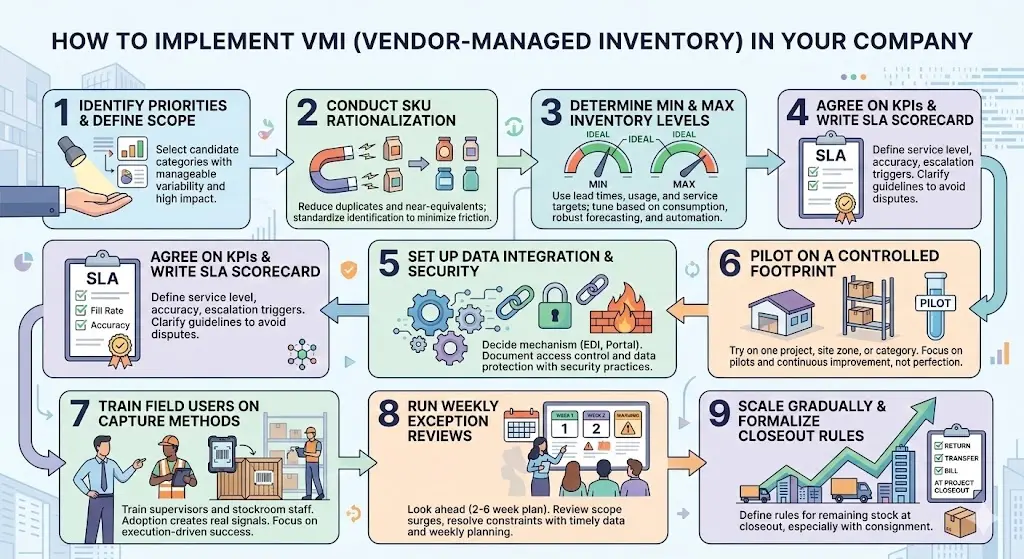
1. Identify Priorities and Define Scope.
Select candidate categories where variability is manageable, and availability matters disproportionately.
2. Conduct SKU Rationalization.
Reduce duplicates and near-equivalents, so min or max rules don’t split demand across multiple codes. Standardized identification practices reduce friction here.
3. Determine Minimum and Maximum Inventory Levels.
Use lead times, usage, service level targets, and phase schedule inputs; then tune based on actual consumption as the project stabilizes. VMI models explicitly rely on min or max thresholds and robust forecasting and automation.
4. Agree on KPIs and Write the SLA Scorecard.
Define service level or fill rate, inventory accuracy, and escalation triggers; tie them to data sources and cadences. VMI guidance links KPIs to SLAs and notes that penalties or disputes can arise without clarity.
5. Set Up Data Integration and Security Expectations.
Decide whether you’ll exchange data via EDI, portal integration, or another mechanism, and document access control and data protection requirements using recognized security practices.
6. Pilot on a Controlled Footprint
One project, one site zone, or one category before expanding. Work on pilots and continuous improvement rather than instant perfection.
7. Train Field Users on Capture Methods.
If the program depends on scans or dispensing, train supervisors and stockroom staff. Adoption is the difference between real signals and noise. Transformation failure risk is often execution-driven, not technology-driven.
8. Run Weekly Exception Reviews.
Look ahead (two- to six-week plan), review upcoming scope surges, and resolve constraints. Remember that VMI relies on timely data and communication; construction relies on weekly planning discipline.
9. Scale Gradually and Formalize Closeout Rules.
Define how remaining stock is returned, transferred, or billed at project closeout, especially if consignment is involved.
Implement your successful Vendor-Managed Inventory strategy with confidence—start by piloting on a controlled footprint today.
Challenges You Can Face During VMI Implementation
You can experience:
- Resistance to change
- Data integration gaps
- Unclear ownership or accountability.
How to Overcome VMI Implementation Challenges
- Lead with a pilot and measurable scorecards
- Standardize item identity
- Make exceptions visible so teams can intervene early.
- Implement baseline cybersecurity governance for shared data
- Limit access to what partners actually need.
FAQs
Which companies can benefit from VMI?
Organizations with repeatable consumption, including retail, manufacturing, healthcare, and many contractor operations, can benefit most when they can share accurate inventory or usage data and align on KPIs.
What problems can you solve with VMI?
- VMI targets stockouts
- Excess inventory
- Reactive ordering
All is solved by letting suppliers replenish based on shared data and service levels.
What is the role of AI in VMI?
AI is most practical when it improves forecasting and tuning of replenishment parameters using broader datasets. Oracle describes AI demand forecasting as applying machine learning and predictive analytics to estimate future demand more accurately using many internal and external data sources.
What are the key differences between traditional inventory management and VMI?
Traditional models rely on buyer-driven ordering; VMI shifts replenishment responsibility to the supplier based on shared inventory and sales or consumption data, governed by KPIs and SLAs.
Conclusion
Vendor-Managed Inventory works in construction when it’s applied to the right categories, governed by clear SLAs and KPIs, and supported by reliable consumption data capture and secure, standardized information exchange.
Done well, it supports leaner jobsites in the JIT sense, reducing waste and re-handling while protecting uptime. However, if it is done casually, it becomes another program that collapses under messy data and weak adoption. This is exactly the kind of execution gap transformation research warns about.
What you need to do is treat Vendor-Managed Inventory like an operational control system, not a purchasing shortcut, because on a live jobsite, availability is execution.