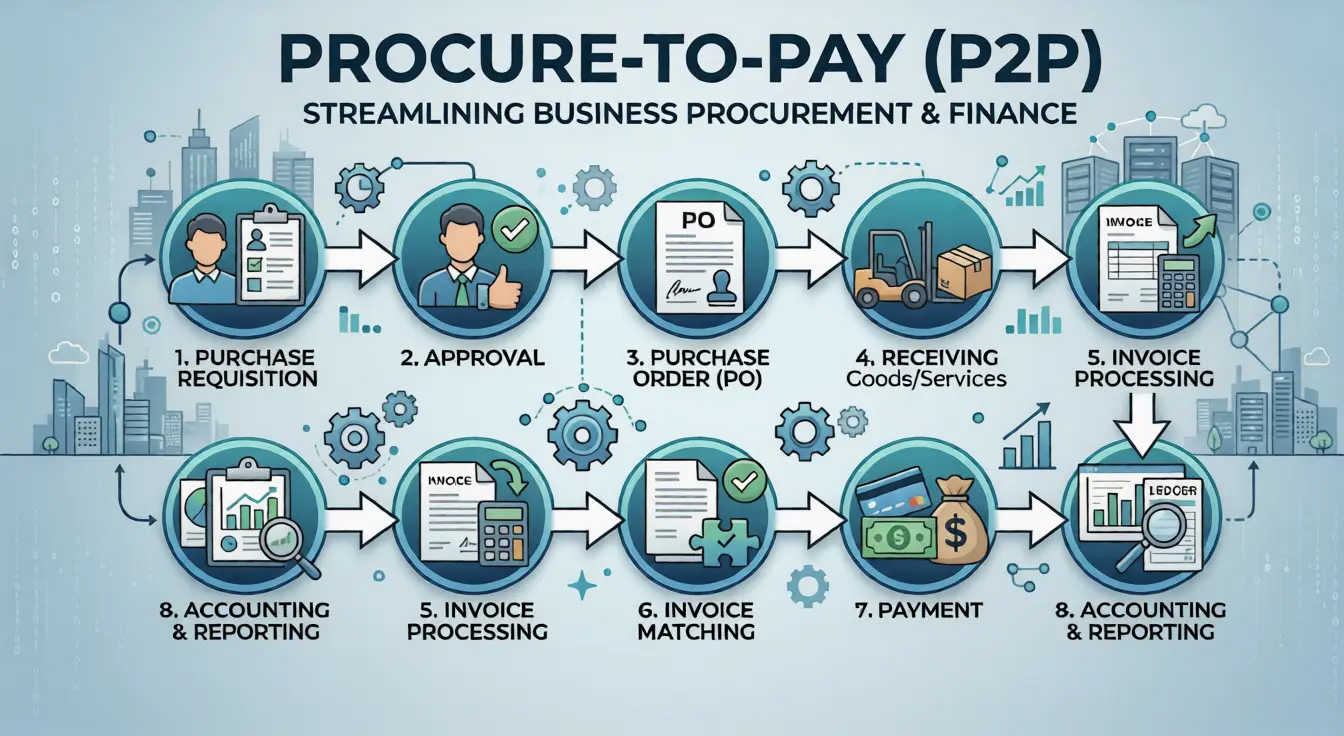
One thing that procurement leaders will encounter going into 2026 is this: the issue of procurement process improvement is no longer a luxury, because it is a necessity in competition. The increasing cost, supplier risk, and digital disruption require more intelligent, quicker, and data-driven procurement choices. This blog goes directly to what works.
What you will gain:
- Practical procurement innovation ideas
- Scalable process optimization strategies
Turn insights into action and start improving procurement performance today.
Introduction
Why Procurement Can’t Afford to Stand Still?
The unstable markets, inflation pressure, and the continuous disruption of the world have made procurement a frontline business process. Organizations that use old workflow processes have problems in increasing supplier risk, increasing cycle times, and leakage. Indeed, according to industry reports, when companies optimize their procurement digitally, they realize a cost saving of between 8 and 12% per year against doing it manually.
Why is a stagnant procurement process a liability?
- The reduced agility is due to slower sourcing decisions.
- Less visibility undermines supplier cooperation.
- Manual approvals increase mistakes and the risk of compliance issues.
The enhancement of the procurement process results in the direct enhancement of the profitability because the cost of the operations will decrease, and the work of suppliers will be enhanced; it will be possible to make decisions faster and supported by data. Streamlined procurement operations are always better than their counterparts with regard to cost management and resiliency.
Are you prepared to modernize procurement? Begin to create an intelligent, future-proof procurement strategy now.
Why Modern Innovation Outpaces Traditional Procurement Methods?
The method that used to be effective in procurement does not produce any results anymore. Leaders of today understand that it is not about the harsh cost-cutting concerning the procurement process improvements, but rather about the value creation in the long term by being quick, insightful, and collaborating with the suppliers. Those organizations that have switched to digital-first procurement models have shorter sourcing times by 20-30% and a better relationship with stakeholders.
Modern teams that achieve procurement process optimization are moving towards the use of real-time analytics, automated processes, and integrated platforms, as opposed to old-fashioned spreadsheets. The change allows collaboration in smarter forecasting, risk avoidance, and continuous enhancement of sourcing and purchasing operations.
Traditional vs Modern Procurement Approaches
| Area | Traditional Methods | Modern Innovation |
| Decision-making | Manual spreadsheets | Data-driven insights |
| Supplier strategy | Price-focused | Value & performance-focused |
| Process speed | Slow approvals | Automated workflows |
| Visibility | Limited reporting | Real-time dashboards |
In order to open up measurably significant benefits, teams need to consider optimizing procurement process workflows through organized, technologically facilitated frameworks that remove bottlenecks and enhance accountability. Explore proven methods for optimizing procurement process workflows:
The current procurement innovation enhances efficiency through data transformation to action that creates faster decisions, less risk, and sustainable value, which is significantly better than the effect of traditional cost-cutting in its capacity to achieve this.
10 Strategic Procurement Innovation Ideas Redefining Performance in 2026
Procurement is no longer a support mechanism, and it is a strategic growth driver. With hastened response to market changes, reduced risks, and concealed values, the organizations that invest in the procurement process improvement will be ahead of the competition. The ideas of the most influential procurement innovations, which will create high-performing procurement teams in 2026, are the following.
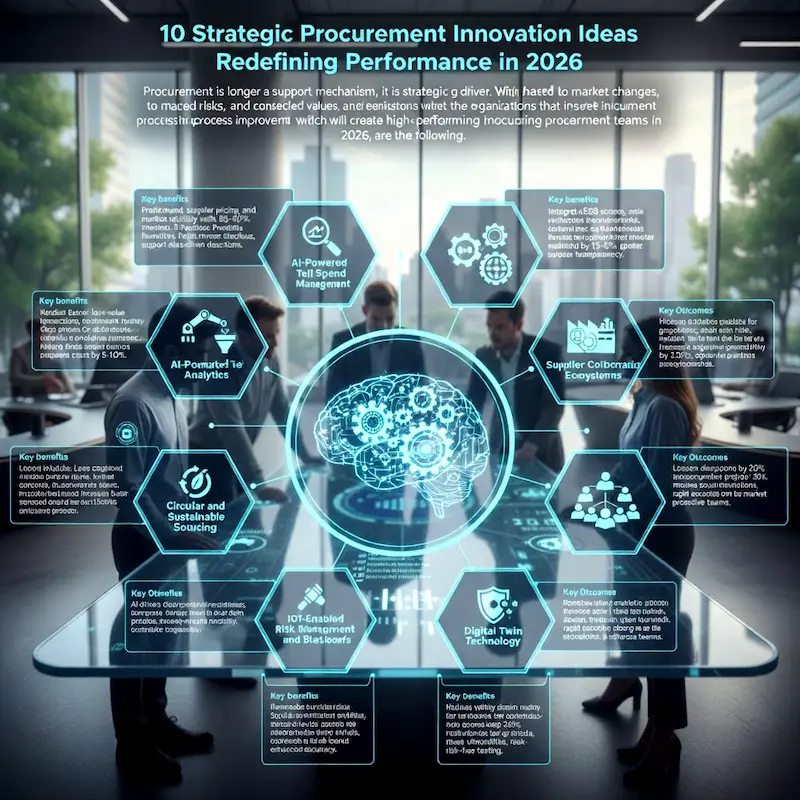
AI-Powered Predictive Analytics
Play the game of knowing the future prices. Teams are now able to predict demand, supplier pricing, and market volatility with up to 85-90% accuracy due to procurement automation and AI, assisting businesses in entering into better contracts and preventing cost volatility. It is a significant advancement in the improvement of the procurement process, which is data-driven rather than guess-based.
Key benefits:
- Predict prices and order superior contracts.
- Minimize the stockouts and overstock.
- Support faster and data-driven decisions for procurement process improvements.
Automated Tail Spend Management
The eye-opener here is that nearly 80% of the transactions in procurement account for only 20% of the total expenditure, but they consume huge resources. Automation tools combine to reduce tail spend, implement policy, minimize maverick purchases and generate 5-10% in savings, directly addressing the question of how to achieve procurement efficiency.
Key gains:
- Combines low-value purchases into concentrated work processes.
- Automatic enforcement of policy.
- Reduces processing costs by 5-10%
- Improves overall procurement process efficiency
Supplier Collaboration Ecosystems
The procurement leaders are moving towards strategic partnerships and away from the idea of transactional buying. Digital supplier portals facilitate collective forecasting, performance monitoring, and innovation alignment, reducing lead time by 25%, and the long-term value is reinforced through the digital procurement transformation.
Benefits include:
- Collective forecasting and planning of shorter lead times.
- Better supplier performance by a factor of up to 25%
- Greater transparency and communication.
- Supports broader digital procurement transformation initiatives
Circular and Sustainable Sourcing
Sustainability is no longer a choice because companies reduce compliance risks and enhance brand trust by using ESG scores in the hiring of employees. It has been found that companies with sustainable sourcing programs enjoy 15- 20% higher supplier resilience, which will sustain procurement process redesign in the long term.
Key Outcomes:
- Less compliance and reduced risks.
- Increases supplier reliability in the long-term by 15-20%.
- Positions make procurement a value-creator, rather than a cost-cutter.
- Strengthens your procurement process redesign
Smart Contracts and Blockchain
Smart contracts aid in compliance, approvals and payment by secure and immutable records. The innovation will decrease the number of disputes by 30-40% and decrease the time between payments procurement process improvement will become faster and more transparent.
Advantages:
- Cuts disputes by 30-40%
- Faster payment period and better cash flow.
- Guarantees complete compliance auditing.
- Motivates open procurement process enhancement.
Dynamic E-Auctions
Live e-auction places the rivalry in the market right before the procurement staff. In the case of large-volume commodities, companies would record cost savings of 8-12% in the short run and maintain a reasonable price, an innovative strategy in the current procurement process enhancement.
Why it works:
- Assures optimum market prices on high-volume commodities.
- Allows instant savings of 8-12%.
- Promotes openness and fair competition.
- Strengthens modern procurement process improvements
Cognitive Risk Management Dashboards
There is hardly a case when supply chain upsets are alarming, provided you know where to find them. The dashboards are AI-driven to analyze geopolitical, supplier, and technical logistics risks and allow teams to respond on time. Proactive risk visibility has the potential to mitigate the effects of disruption by half.
Impact:
- Lessens the impact of interruptions by 50%.
- Enhances the resiliency of the supply chain.
- Helps procurement teams be proactive.
- Supports smarter procurement process optimization
Agile Sourcing Squads
Agile procurement squads are borrowed from software development and speed complex sourcing initiatives such as construction or FF&E. Through sprint-based workflows, there is a 30% faster project delivery by teams, and this is a testament that redesigning the procurement process enhances speed and collaboration.
Key results:
- 30% faster project delivery
- Greater teamwork and responsibility.
- The capability of reacting fast to market situations.
- Enhances procurement process redesign for complex projects
IoT-Enabled Inventory Tracking
Everything is transformed by real-time visibility. IoT sensors monitor inventory movement, condition, and location by cutting inventory stockouts up to 25% and enhancing cash flow by enabling smarter demand planning.
Benefits:
- Reduces stockouts by up to 25%
- Maximizes storage and cash circulation.
- Enhances the accuracy of tracking and accountability.
- Funds continuous procurement process enhancement programs.
Digital Twin Technology
Digital twins assume virtual representations of supply chains, which enable teams to test what-if scenarios to make real decisions. Companies that adopt the technology enhance the accuracy of planning by 20-30%, which supports the long-term procurement process improvement policies.
Why it matters:
- Enhances the accuracy of planning by 20-30%.
- Raises vulnerabilities before the effects on operations.
- Allows testing of scenarios with no real-life risk.
- Enhances larger procurement innovation ideas.
How These Innovations Fit the Bigger Picture?
All the mentioned ideas coincide with the emerging future procurement trends and innovations, enabling organizations to shift towards the realms of reactive buying to proactive value creation. To make the most out of these strategies, the teams should be concerned with optimization of the procurement process workflow on people, processes, and technology. Explore deeper insights into future procurement trends and innovations:
Strategic innovation does not involve the adoption of tools but rather re-inventing procurement as fast, smart, and value-driven. Companies that start today will determine what procurement leadership will be like in 2026 and beyond.
Signs Your Business Needs a Procurement Process Redesign
Even highly qualified procurement teams might fall victim to the hidden inefficiencies. It is important to know when those small tweaks are not sufficient; at times, your organization requires a total redesign of the procurement process to remain competitive. The digital transformation, supply risks globally, and the cost pressures that are being encountered today have made this look more than relevant.
Warning Sign 1: High Maverick Spend
One of the most evident signs that your procurement process is out of control is uncontrolled or off-policy spending.
- Impact: The high maverick spend companies tend to pay 10-15% higher per transaction than the compliant purchases.
- Resolution: Have systematic approvals, automation, and standardized work processes.
- Advantage: Wastes are diminished, and the overall strategic sourcing innovation is enhanced.
Warning Sign 2: Slow Approval Bottlenecks
Delays in the number of days or even in a week to get approvals mean lost time, wasted and an irritated supplier.
- Impact: The slow process of procurement approval can slow down the project by 20-30% the project, and it can have an impact on the delivery schedule and revenue.
- Resolution: Routing should be automated, have AI approvals, and become real-time monitored.
- Deliverable: Better decision-making and measurable buying process.
Warning Sign 3: Lack of Supplier Transparency
It can ruin efficiency because there is low visibility of the supplier performance, risks, and delivery schedules.
- Impact: The lack of transparency enhances the chances of slowdown, failure to deliver, and the absence of space to be innovative in companies.
- Resolution: Adopt collaborative portals, consolidate supplier scorecards, and predictive analytics.
- Result: Better supplier relations and future preparation for procurement in 2026.
When Tweaks Aren’t Enough
Minor changes, such as changing forms or renegotiating contracts, are not enough in some cases. A full procurement process redesign may be required when:
- Multiple warning signs exist simultaneously
- Current systems are unable to expand or embrace digital innovation.
- Teams do not have real-time and actionable insights.
Strategic Takeaway: Businesses that embrace a full redesign unlock:
- Streamlined workflows
- Cost savings of up to 12% annually
- Enhanced agility for responding to market shifts
- Increased implementation of strategic sourcing innovation.
It is time to revisit your procurement system and consider redesigning your whole procurement process to be able to keep up with the competition and be prepared to face the future.
| Sign You Need a Redesign | Quick Diagnostic Check | Urgency Level |
| High Maverick Spend | >15% of purchases off-contract | High |
| Slow Approvals | Average approval >3 days | Medium |
| Supplier Transparency Gaps | >30% of suppliers without performance scorecards | High |
| Outdated Systems | Manual spreadsheets dominate >50% of processes | High |
Comparison Table
| Area | Traditional Process | Redesigned Process | Benefits |
| Approvals | Manual, slow | Automated, real-time | Faster decisions and fewer bottlenecks |
| Supplier Management | Limited visibility | Collaborative portals | Better transparency, reduced risk |
| Spend Management | Maverick spending high | Tail-spend automation | Cost savings, compliance |
| Technology | Spreadsheets | AI & analytics | Procurement process improvements, efficiency |
Industry Focus and Construction Excellence
Construction procurement is one of its kind. Projects are time-sensitive, resource-intensive, and high-stakes projects and therefore require proper coordination of long lead items, subcontractors, and materials. Delays and cost overruns are bound to happen without a modernized approach. The progressive construction companies are embracing procurement process improvements in an effort to remain competitive.
Why construction needs innovation:
- Management of long-lead items has an effect on the project timelines and budgets.
- The intricate supply chain systems need real-time monitoring.
- The legacy processes and approvals by hand slow down procurement.
Through the adoption of strategic digital tools, the construction teams can save up to 25% in project delays and oversee material cost predictability by 15%. Such improvements are in line with the future of procurement 2026, where agility, visibility, and making decisions based on data are major distinguishing factors.
Key best practices for construction procurement:
- Give priority to long lead products with automatic notification and scheduling.
- Streamline supplier cooperation via digital portals in order to be transparent.
- Monitor costs, timelines, and risk using leverage analytics dashboards.
- Put in place the ongoing process enhancement through Procurement Transformation Best Practices.
Teams of constructors that implement these new things take shorter durations to execute their project, less risk, and their procurement process can be measured to improve their operations in the future of procurement 2026.
Modernize your construction procurement to reduce delays, control costs, and stay competitive in 2026.
Conclusion
Building a Future-Proof Procurement Engine
The future of procurement lies in the organizations that are flexible, progressive, and constantly improving. Through the adoption of technology, strategic sourcing, and contemporary working processes, businesses can convert procurement into a value creation mechanism rather than a transactional process. Each action towards digitalization and efficiency makes people more resilient, less risky, and results are measurable.
Ready to modernize? We have experts who specialize in procurement process improvement that suits your industry. Schedule your audit today and begin developing an engine of procurement that is geared towards long-term growth and competitive advantage.
FAQs
What is procurement process improvement, and why is it important?
Procurement process improvement is the process of streamlining sourcing, supplier management, and purchasing processes in order to lower costs, enhance processes, and eliminate risks. Firms adopting these enhancements claim to have saved 8-12% on their annual costs and, more importantly, are enabled to make their decisions more quickly, making it critical to their ability to remain competitive in the year 2026.
What are the ways AI and automation can improve the efficiency of procurement?
AI-driven solutions and automation in procurement can help with predictive analytics, demand, and supplier insights in real-time. This improves manual errors, quickens approvals, and assists teams in embracing strategic sourcing innovation, enhancing speed and accuracy.
When does a business need a procurement process redesign?
When your organization has an issue with high maverick spend, lengthy approval bottlenecks, or a paucity of supplier transparency, just making minor adjustments won’t do. Complete redesign of the procurement process guarantees scalable processes, improved teamwork, and suitability to the upcoming procurement trends and innovations.
What are the best procurement innovation ideas in 2026?
Key procurement innovation ideas include:
- Predictive analytics by AI.
- Tail spend management (Automated).
- Ecosystems of supplier collaboration.
- Circular/sustainablesourcing.
- Smart contracts & blockchain
- Dynamic e-auctions
- Cognitive risk dashboards
- Agile sourcing squads
- Smart inventory monitoring.
- Digital twin technology
The innovations enable businesses to have procurement process benefits, cost reduction, and strategic benefits.
What can be done to enhance procurement in construction companies?
Optimization of procurement in construction projects is based on projects. By concentrating on the long-lead item management, centralized collaboration with suppliers, and digital tracking, the process of delays is reduced, costs are minimized up to 15 percent, and teams are ready to attend the Future of Procurement 2026.
What are the quantifiable results of contemporary procurement transformation?
Organizations that embrace digital procurement solutions, predictive analytics, and automated processes will anticipate:
- 20-30% faster sourcing cycles
- 10-12% annual cost savings
- Cut supply chain interruptions by half.
- Better supplier alliances and compliance.
These enhancements ensure that procurement is a value-generating department and not a cost centre.